Why study Education at MC?
Maryville College has a long and proud tradition of preparing teachers who demonstrate and promote excellence in teaching and learning. If you are considering a professional career in teaching, we offer eleven areas of licensure. Our program prepares new teachers for the demands of the 21st-century classroom through extensive field-based experiences, essential coursework in the teaching area supported by professional education courses, and project-based learning designed in partnership with local school administrators and teachers.
While each major track is housed within the corresponding discipline of study (ex: History for Teacher Licensure is a major in the Division of Humanities), the Division of Education coordinates the teacher licensure screening process, field experiences, instruction in the Professional Education courses, and supervision of student teachers. Learn more about our Education Preparation Program (EPP).
**If you already hold an undergraduate degree and want to teach, we offer post-baccalaureate options for all areas of licensure. Post-bacc programs are individualized programs of study and are impacted by previous coursework completion. Please contact our office for more information.
Do you want to teach in grades K-5?
Candidates in the Elementary Education Major are prepared to become highly qualified teachers for grades Kindergarten through Grade (K-5) following collaborative, supportive, and stimulating learning experiences. The Elementary Education major embeds the broad study of the liberal arts, content coursework, and professional licensure coursework into the 120-credit bachelor’s degree.
The Elementary Education Major is supported by early field experiences that play a critical role in preparing candidates for their careers. All candidates develop a strong understanding of child development, the processes of learning and teaching, and the skills to design, implement, and assess instruction for diverse student populations. The program culminates in a semester-long student teaching experience.
Grounded in a commitment to personal and professional growth, students gain skills to solve the many theoretical, practical, and ethical problems associated with what to teach and how to teach, as well as the ability to effectively integrate technology into the instructional process.
Do you want to teach in grades 6-12?
We offer several areas of licensure for those interested in teaching at the high school level. Each program prepares students for the demands of teaching a specific content area. Students completing a program of study for teaching in the secondary grades 6-12 develop expertise and understanding of a specific content area. The professional education component of this program focuses on those skills and competencies critical to the success of a new teacher (lesson design, classroom management, assessment, teaching pedagogy…).
- Biology with Teacher Licensure – 4 Year Plan
- Chemistry with Teacher Licensure – 4 Year Plan
- English with Teacher Licensure – 4 Year Plan
- History with Teacher Licensure – 4 Year Plan
- Math with Teacher Licensure – 4 Year Plan
Do you want to teach in grades PK/K-12?
We offer several areas of licensure for those interested in teaching special topics designed for all grade levels. Each program prepares students for the demands of teaching a specific content area. Students completing a program of study for teaching in the grades PK/K-12 develop expertise and understanding of a specific content area. The professional education component of this program focuses on those skills and competencies critical to the success of a new teacher (lesson design, classroom management, assessment, teaching pedagogy…).
- French with Teacher Licensure (grades K-12) – 4 Year Plan
- German with Teacher Licensure (grades K-12) – 4 Year Plan
- Music (Instrumental) with Teacher Licensure (grades K-12) – 4 Year Plan
- Music (Vocal) with Teacher Licensure (grades K-12) – 4 Year Plan
- Physical Education/Health with Teacher Licensure (grades K-12) – 4 Year Plan
- Teaching English as a Second Language with Teacher Licensure (grades PK-12) – 4 Year
- Theatre with Teacher Licensure (grades K-12) – 4 Year Plan
Educator Preparation Program Admission
Candidates seeking a degree with teacher licensure must be enrolled at Maryville College before applying for initial entry into the Educator Preparation Program (EPP). Candidates should work closely with their advisor(s) to follow the recommended 4 Year Plan leading to initial licensure. However, it is the candidate’s responsibility to meet all requirements and specified deadlines.
Initial entry into the EPP may occur as early as the second semester of the first year and should be no later than the second semester of the sophomore year. Minimum requirements for initial entry are:
- Be enrolled at Maryville College.
- Qualifying scores on one of the following (while MC is a test optional institution, this is a requirement of the TN State Board of Education for entry into a teacher education program):
- ACT score of 21 or higher; or
- SAT score of 1080 or higher; or
- Passing scores on all three subtests of Praxis Core (reading, writing, and math).
- Overall GPA of 2.75 or higher on a 4.0 scale.
- Clear and current Background Check
- “At Target” professional dispositions (evaluated in EDU 199, EDU 201, and/or EDU 301).
- Successful completion of a Screening Interview and recommendation of the interview team.
Meet a Current Scot
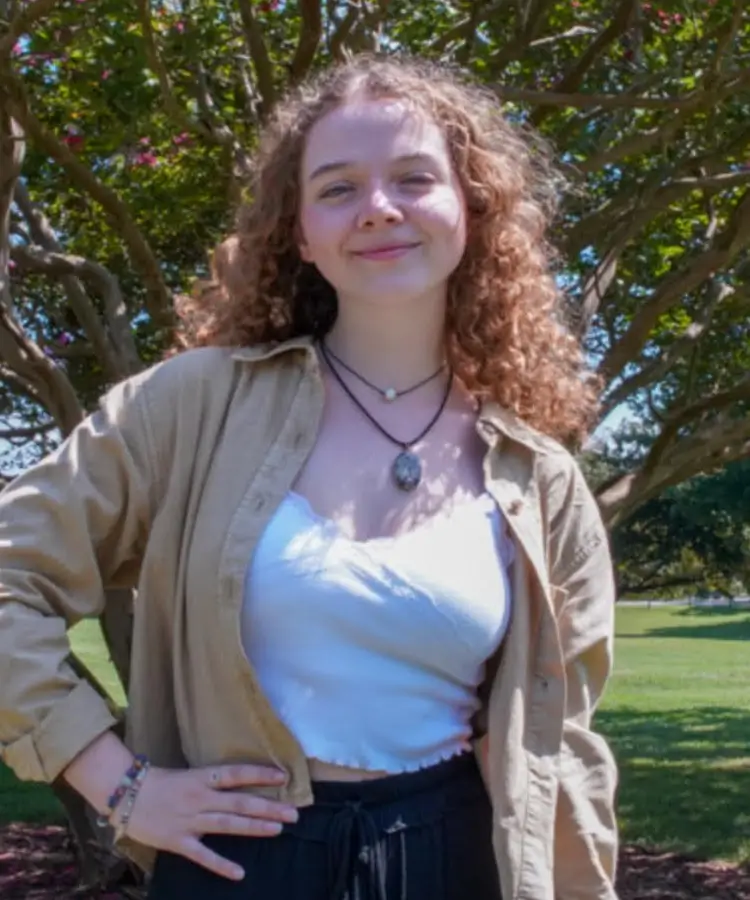
Meredith Wynn
Hometown: Maryville, Tennessee
Growing up in East Tennessee, Meredith had heard high praise for Maryville College and its education department. Since enrolling, Meredith, who is pursuing Theatre with Licensure, has found that praise to be well-founded. “With the wide variety of leadership opportunities provided by many majors at Maryville, education students can get a significant amount of hands-on experience in what their careers will actually look like,” she said.
Meredith recently attended the Southeastern Theatre Conference, where she learned about secondary school budgeting and ways to engage students. She also interviewed for several jobs involving teaching theatre. That knowledge, she said, helped her have “a real-world understanding of what would be expected of me as a teacher.”
Meet a Recent Grad

Carder Sprous ’24
Currently: Teaching 7th Grade Social Studies at South Doyle Middle School in Knoxville, Tennessee
Carder came to MC as a Religion major but felt a call towards education and so changed his major to History with Licensure in the educator preparation track. Originally from Massachusetts, Carder has made his home in East Tennessee, saying “it is an honor to teach the children of East Tennessee and help them grow each day.”
Crediting his professors and his student teaching experience for giving him a wealth of knowledge and practical experiences before stepping foot in his own classroom, Carder said, “without Maryville College, I would not be making the true impact I am now in the local Knoxville community.” His career plans are to continue teaching and positively impacting his students and the community he serves