


Carl Gombert: Radiant Geometry
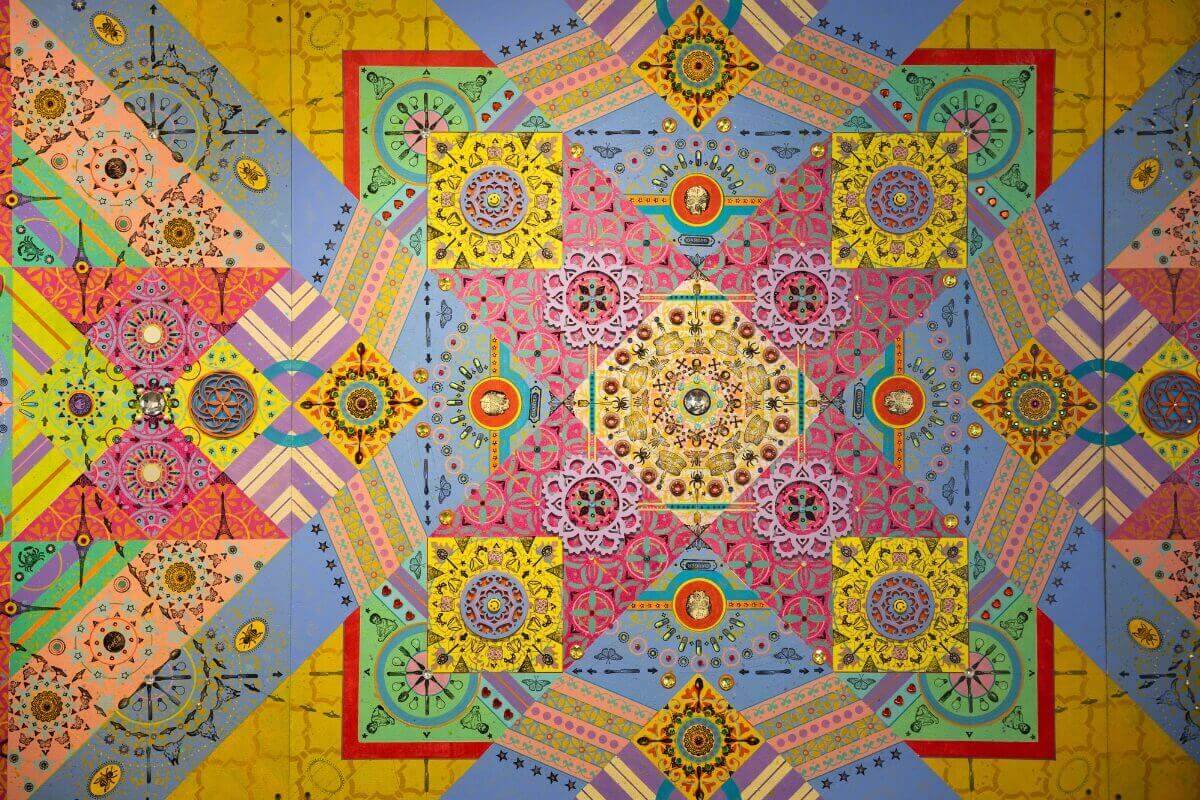
RADIANT GEOMETRY BY CARL GOMBERT
I have always been interested in geometry, structure, and pattern. As I remember it now, studying geometry was the highlight of my adventures in the ninth grade. I was fascinated by shapes, especially circles and squares, and the elegant mathematical relationships between them. I believe I intuitively sensed both magic and mystery, and was captivated by the complexity arising from the orderly repetition of simple elements. And even though the following summer I began taking professional art lessons focused on traditional realism, the fascination with repetition, rotation, structure, and order remained.
Now, many years later, that fascination finds form in the paintings I make. For years I have looked at, and been inspired by, decorative art-making traditions from across the globe. I have fill edmy head with medieval illumination, Celtic and Islamic patterns, textiles, bead-weaving, quilting patterns, Renaissance floors, and so on, and I have been making paintings based on mandalas.
Simply put, a mandala is a symmetrical arrangement of symbols. To my mind they embody the perfect balance of form and content: their meaning and power come from both the elegant, radial structure and the meaning of the embedded symbols. In many of the world’s spiritual traditions, mandalas are used to focus and guide meditation or worship, and to define, describe, or create sacred space. Quite often, mandalas combine circles and squares. For me, one of the most important parts of the process is deriving interesting compositional patterns through a process that is highly improvisational. Although the paintings look highly planned, the process allows for considerable adjustment along the way. I generally start with only the most basic pattern of large circles and squares and a general color idea; the design defines and refines itself as it becomes more intricate and more filled with smaller elements.
My mandalas are not grand cosmological maps, sacred allegories, or records of spiritual journeys. They are not guides to meditation, although the process of making them is often quite meditative. The repetition of numerous small acts¾hand-stamping a butterfly dozens of times or carefully placing round pink stickers in a big circle¾takes on a decidedly meditative aspect.
Finally, unlike traditional mandalas, my paintings do not aim for coherent symbolism or narrative. I am interested in contrast and balance, but I also choose images because they are amusing. Rubber stamps are chosen as often for their shape as for what they “mean.” Thus, a butterfly might be used as a triangular element, or to suggest the idea of transformation. Sometimes the choice is as simple as light against dark or big against small. At other times I try to play pop culture against art history. I am trying to juxtapose the old and the new, public and private, and the serious and the silly. But mostly I want things that are fun to make and fun to look at.
Carl Gombert was born in Brimfield, Ohio in 1959. He started taking painting lessons at the age of 14 with money he earned delivering newspapers. He earned a BFA in Drawing from the University of Akron and an MFA in Painting from Kent State University. He worked as a stagehand before pursuing a Ph.D. in Interdisciplinary Fine Arts at Texas Tech University. He has exhibited widely and his work is in numerous public and corporate collections. Since 1993 has taught painting, drawing and art history at Maryville College in Tennessee.