The ultimate in selflessness: Chelsea Barker ’10 gives her kidney for the greater good

It’s a bit of a stretch to credit the undergraduate experiences of Cheslea Barker ’10 with her decision to give away one of her kidneys, but her time as a Scot certainly played a role in it.
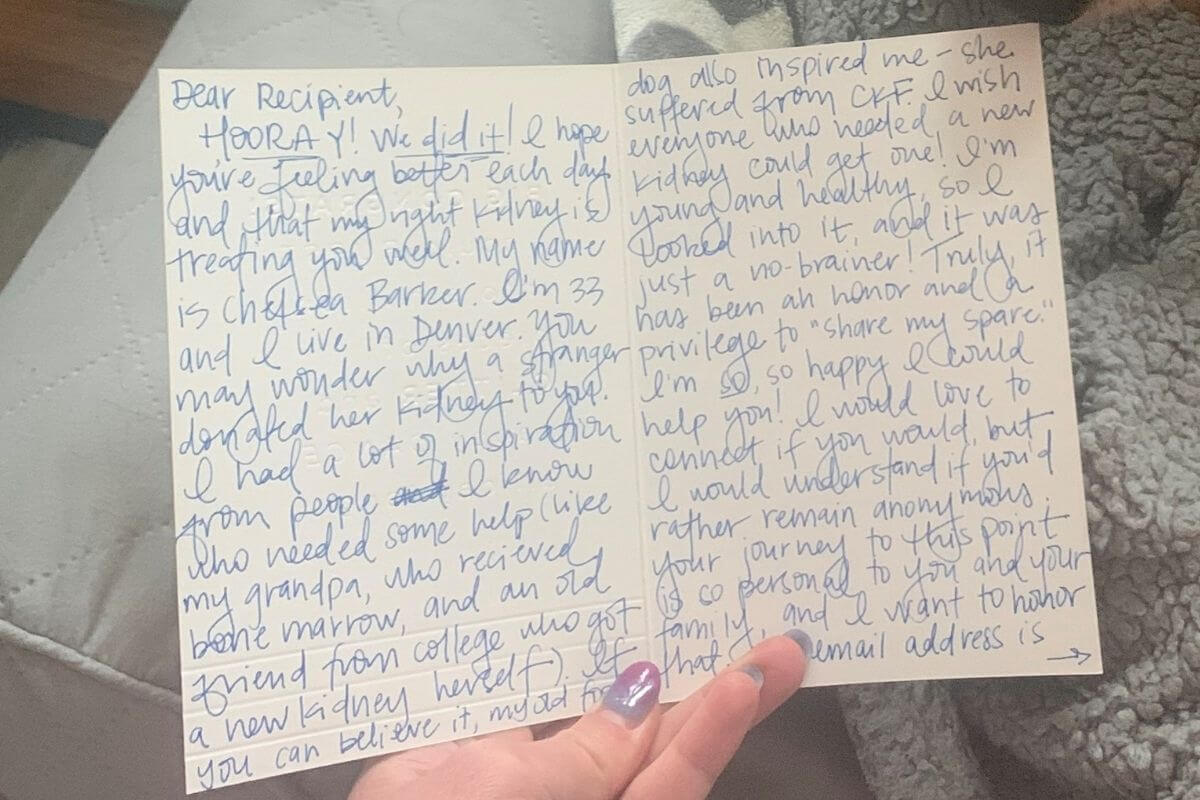
Barker, a Denver resident, recently donated her right kidney to a recipient on the National Kidney Registry. She has yet to meet the individual, although she would like to. In fact, she knows nothing about this person at all, save for the fact that he prefers he/him pronouns.
Ultimately, Barker said, it doesn’t matter. What does is the Maryville College creed coined by the Rev. Isaac Anderson: to “do good on the largest possible scale.”
“It’s up to the recipient and the donor if they want to meet or remain anonymous, but I did write a letter and dropped it off at the transplant center,” she said. “I hope he got it, but I don’t know. Sometimes it’s just so highly personal, and maybe my recipient wants to be friends, or maybe not. I hope he’s doing well; the surgeon says he is.
“I don’t know, I just get very uncomfortable when people say, ‘You’re my hero!,’ because to me, it’s a no-brainer. To me, it’s just so obvious that if you’re young and healthy, you can do something that’s very low-impact for a short period of time that has an outsized impact on someone’s life.”
A native of Brentwood, Tennessee, Barker embraced college life at MC with unbridled enthusiasm. She joined numerous clubs, ran cross country, studied abroad … the list goes on and on, she added, because of all the ways in which Maryville College excels, it’s the provision of opportunity that made a difference in her life.
“I took advantage of everything I could because I wanted to try it all,” she said. “That’s something I loved about Maryville: I could go down a rabbit hole of anything that interested me, and I received widespread support from my professors to try something new, to research something further, to get involved in the community to learn more. There are so many options at Maryville that you get a little bit of everything.”
‘It encourages you to jump in with both feet’
A sociology and environmental studies double-major, Barker joined the Peace Corps after graduation, serving in the West African nation of Mali, in which she helped remote villages obtain faster service when their communal water pumps failed. Back home, she worked on a farm in Tennessee — her senior study thesis was on urban agriculture — before moving to California, where she worked at an eco-nonprofit. Another move took her to Washington, D.C., where she was part-owner of a business that sold micro-greens to area restaurants.
“Here I was, a business owner, even though I never took business classes at Maryville,” she said with a laugh. “But even though I had never done it before, I had done so many other things, I was sure I could learn it. That’s the kind of place Maryville College is — it encourages you to jump in with both feet. I wasn’t scared; I was excited to learn the skillset.”
Eventually settling in Denver with her husband, Matthew Fritz-Mauer, it was a dog that pushed her to take a long-simmering desire to give of herself — literally — for the greater good. She had considered it while living in DC, she said, but given a hectic work schedule, it was logistically impossible. But as she began working with animal rescue organizations in the Mile High City — volunteerism that would eventually lead to her current job as a volunteer coordinator for a no-kill Denver shelter — she and her husband brought home a special needs Great Dane.
“She was young, but she had been neglected and abused, and she suffered from chronic kidney failure,” Barker said. “She was 2 when we had to put her down, and at the end, we had to give her IV fluids — doggy dialysis, basically — and watch her diet and give her medicine, and still it was just a short-term solution. And I just thought, if it’s this terrible for a dog, I can only imagine how terrible it is for a person.”
A simple gesture with an big impact
And so she began to research both the problem and how her potential contribution might help. According to the National Kidney Foundation, 37 million Americans have chronic kidney disease; another 600,000 are living with kidney failure; and 100,000 are currently waiting on a transplant. After discussing with her family, she began the process of undergoing medical testing and learning everything she could about the process.
“It didn’t frighten me; science backs up the fact that even with one kidney, I’m not at a higher risk for kidney failure, and the only thing that’s going to change is that I can’t take ibuprofen as much,” she said. “I can still go skiing; I can still work out; I can do anything. I wish more people would do it, but I think a lot of people don’t know that it can be as simple as it is.”
After a lengthy evaluation process, she and her doctors targeted the 2021 holiday season for her donation, so that she could return to work in a reasonable amount of time. When she got the call that a suitable donor in the Denver area had been found, she checked into the hospital on a Monday. The surgery was conducted laparoscopically, she was discharged the following Thursday, and after two days on prescription opioids, she switched to Tylenol and hasn’t looked back.
Now, she said, she simply has to lead a healthy lifestyle — something she did beforehand — stay hydrated and hopefully, at some point, meet the individual who received “Righty,” as she fondly nicknamed the part of herself that now lives inside a total stranger.
“I’m in a lot of donor Facebook groups, and one of the other donors on there had this really cool analogy. He said, ‘If I walked by a pond and saw somebody drowning, and I had two lifejackets, why wouldn’t I throw them one?’” she said. “Kidneys are amazing organs, and kidney donation is just the coolest thing. It’s a real honor to help someone in an intimate way like that.
“It was just something I was interested in, and that’s something that Maryville College taught me: If I have an interest, and if this is a valid part of who I am and I feel it’s worth pursuing, then I should do it, because you never know how it’s going to turn out. That’s one of the things I never realized I was learning at the time — that the disparate parts always make something greater than the sum.”