


Journalist, author, climate activist Devi Lockwood to speak at MC as part of International Education Month
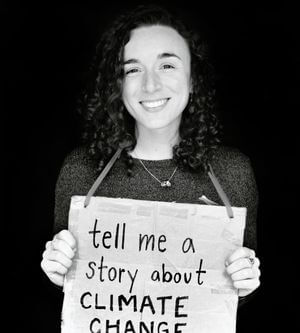
It was a bicycle trip down the Mississippi River valley by journalist and author Devi Lockwood that transformed her, and she’ll share the journey she’s been on ever since at 5:30 p.m. Wednesday, March 23, in Room 140 of Anderson Hall on the Maryville College campus as part of International Education Month.
What began as a way to complete her senior thesis in Folklore & Mythology at Harvard University turned into a book — “1,001 Voices on Climate Change,” published last year by Simon & Schuster. While the science of climate change is often abstract and numerical, she said, putting personal stories to the ways in which floods, fires, droughts and rising sea levels are changing global communities makes it a much more relatable topic.
“Storytelling is one of the oldest forms of technology we have,” said Lockwood, who now works as an opinion editor for The Philadelphia Inquirer. “It’s hard to empathize with a number or really get around what the numbers mean. The language we use to discuss climate change is often abstract and inaccessible; we can hear about parts per million of carbon dioxide in the atmosphere, or millimeters of sea level rise, but understanding what that means in someone’s life is a different way of relating to the topic. By prioritizing storytelling, we’re putting human stories at the center of the conversation.”
When she was a junior at Harvard, the Boston Marathon bombings in 2013 put the city on lockdown for two days, and after it was lifted, she was eager to “have face-to-face conversations with strangers, to remind myself that not everyone was murderous,” she added.
One of the ways she did so was by making a sign out of part of a cardboard box, writing “open call for stories,” on the outside, and wearing the sign around her neck as she walked around the city.
“I had a little audio recorder I would turn on when people were comfortable, and I listened to any kind of stories people wanted to share,” she said. “It felt like a way to connect with people that I hadn’t ever experienced before, and it broke down barriers.”
She employed the same strategy that summer, biking 800 miles alongside the Mississippi River. The farther south she rode, the more a singular issue seemed to be the most pressing one people wanted to talk about: water.
“Water and climate change are two of the defining issues of our time and my generation, and I thought that it would be impactful to put those stories that I heard in the Mississippi River Delta alongside dialogue from other parts of the world where people are experiencing climate change in very specific ways,” she said.
The segue to “1,001 Voices on Climate Change” began the following year at the 2014 People’s Climate March in New York City. She drew inspiration from Scheherazade, the storyteller at the center of the Arabian folk tale “1,001 Nights,” and she spent the next five years traveling in 20 countries and collecting stories — for both the book and her career. Her writing has been published in The Guardian, Slate, The Washington Post, Bicycling Magazine, Yale Climate Connections and The New York Times, where she worked as an editor and writer of the Opinion section.
She continues to use this approach as an editor and writer, not only calling attention to the most pressing issues facing the planet today, but also as a way of connecting to individuals from walks of life far different from her own.
“Lived experience is a form of expertise, and there’s so much to be learned from having conversations with people outside of an academic context — and travel is one way of doing that,” she said. “I think there’s something to be said for taking the time to explore in that way, not only externally but internally, and wandering with a purpose. Being able to do that has stuck with me, and I still try to carry that with me as I move through the world in different ways.”
Lockwood’s talk is a Global+ presentation of the Maryville College Center for Global Engagement and is free and open to the public.