


Text: Professor Kim Trevathan’s Baccalaureate address to the MC Class of 2023
May 5, 2023
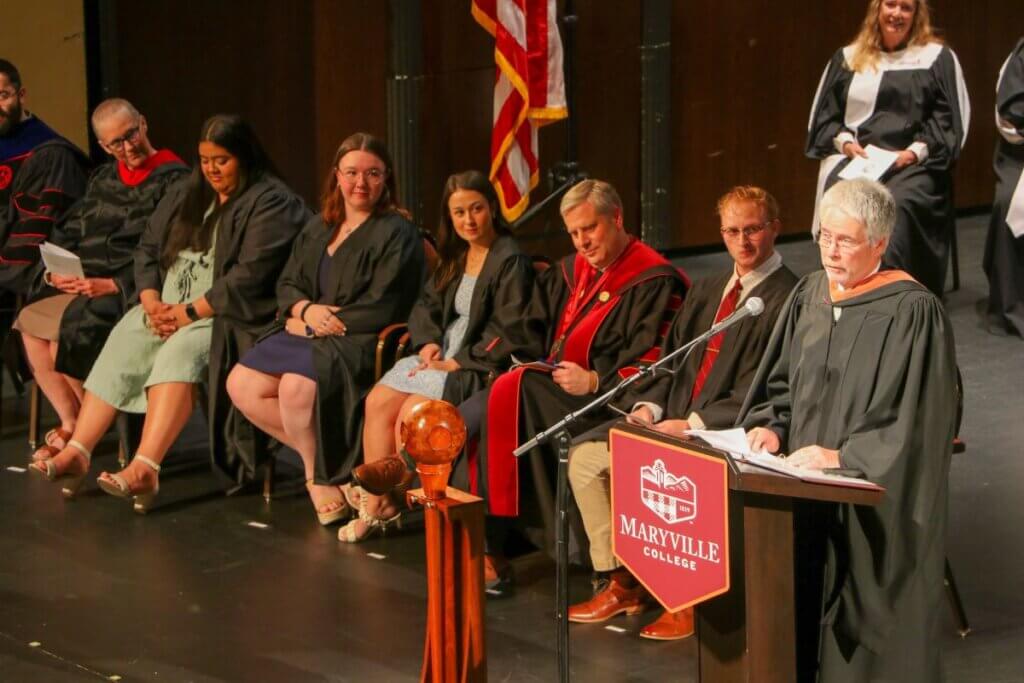
Maryville College Professor of Writing Communication Kim Trevathan delivered the Baccalaureate sermon to the Maryville College Class of 2023 on May 5, 2023. Here is the full text of his sermon, titled “Keeping Silence: The Power of Quiet in a World Full of Noise.”
Thank you for the opportunity to speak today and congratulations to the class of 2023. On the verge of my retirement from MC, I honestly didn’t see this invitation coming, which makes it even sweeter. I’m grateful for the opportunity.
Like me, my family was surprised that I had been chosen as the one to deliver a spiritual message (a sermon!) to the entire college. I did go to church as a kid, but what I remember most was sitting with my friends on the farthest row up in the balcony of our enormous Baptist church, stifling laughter and not being able to stop while the pastor engaged in vivid descriptions of hell, enhanced by sibilant whistles on “S” sounds. We weren’t laughing at the sermon so much as our own lack of control, of doing the most inappropriate thing in the most inappropriate place. So I’m okay with those of you sitting way in the back. I see you. When I told my sister, Melissa, executive director of a Christian counseling ministry, about this honor and what topic I’d planned to speak on, her response, in text, was “Hmm. Seriously?”
Believe me, I recognize the irony of speaking about the subject of “keeping silence.”
I got the idea for this talk by reflecting back on my time at this college — 23 years — and some moments that stand out. I ruled out drawing lessons from some prominent memories as inappropriate for a spiritual talk. But I hope you won’t mind if I give them a brief mention. Like the time in 2007 I agreed to let the Highland Echo staff (of which I was faculty advisor) do an April Fools spoof issue, and on the front page they put a photo of themselves that made it look like they were naked in front of the MC entrance sign, black bars used strategically by the graphics editor, who possessed talent beyond my expectations. The dean at the time called me up and said, “Have you seen the paper?” I said that I had. And he said, “Are you aware that we’re in the middle of a fundraising drive?” I think we got some local television news coverage on that one. And then there was another time that I gave my assent to having MC board members attend a fiction writing workshop, without having yet looked at the student stories up for workshop. One student’s story was X rated — starting from sentence No. 1! — which would have been fine under normal circumstances — a teaching moment, even — but not ideal with such distinguished visitors in the room. My academic life passed before my eyes that class period, but students managed to talk about this story in a way that was valuable to the writer and avoided the X-rated parts so that the board members apparently weren’t aware of it. I’m not sure what lessons I derived from these memorable crises, mostly notes to self about the dangers of newspaper spoof issues and the sanctity and privacy of fiction-writing workshops, which I never allowed anyone to visit ever again.
It has been a rewarding job — teaching writing — and I’ve spent a good part of my career writing, talking about writing, and trying to get some of you to talk about writing.
But the longer I taught, the more I saw that shutting up and listening to students was something I needed to do more of, and that being quiet in the world led them to learning in ways I hadn’t anticipated. This became evident in lot of different classes and in a lot of different educational contexts, but it was especially impactful in my nature writing class, Words and the Land; in particular, 15 minutes I remember from this class in 2005. That’s right, 18 years ago!
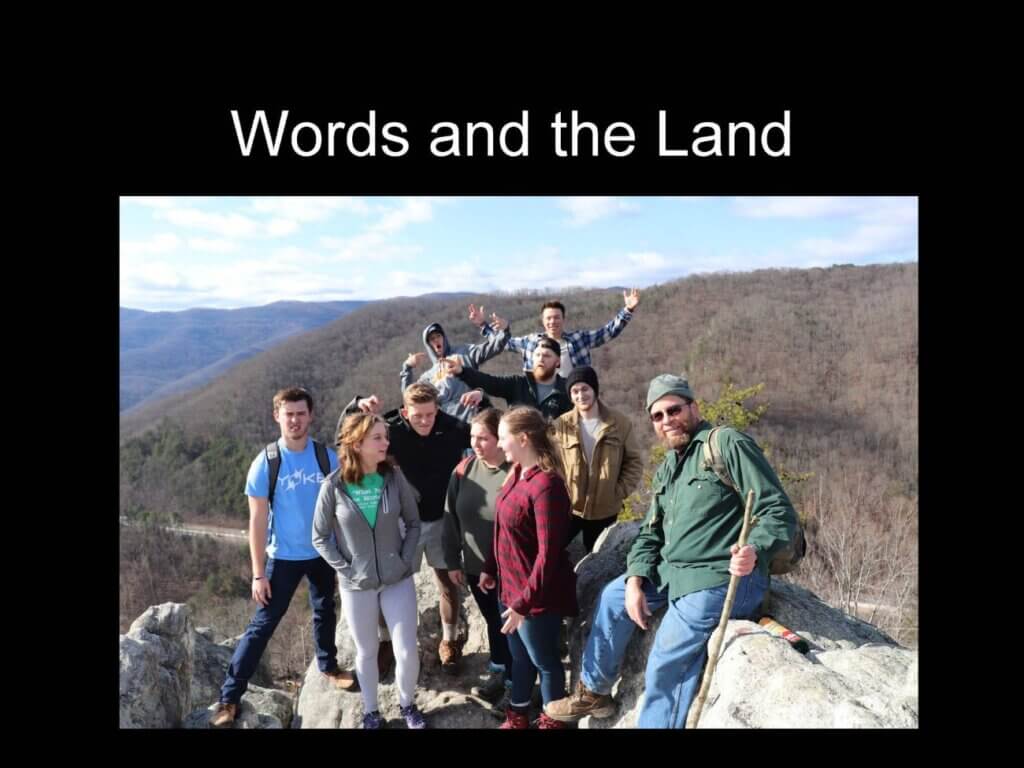
The Words and the Land nature writing class was about going outdoors, observing, keeping a journal, and at the end writing fiction, poetry, or nonfiction as a final project. This photo was taken in an era when the course was taught during the three week term in January. In 2018, this was the last incarnation of that version of the J-term class, which became a semester-long class the following year. Some of the people in this photograph may be in the audience.
So our January term trips were usually in cold weather. One of the hikes we took in this class was to Whiteoak Sinks, a popular but unofficial trail in the Smokies, a descent into a place with a couple of caves, a waterfall, vestiges of an old settlement, and a dazzling display of wildflowers in the spring. There’s plenty to talk about down there, even in the wintertime.
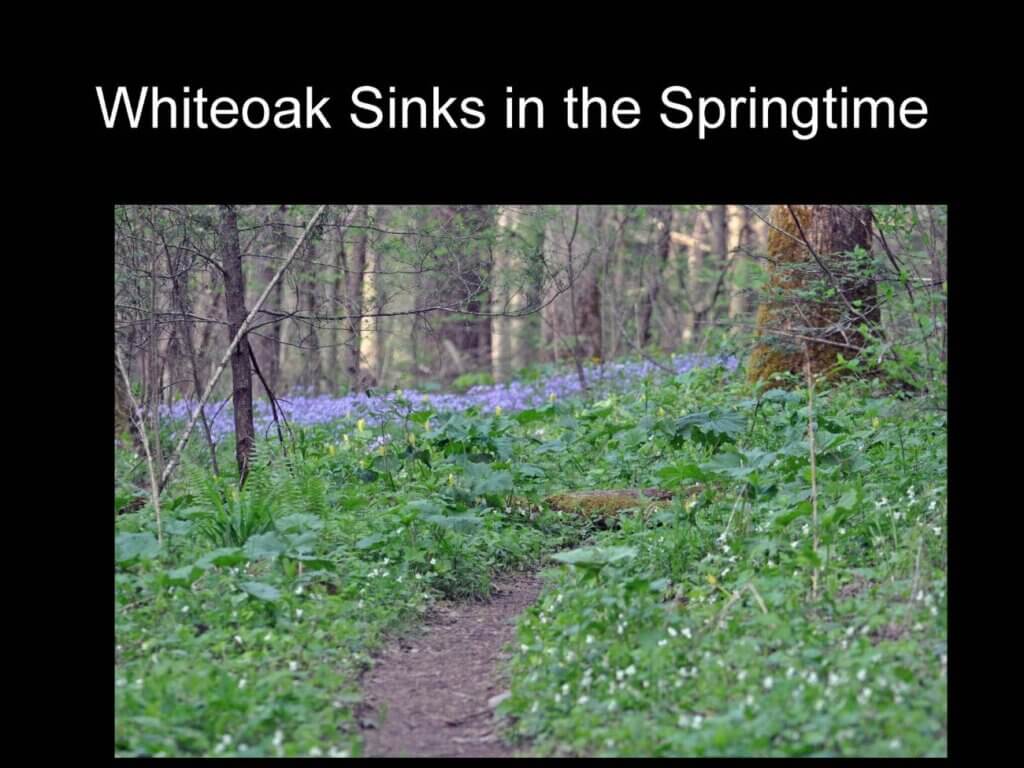
Here’s a springtime view. It might have looked like this a few weeks ago.
This 2005 class was full of talkers, and I remember every one of them, some I still keep in touch with. At least one is a lawyer now, another a copywriter at an ad agency. They talked constantly on the trail. Never ran out of breath. Which was fine with me. I wanted talkers in most classes, this one too.
We got a good warm January day to tour the sinks. We looked at the waterfall that disappeared into a cave, considered the other cave with bars on the opening to protect the bats that lived there from humans who like to descend into caves. And we strolled on to the far end of the sinks and found a place to sit and rest and snack. Saw a couple of deer. Talk continued, chatter chatter, chatter … and then a silence descended upon us.
Everybody just stopped talking. And it lasted and lasted. I could tell that the students were reluctant to break it, that there was something magical about the silence, something spontaneous and natural.
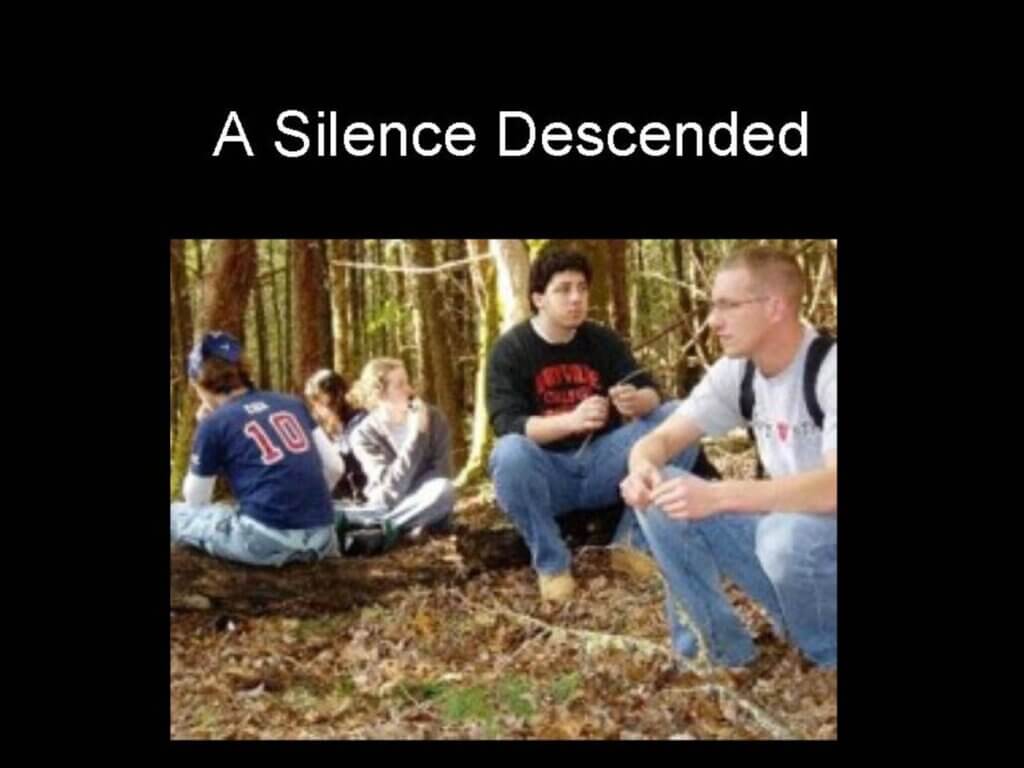
Here’s the photo I took. Forgive the poor quality. Again, this was 2005, and I think I had a flip phone of some kind. Nokia?
I bet it lasted 10 or 15 minutes, which doesn’t sound that long, but for a group of 10 talkers and a professor who gets paid to talk, it’s a long time. We just sat there, not really looking at each other much, and were content with remaining silent. Some were lost in thought, I could tell, and others were observing what was around us. I can’t remember who broke the silence; probably me. We might still be there if I hadn’t. Again, 15 minutes doesn’t sound that long, but it was long enough for all of us to marvel about it afterward, for it to be one of the things to stands out in my years of teaching as a magical moment that I really did nothing to bring about. WE let it happen.
Now, thinking back, I wonder why the silence that day was so memorable, and I came up with four reasons. No. 1, it was spontaneous and unplanned, not work, like formal meditation can be (to me, at least). No. 2, there was a restorative quality to being able to just sit and not talk, not really have to think about anything at all. No. 3: it was communal, it was something we shared, not at all like the awkward silence that you sometimes have in the classroom after asking a question. And No. 4: it was revelatory in a way that’s impossible to explain, a memory that transcends all the words I’ve tried to say about the value of time spent outdoors. It stands alone.
When I found out I was delivering the Baccalaureate speech, I thought my idea about the value of silence was original, something unique to share with you. And then I did a bit of research to find some support in the Bible. Guess what? Not so original. Lots of references to silence, to the value and virtues of it. This one is my favorite, from Ecclesiastes, Chapter 3.
Ecclesiastes 3
1 To every thing there is a season, and a time to every purpose under the heaven:
2 A time to be born, and a time to die; a time to plant, and a time to pluck up that which is planted;
3 A time to kill, and a time to heal; a time to break down, and a time to build up;
4 A time to weep, and a time to laugh; a time to mourn, and a time to dance;
5 A time to cast away stones, and a time to gather stones together; a time to embrace, and a time to refrain from embracing;
6 A time to get, and a time to lose; a time to keep, and a time to cast away;
7 A time to rend, and a time to sew; a time to keep silence, and a time to speak;
8 A time to love, and a time to hate; a time of war, and a time of peace.
I like this passage — attributed to King Solomon — because it lists being silent in the realm of activities in our lives, places it within the larger context of acceptance. You might hear this at a funeral, intended to help us come to terms with adversity that we might not understand or be able to bear. It’s a verse which attempts a comprehensive account of the things that make up our lives. It’s very ambitious in that way.
Silence in its purest sense is rarer and rarer to find in a world full of noise — not just the noise coming from your phone, laptop, television, PlayStation, artificial intelligence, and yes, even books, but also inner noise, including self doubt, hating on others, intolerance, unfocused rage — coming at us in all directions. And the ironies are not lost on me: a writer and writing communication professor advocating silence and giving a speech — talking! — about the virtues of silence.
Remember this: I’m not recommending a life of passivity or of being a hermit in the woods. That’s why I value the Whiteoak Sinks example; it was one of communal silence that lasted a short time. Just remember not to neglect silence (and listening) as a lifelong learning tool, as a restorative way of being, especially outside in the woods, the mountains, the rivers — in a boat or on foot. Sometimes the learning, the enlightenment will come to you. Take time to be silent. Take time to listen to the silence.
Thank you.