


Resources for 1st Generation Students & Families
Maryville College welcomes students who identify as the first generation in their families to attend a four year college. Our goal today is the same as it was at our founding more than 200 years ago: produce graduates who possess a sense of purpose, to be giving citizens and gifted leaders, who do good on the largest possible scale. Regardless of where they start, every student at Maryville College has a place, a voice, and a helping hand every step of the way.
This page provides links and PDF resources for all prospective students, especially those who identify as first generation. Look through the sections below for advice on how to find your ideal college, get accepted, pay for tuition, and more. No matter where you are in your college search, MC is here to help.
Guides to College by Grade
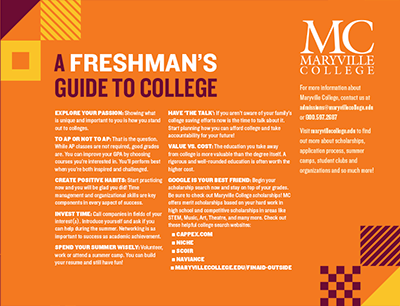
Freshman Guide
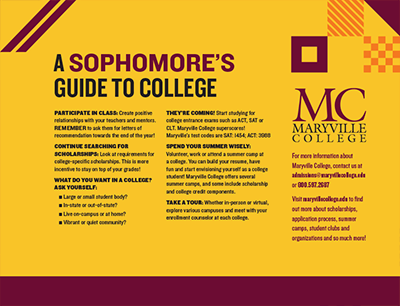
Sophomore Guide
Junior Guide

General Tips and Tricks from Admissions Counselors
- Sticker Price ≠ Final Price. Don’t rule schools out based on their tuition costs. Most schools that cost more on the surface give more scholarships and financial aid to students than less expensive schools.
- Don’t rely solely on national rankings. There are hundreds of college ranking lists that try to break down every category that a student could consider when choosing a college. Write out a list of what you want and don’t want in a college, then use your own preferences to start your search.
- Not sure what you want? Try visiting different schools! You might not think you have a preference between a big or small school, but you might change your mind after walking around each. Try to work in at least one school that fits into each of these four categories.
- Large (typically public)
- Small (typically private)
- Urban
- Rural
- Make a separate email address specifically for college. Make it simple and professional like jane.doe@gmail.com rather than geraldlikesturtles2002@gmail.com.
- When you make your college decision and formally enroll, tell the rest of the schools where you applied that you have made your decision. It’s not rude. It takes you off their communications lists and it helps the other schools focus on the students who are still interested.
- At each school you apply, ask each admissions office specifically about the scholarships they offer. Every school handles scholarships and financial aid differently, so you might earn more at one school than another.
- Some scholarships are single use and others are automatically renewable each year. Pay attention to the fine print and whenever you don’t know, ask!
- Check your place of employment and your family’s places of employment for scholarship opportunities.
- Fill out your FAFSA as quickly as possible and send it to your top schools. Then you can see your packages and compare.
- Check in your local community because there will be fewer applicants than nation-wide scholarship competitions. It’s worth tossing your hat in the ring with big names like Comcast or Ronald McDonald House, but see what opportunities are at your home church or small nonprofits, too.
- Be personable, be professional, and be yourself.
- Pay attention to length requirements and try not to putter out at the end. That’s the last thing you are leaving your reader with, so don’t elongate and leave weakness.
- Refer to a thesaurus – don’t rely on it.
- Have three sets of eyes to proofread. Try teachers, mentors, parents, and guidance counselors. Remember that proofreading is not rewriting, though.
- Your essay is not just a retelling of your resume or recounting an event that happened. Reviewers are more interested in the “why” in your story than the “who, what, when, and where.”
- Give your recommenders time. Don’t ask the day before it’s due. Recommenders want to advocate for you as best as they possibly can, but your letter isn’t the only thing on their plate.
- Ask your recommenders what they need to write your letter. Don’t assume every teacher or coach you ask has written a recommendation letter before, so find out what will help them help you.
- If you can, talk with your recommenders in person about the letter you’re asking them to write. Even if it’s to simply thank them, it will make it a much more satisfying experience to communicate face to face.
- Make sure you are asking people who can give examples of your best qualities at work. That personal touch makes recommendations stronger.
- Confirm that your schools receive your recommendations. Most schools have an application portal where you can keep up with your required materials. If a school doesn’t, ask the admissions office directly.
Breaking Down Financial Aid
Most students and their families are unable to pay the full cost of a college’s tuition, room, and board. Luckily, very few actually have to. The bulk of students receive financial assistance from these 3 sources:
- Institutional Funding – Money that individual colleges offer to students as incentives to attend their institution. These are often referred to as scholarships, awards, and fellowships.
- Federal/State Funding – Money that comes from the Department of Education. Typically, this type of funding is based on a family’s financial need so that families who make less, get more financial assistance. Some programs, like the TN Hope Scholarship, are based on merit rather than need. Federal and state financial aid can come in the form of scholarships, grants, and loans. In order to qualify for this type of aid, families must submit the Free Application for Federal Student Aid (FAFSA)
- Outside Funding – Money that comes from any source other than the college and the government. There are thousands of scholarships and grants that are available to students. Some cover the cost of books for a semester, while others cover the full cost of tuition. Bigger nation-wide awards typically have a lot more competition. Local churches, nonprofits, foundations, and philanthropic organizations will often offer smaller awards, but may be more likely for you to earn and ultimately a better use of your time.
While some students are lucky enough to go all through college without having to take out any loans, the truth is that most students have to borrow at least a small amount in student loans. Educating yourself in this area can be the difference between you taking advantage of student loans and student loans taking advantage of you.
- Federal Student Loans – The U.S. Department of Education’s office of Federal Student Aid provides more than $120 billion in financial aid to help pay for college or career school each year. You have to fill out the Free Application for Federal Student Aid (FAFSA) to apply for this funding. Follow these 5 links to get to the Department of Education’s student aid website and become a financial aid pro.
- Before senior year -> visit colleges, meet admissions counselors, ask questions
- August – September -> apply to colleges, apply to institutional scholarships
- October -> complete the FAFSA, add every college for which you are planning to apply
- November – December -> check with each college’s financial aid office for additional requirements, begin hearing back about admission, scholarships, and financial aid packages
- January – February -> tally up all institutional scholarships, financial aid, outside aid, and start comparing bottom line costs between schools.
- March – May -> make your college decision, notify each school about your decision, accept your financial aid package, complete federal loan counseling if taking loans.
Maryville College keeps a list of reputable outside scholarship databases. This list is not exhaustive, but it will be a good place to start your outside scholarship search.