


Dr. Bryan Coker: Family, Work and ‘Helping Students Find their Voice’
Note: This story originally appeared in the Winter/Spring 2021 issue of FOCUS magazine | Story by Amy Blakely
The silicone bands around Dr. Bryan Coker’s wrist represent things dear to his heart: family, serving students, and Maryville College.
He wears a dark blue band in memory of a Goucher College student who was killed by a drunk driver while crossing a campus street. “I walked with his family through the whole process, and I was in the room when they removed him from life support,” Coker said.
A light blue band advocates suicide prevention. Coker lost his mother to suicide in 2016, after a lifelong struggle with mental illness.
His newest band, the green one, commemorates Maryville College’s Mountain Challenge program. It’s one of many things Coker has come to love about the College since becoming its 12th president.
Finding his niche
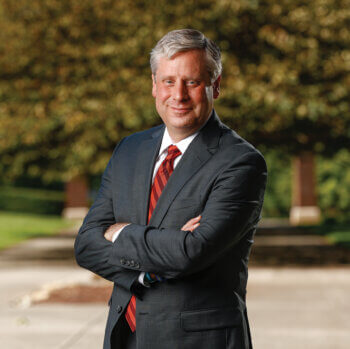
Coker grew up in Forest City in western North Carolina. His mother’s family could trace their roots in the small town back to the Revolutionary War.
He was an only child, and his parents divorced when he was 6. He attended public school.
His stepfather – who died from ALS, or Lou Gehrig’s disease, when Coker was a college first-year student – encouraged him to pursue a liberal arts education.
Coker set his sights on Rhodes College, a 2,000-student Presbyterian liberal arts college in Memphis. Even though it would mean moving to a big city eight hours away, his family was supportive.
“I think they knew if I was too close to home, I wouldn’t have had a real college experience,” he said.
At Rhodes, Coker joined Kappa Sigma fraternity and began finding “his people” – others who loved learning and wanted to make the world a better place. A psychology major, Coker found his niche studying college student development.
“I love the art of human interaction,” he said. “I love watching how we bring people together in a college community who are from very different backgrounds.”
Newly appointed Supreme Court Justice Amy Coney Barrett was a year ahead of Coker at Rhodes.
“Amy and I were on the honor council together, and we were resident advisers together in the same building.”
The honor council adjudicated students for violating the college’s honor code, which mandated they not lie, cheat or steal.
Since Coney Barrett’s nomination and confirmation, Coker has sidestepped numerous queries from media outlets seeking his thoughts about the new justice.
“If Amy is still the person she was when I worked with her, we’re going to be fine. That person is a very reasonable, highly intelligent person.”
In a sociology class during his junior year, Coker met the woman he would marry: Texas-born, Louisiana-raised Sara Barnette Coker (Read “Meet Sara Coker,” which appeared in the Winter/Spring 2021 issue of FOCUS magazine).
“I finally got the courage to ask her out to a fraternity function,” he said. They’ve been together ever since.
Life throws a curve
After finishing his master’s degree at the University of South Carolina in 1997, Coker was hired as the fraternity affairs adviser at the University of Tennessee, Knoxville. Within two years, he was named director of student judicial affairs. He was only 25 – the youngest person in the office – and the first person without a law degree to hold the position.
“They either really wanted me to fail or they had a heck of a lot of confidence in me,” he said. “I dealt with some very difficult cases. Some that were very public, high profile. I think I learned a lot about really doing the right thing.
“On a personal level it was a meat grinder, but I got some great experience. I learned about supervision and motivating a team to do great work.”
After six years at UT, Coker left to become dean of students at Jacksonville University in Florida, a private residential liberal arts university with about 3,000 students. There, he oversaw the construction of a residence hall and the university’s first true student center. While showing a trustee around the unfinished student center, he described how he envisioned the space. She committed to funding the project on the spot.
In 2008, after five years in Jacksonville, Coker was thinking about his next move – until a tragic accident put everything on hold.
The Cokers’ daughter, Caroline, was 7 and their son, William, was 4. Sara was pregnant with their third child. The Cokers and Sara’s parents were vacationing in Orange Beach, Ala. They’d gone out to dinner, taking two cars – Coker, Sara, and Caroline in one and Sara’s parents and William following in another.
The Cokers had just returned to the beach house when their phone rang. Sara’s parents’ car had been hit head-on by an intoxicated driver. Sara’s father died at the scene, and her mother was badly injured. William escaped with only bruises.
The family spent the next few years recovering.
When the Cokers’ third child was born later that year, they named him Chris, after Sara’s father.
Also to honor her dad, who had worked in health care, the Cokers started a chapter of Solace for the Children, a humanitarian organization that brings children from Afghanistan to America for medical care. Over three years, 45 Afghan children came to Jacksonville and received $10 million of medical care. The Cokers opened their home to three of the young patients – Sahar, 11, who suffered from severe headaches; Soman, 6, who needed heart surgery; and Ashraf, 12, who had a club foot.
Helping students find their voice
In 2013, Coker – who had completed his doctorate from UT in 2010 – was named vice president and dean of students at Goucher College, a 1,600-student liberal arts college near Baltimore, Md.
A pivotal moment of his tenure came in 2015, during racial unrest following the death of Freddie Gray, a 25-year-old African-American who suffered a fatal spinal cord injury while being transported to jail after his arrest on weapons charges in Baltimore.
Goucher students joined the protests.
“I’ll never forget following them around in my car,” Coker said. “I’d tell the police, ‘These are our students. I am here. They are here exercising their rights. If there is a problem, let me know.’”
When students penned a list of campus concerns, Coker met with them.
“Being with that campus on a journey of racial justice, I realized this is what I really wanted to do in my career – watch students find their voices.”
While in Baltimore, Coker also taught at Morgan State University, a historically black university.
Coker, who served as Goucher’s acting president in the summer of 2019, said his time there also taught him to avoid getting “so bogged down in the challenges of the moment that we don’t advance the organization.”
It’s a lesson that continues to serve him well.
“I was recently on a call with other university presidents, and we were talking about what we’re most concerned about,” he said.
Not surprisingly, most were focused on the pandemic. But Coker said he’s trying to think beyond COVID-19 – to leading 200-year-old Maryville College into its next 200 years.
Work-life balance
With their fourth child born in Baltimore, the Cokers’ brood now ranges from a college sophomore to a first grader.
Caroline, 19, attends Florida Southern College. She is, Coker said, “a fun, free spirit. She’s the mini-me in many ways.”
William, 16, a sophomore at Maryville High School, is a swimmer. Coker is teaching him to drive on the campus roads.
Chris, 12, a sixth grader at Montgomery Ridge Intermediate School, loves art. He’s inquisitive and “will talk your ear off.”
Andrew, 6, a first grader at Sam Houston Elementary School, is “the life of the party.”
Although overseeing a college is more of a lifestyle than a career, Coker strives for a healthy work-life balance.
“I will outwork anyone,” he said. “But I will also do my best to sit down and have dinner with my family. Once they’re in bed, I’ll get the laptop out and work some more.”
When there’s time, the family takes hikes and plays with their 11-year-old goldendoodle, Allie, and basset hound pup, Dolly. They also spend time working on their 100-year-old Barber-McMurray house, believed to be the first architect-designed house in Maryville. The family attends New Providence Presbyterian Church, and Coker is an ordained elder and liturgist in the Presbyterian Church (USA).
Coker is both enthusiastic and optimistic about Maryville College’s future.
“Even in the midst of this pandemic, we have incredible energy and momentum. Maryville College has been through a Civil War, two World Wars, and a past pandemic. We’ve got some resilience, some staying power. We’re going to be OK.”