


Brian Childs ’69, Caroline Anglim ’13 return to Maryville College to discuss bioethics for the 2022 Cummings Conversations
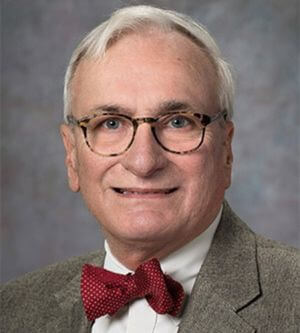
They graduated from Maryville College more than 40 years apart, but a mutual career calling will bring Dr. Brian Childs ’69 and Caroline Anglim ’13 back to campus in March to take part in the annual Cummings Conversations.
Named for Margaret Cummings, a former instructor of Bible and Religious Education at the College who left behind a legacy of faith, service, and lifelong learning, the Margaret M. Cummings Conversations on Faith, Learning, and Service take place every spring. Formerly known as “February Meetings,” they give MC students, faculty and staff — along with the local community — a chance to gather and discuss questions of faith and responsible living.
Childs, a professor of bioethics and professionalism and chair of the Department of Bioethics and Medical Humanities at the Mercer University School of Medicine in Macon, Georgia, will be joined by Anglim, who will receive her Ph.D in religious ethics from the University of Chicago Divinity School in June and join Mercer as an assistant professor of bioethics and professionalism in July.
The theme for this year’s Cummings Conversations is “Neighborly Love: Reimagining Social Responsibility in Medical Ethics.”
“Medical ethics needs to live in the tension between the one and the 99, to borrow a parable from the Bible,” Childs said. “I’ll talk about my own clinical experience with the (COVID-19) pandemic, and the realization I had as we were working on allocation policies for resources — things like ventilators, treatments, even oxygen — that we had overlooked something that was terribly important, because all of our allocation algorithms ignored underserved populations.”
Individual concern vs. community responsibility is a complex issue, Anglim added, and health care debates often focus on the care of patients rather than the needs of certain populations and communities. Ensuring that the underserved get the services they need doesn’t have to take place at the expense of personal care, she pointed out, but it does require a nuanced approach.
“There’s been so much attention about what happens to an individual that the way we think about issues that arise are often in terms of this very intimate relationship,” she said. “We’re sort of harming ourselves when we only attend to the problems in front of us and willfully ignore these layers of other related concerns. The pandemic has brought that into sharp relief, but we’ll talk about that history and how it came to be outside of this immediate context as well.”

“We’re not saying that society matters, and the individual doesn’t,” Childs added. “But in the larger frame of medical ethics, when we’re building institutions meant to serve wide populations, we’re doing a disservice when we only consider certain individuals.”
The story of how the two MC grads connected is almost as fascinating as the topic they’ll discuss when they return to their alma mater. A self-described “bad boy” as an undergraduate, Childs has lost none of his rakish charm as he describes how, at an alumni awards dinner a few years ago, he joked with the crowd upon being recognized as a distinguished graduate that “I’m quite sure the only citation you thought I would ever get would be from the Blount County Sheriff’s Office!”
“I got into Maryville by hook or by crook: I was not a very good student, and so I was turned down when I applied. I wrote a letter asking them to take a chance on me, and they let me in under probation,” he said. “I ended up on the dean’s list and went on to Princeton for graduate school and seminary, and I look back and see how the rigor of Maryville College, particularly in its academics, was formative, and it gave me a marvelous foundation for doing future work.”
After graduating in 2013, Anglim worked as a grant writer for Blount County Habitat for Humanity but found herself drawn to a different career path. That same rigorous academic background, she said, allowed her to pivot and, within a year, present herself as a strong candidate for a number of graduate school programs. Moving through the master’s and Ph.D programs at the University of Chicago, she applied for an assistant professorship at Mercer and received a call from Childs, who immediately recognized the value of adding her to his faculty.
“It’s been sort of a whirlwind how all of this has fallen into place, and to be able to come back together feels very serendipitous,” Anglim said. “I remember going to these lectures, or some version of them, as an undergrad, and at the time, I often felt intimidated about asking questions. One thing we’re really hoping to be able to achieve is to have a more conversational approach, so that everyone feels like they can ask those questions about this important topic.”
The pair, whose visit is arranged in partnership with the MC Neuroscience Department of the Division of Behavioral Sciences, will speak at 7 p.m. March 28 in the Lambert Recital Hall of the Clayton Center for the Arts on the subject of, “Who Is My Neighbor?” At 1 p.m. March 29, they’ll talk on “Neighbor Love in Crisis” in the Lawson Auditorium of Fayerweather Hall.
Both talks are free and open to the community.