


Ledford Scholarship Program awards two MC undergrads funding for summer research
July 7, 2023
It’s a summer tradition at Maryville College: After their peers leave campus between the spring and fall semesters, the Ledford Scholars get to work.
This year, two MC students — rising senior Autumn Seeders ’24 and rising junior Colby Huffman ’25 — are taking advantage of the vacancy in the College’s Sutton Science Center to conduct research supported by the Appalachian College Association’s Ledford Scholars Program.
Named for Col. Lee B. Ledford, the program offers financial assistance for students who are enrolled at ACA member institutions and are conducting summer research in such areas as laboratory and field work, interviews, special collections analysis, and participant observation.
“The Appalachian College Association has consistently recognized that undergraduate research is an integral part of the academic curriculum at Maryville College, and I’m just as pleased this time as I have been in the past,” said Dr. Dan Klingensmith, vice president and dean of the College. “When we talk about urging students to ‘study everything, to prepare for anything,’ it means we’re training them to seek and produce knowledge and not to simply be receivers of content. Undergraduate research is a great way of learning problem-solving skills and critical thinking, as well as patience. And experience in research at the undergraduate level can give our students certain advantages if and when they choose to apply to graduate school.”
A total of 43 students enrolled at 18 ACA institutions were awarded scholarships for 2023. As recipients, Seeders and Huffman will present their research outcomes during the fall semester, as well as submit a short video presentation of their findings to the ACA, which will feature them on the ACA website.
Autumn Seeders
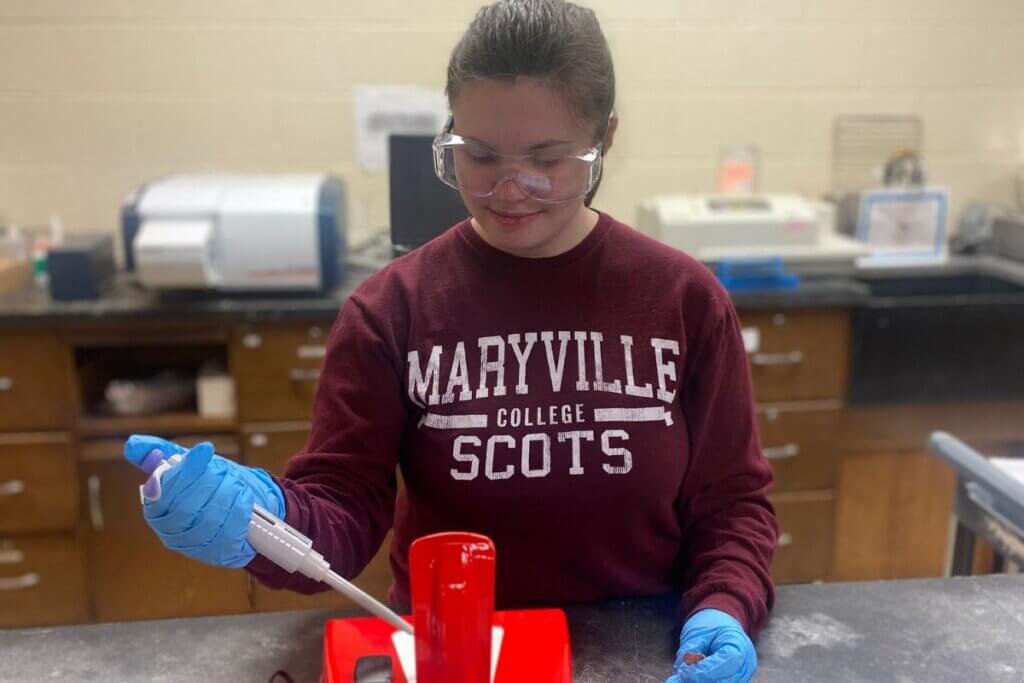
Seeders, a Biochemistry major and Knoxville native, was awarded almost $2,200 to develop “research assays to use Förster resonance energy transfer to measure macromolecular interactions,” a technique that is based on energy transfer between two light-sensitive molecules — in this case, she added, blood proteins.
“With this, I am attaching a fluorescence probe to a blood protein so I can measure how its structure may change when it comes in contact with different blood proteins,” she said. “Specifically, I’m planning on labeling TLT-1, a blood protein that is involved with the coagulation process, with a fluorescent probe and investigating how it reacts with other blood proteins such as fibrinogen,” which is naturally fluorescent in ultraviolet light. Seeders and Dr. Angelia Gibson, MC professor of chemistry, expect to be able to measure changes in the fluorescence of the probe on TLT-1 by measuring the transfer of energy from fibrinogen to the probe on TLT-1.
Seeders will be conducting her studies using a new fluorescence plate reader, which can measure fluorescence, luminescence, or absorbance in up to 384 samples at a time. The high-throughput plate reader was purchased with congressionally appropriated funds that were recently awarded to Maryville College for developing STEM workforce in the state of Tennessee.
Such studies have fascinated her, Seeders added, since her interest in science began to grow during middle school. She remembers a particular Advanced Placement Biology class in high school where she and her classmates studied fruit flies over the course of several generations. Attracted by the smaller class size and the hands-on learning in the Division of Natural Sciences, she found a way to marry her long-time love of biology with a newfound appreciation for chemistry at MC.
“I just completed my junior year where I took my first biochemistry course, and I loved focusing on how the body works at a molecular level,” she said. “Since Maryville College is small, I have been able to connect more closely with different professors and classmates. I have also been able to work more closely with equipment by myself and learn skills that a student who goes to a larger school may not.”
Seeders was encouraged to apply for a Ledford scholarship by Gibson, who also serves as co-director of the Scots Science Scholars (S3) alongside Dr. Maria Siopsis, professor of mathematics.
“As my advisor, she has helped me plan my courses and reached out to me about research opportunities to apply for,” Seeders added. “She also became my thesis advisor, where she helped me choose a topic to focus on and guided me through the procedures I needed to complete. I applied (for the Ledford scholarship) by writing a proposal about my thesis, where I detailed my goals and my plan on how I would achieve my goals. I also submitted my expected budget for my project and asked for two letters of recommendation, which were graciously written by Dr. Gibson and Dr. Klingensmith.”
Colby Huffman

Huffman, a Biochemistry and Mathematics double major from Sevierville and a Scots Science Scholar, received almost $2,700 in Ledford scholarship funding to develop “laboratory protocols and research assays that will use fluorescence polarization to monitor changes in protein conformation,” a proposal that was an outgrowth of lab work he was already doing at MC under the supervision of Gibson, he said.
“The process consisted of making budget estimates, writing a project narrative, describing what roles Dr. Gibson and myself would take, a brief biography of myself, getting a letter of endorsement from Dr. Gibson and Dr. Klingensmith, and submitting my transcript,” he said. “She was extremely patient and very helpful. I was very lucky to have the guidance of Dr. Gibson on this project.”
His Ledford research is built on work in the Sutton Science Center biochemistry lab using a spectrofluorometer, an instrument used to measure fluorescence, or the emission of light by a substance that has absorbed light or other electromagnetic radiation. Huffman will be using another relatively new instrument purchased with funds from a donor. Like Seeders, Huffman will also be measuring the changes in fluorescence that occur as molecules undergo changes when they bind with other molecules.
“I will create lab protocols for MC, because only students completing Senior Study utilize the spectrofluorometer, and it would be a good instrument to know how to use for careers in chemistry as well as for Senior Studies, so that there isn’t a big learning curve,” he said. “After the protocols are developed, I will be using the anisotropy function (a method used to measure the changing orientation of a molecule in space) on the spectrofluorometer to see if I can see significant signs of the binding occurring,” he said.
Fluorescence anisotropy is a technique that uses polarized light to measure the degree to which a fluorescent probe is moving or tumbling. Since fluorescence anisotropy typically changes when molecules experience different environments, Huffman and Gibson expect to be able to use it to monitor the binding of two molecules.
In addition to his Ledford study, Huffman received roughly $6,000 from the National Science Foundation to take part in a summer REU (research experience for undergraduates) at The Ohio State University in Columbus, Ohio, where he’s also working on molecular modeling and docking software to develop computer models of the ways that proteins vibrate, move, rotate and form bonds.
It’s a complex process, but like Seeders, innate curiosity, a lifelong love of science and the support of the Scots Science Scholars program have led to a hands-on experience unlike anything he might have found at another college, he added.
“I think the Scots Science Scholars program gave me a very important and beneficial introduction to what it takes to succeed in college, specifically at MC,” he said. “S3 has also introduced me to many professionals in the field where I want to end up, allowing me to form connections and ask them questions about their journey getting there. This is beneficial because it opens shadowing or internship opportunities as well as a resource and guide for what to do and not do.”