Maryville College’s Witherspoon Lecture Series to focus on Southern Appalachia’s role in the nation’s founding
Dec. 16, 2025
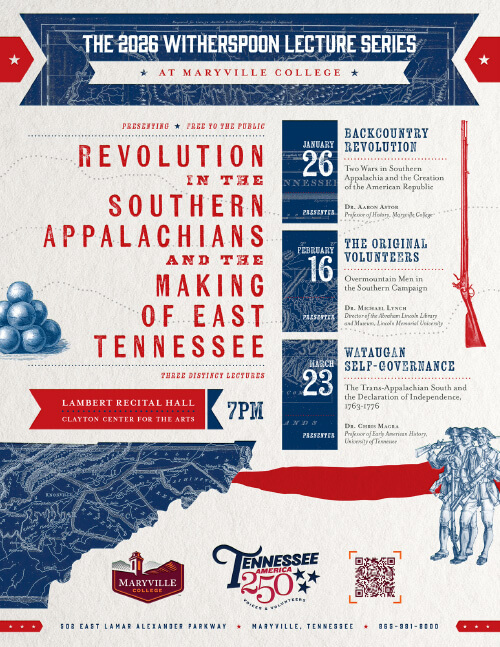
As Maryville College prepares to join the nation in marking the United States’ Semiquincentennial, administrators have announced the 2026 Witherspoon Lecture Series — a slate of events that will bring leading scholars to campus to explore Southern Appalachia’s influence on America’s founding and the region’s role in the American Revolution.
The series, funded by the Newell and Mary Lee Witherspoon Lecture Series endowment, will feature three public lectures in early 2026. Each event will highlight aspects of the Revolutionary era through the lens of the Southern Appalachian experience — a perspective that aligns with Maryville College’s commitment to being a college “of and for the region.”
“We talk a lot about being a college that is ‘of and for the region,’ so we decided to let that inspire our planning,” said Karen Beaty Eldridge ’94, executive director of Marketing and Communications at Maryville College and one of the lecture series organizers. “We hope that by inviting scholars to reflect on the influence that Southern Appalachia had on the Revolution, as well as how the Revolution impacted Southern Appalachia, attendees will have a greater understanding of — and appreciation for — the celebrations that will follow this year.”
While the nation’s celebration of its 250 years of existence will be centered around the annual Independence Day holiday, the summer observance falls outside of the traditional academic year, Eldridge pointed out.
“Many of our faculty, staff and students will be away from campus during the July 4 holiday, but we still wanted to honor the United States Semiquincentennial in a way that would be meaningful for our community but also distinctive to the College,” she added.
All Witherspoon lectures are free and open to the public. The schedule includes:
‘Backcountry Revolution: Two Wars in Southern Appalachia and the Creation of the American Republic’
Taking place at 7 p.m. Tuesday, Feb. 10, 2026, in the Harold and Jean Lambert Recital Hall of the Clayton Center for the Arts, this lecture — led by MC History Professor Dr. Aaron Astor — will examine how the American Revolution unfolded alongside conflicts between European and Indigenous peoples over control of the land. (NOTE: This lecture, originally scheduled for Jan. 26, has been postponed until Feb. 10 due to the forecast for inclement weather.)
“At the time, there were two simultaneous and overlapping wars: one between European and Indigenous peoples over control of the land and the other between American patriots, British loyalists, and the army of the British Empire over the nature of liberty and governance itself,” Astor said. “The struggles in the American backcountry helped secure independence and pave the way for an expanded American Republic in the West.”
Astor is the author of “Rebels on the Border: Civil War, Emancipation and the Reconstruction of Kentucky and Missouri, 1860-1872,” published in 2012, and “The Civil War Along Tennessee’s Cumberland Plateau,” published in 2015, as well as co-editor of the 2021 publication “Slavery: Interpreting American History.” He has written extensively for the New York Times’ award-winning Disunion series and is currently working on a book exploring the 1860 Presidential election through the grassroots experiences of four American communities. He earned his Ph.D. from Northwestern University.
‘The Original Volunteers: Overmountain Men in the Southern Campaign’
Dr. Michael Lynch, director of the Abraham Lincoln Library and Museum at Lincoln Memorial University in Harrogate, Tennessee, will headline the next lecture, set for 7 p.m. Monday, Feb. 16, 2026, in the Lambert Recital Hall.
“I’ll be discussing Appalachian frontiersmen’s involvement in the Revolution, why and how they mobilized to make a significant contribution to victory in the South — and why there were limits to that mobilization,” Lynch said.
The Abraham Lincoln Library and Museum contains one of the world’s largest collections of Lincoln and Civil War material. Lynch recently oversaw a multimillion-dollar, award-winning renovation of the museum’s exhibit galleries. Located in Harrogate, Tennessee, its mission is to collect, preserve and exhibit artifacts and archival materials concerning Abraham Lincoln, his contemporaries, the American Civil War and the study of Lincolniana. Lynch’s professional research focuses on the Southern backcountry during the Revolution, and he received his graduate training at the University of Tennessee.
‘Wataugan Self-Governance: The Trans-Appalachian South and the Declaration of Independence, 1763–1776’
The final discussion of the Witherspoon Lecture Series is scheduled for 7 p.m. Monday, March 23, 2026, in the Lambert Recital Hall and will be led by Dr. Christopher Magra, a professor of early American history at the University of Tennessee-Knoxville and director of the Center for the Study of Tennesseans and War. He has authored influential works on the American Revolution, including “The Fisherman’s Cause” and “Poseidon’s Curse,” and is currently completing an edited volume on the military history of the Declaration of Independence, forthcoming from the University of Tennessee Press for the nation’s 250th anniversary.
“The Watauga Settlement was one of the first settlements west of the Appalachian Mountains,” Magra said. “Settlers such as John Sevier and Daniel Boone created their own government known as the Watauga Association prior to the Declaration of Independence. Sevier and Boone insisted British imperial policies limited westward expansion and failed to protect settlers from Native American resistance movements. They believed these policies were detrimental to their safety and prosperity. Thomas Jefferson agreed with these sentiments and incorporated them in the Declaration.”
Located in the Hoskins Library on the campus of the University of Tennessee-Knoxville, the Center for the Study of Tennesseans and War is designed to research, preserve and share the stories of all those in Tennessee who have been involved in armed conflicts between 1700 and the present day.
About the Witherspoon Lecture Series
The Newell and Mary Lee Witherspoon Lecture Series, endowed in 2022 by Newell Witherspoon ’52 and Mary Lee Witherspoon ’56, was established to strengthen relationships between members of the campus community, as well as between the campus and the greater East Tennessee region through the creation of opportunities to learn about and discuss topics that are important, timely and of broad interest. Events and guest speakers strive to express the value of differing views while seeking common ground and acknowledging the dignity in all.
“We are very grateful for the funding provided by the Witherspoon Lecture Series that allows us to explore important topics with the campus and external communities,” Eldridge said.