


Orchestra at Maryville College, MC Community Chorus combine might for an April 8 spring concert
April 1, 2025
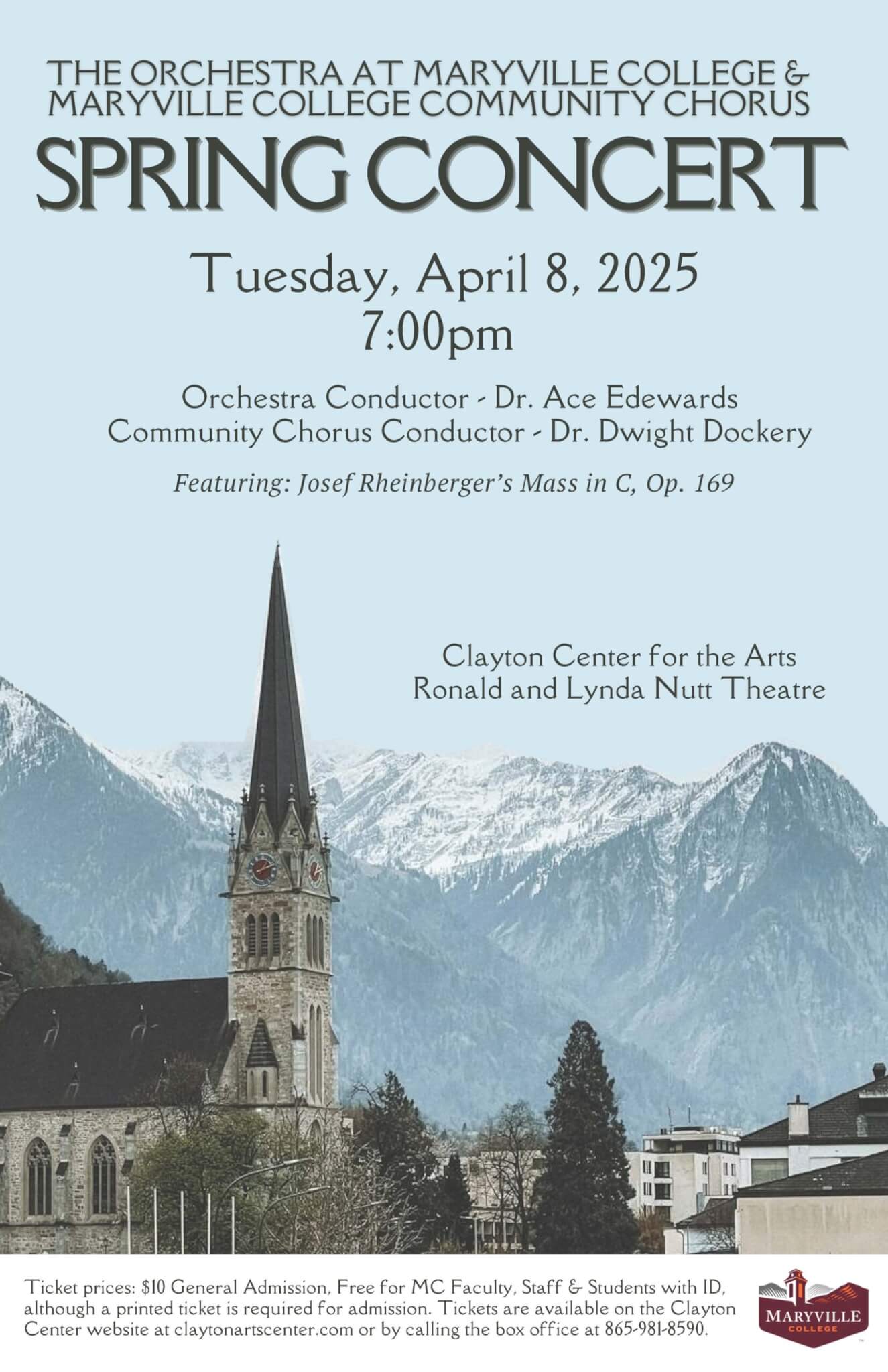
On April 8, the Orchestra at Maryville College and the Maryville College Community Chorus will once again combine their talents for a joint spring concert in the Clayton Center for the Arts.
The chorus, led by Dr. Dwight Dockery ’05, and the orchestra, led by Dr. Ace Edewards, will each perform a composition alone, followed by a set of works that the two groups will perform together.
“The combination of chorus and orchestra is always thrilling,” Dockery said. “I look forward to our combining forces again for this concert.”
While this concert does not have a particular theme, many of the works focus on the evolution of Western music; specifically, the chorus’ solo section of the concert focuses on the work of Giovanni Pierluigi da Palestrina (1525-1594), an Italian composer whose work, Dockery said, is “one of the best examples of late Renaissance music that we have.”
“Just before and during his lifetime, music for the Church had gotten to a point that the polyphony made it difficult to understand the text being sung, and therefore impeded worshipers’ ability to engage with it,” Dockery explained. “Very often, it is misrepresented that Palestrina singlehandedly ‘saved’ Western music, but scholars do believe that it’s true that his music might have been used as an example of ‘good’ (meaning intelligible but also musically interesting) music for worship.”
The chorus will perform Palestrina’s motet “Sicut Cervus,” which is a setting of Psalm 42.
The orchestra’s solo performance will be “the three Entr’actes” from “Rosamunde, D.797,” a theatrical score composed by Franz Schubert (1797-1828).
“This piece is part of the incidental music composed for the play ‘Rosamunde, Fürstin von Zypern (Rosamunde, Princess of Cyprus)’ by Helmina von Chézy, which premiered at Vienna’s Theater an der Wien on Dec. 20, 1823,” Edewards explained.
While most of the rehearsals for the concert have been done separately, the two groups recently began combined rehearsals, which both Dockery and Edewards said is always an exciting time in the process.
“The piece always sounds different when you get to experience it combined, and this one is no different,” Dockery said. “From the singers’ perspective, it’s helpful to hear who is playing cues and doubling your part. In a piece as harmonically rich as this one, it’s necessary to know who to listen for.”
The harmonically rich piece, in this case, is Josef Rheinberger’s “Mass in C Major, op. 169,” a score made up of six sections composed during what is known as the Cecilian Movement.
Similar to Palestrina, composers of the Cecilian Movement sought to “tame” church music — the main difference, however, being that the genre had at the time moved from the church to the concert hall, hence the ability to create much grander orchestral and vocal scores, which was not possible in Palestrina’s time.
“As far as a favorite piece on this concert, I am probably partial to the Palestrina. It’s quite a miniature masterpiece, and it’s one of those pieces that, no matter how many times I’ve interacted with it, I never tire of its beauty and brilliance,” Dockery said. “That said, this is my first time working on the Rheinberger, and it’s one that has really grown on me considerably. It’s been a good challenge for both the chorus and me to shift gears so dramatically between the works.”
“I look forward to presenting this repertoire to our audience,” Edewards added. “I’ve found no record of the Mass being performed in this area, so I’m fairly confident we are giving its East Tennessee premiere.”
“It is a bit ironic that we’re doing a mass by Rheinberger and a motet by Palestrina in celebration of their connections to returning music to the church for a decidedly non-religious concert,” Dockery joked.
However, the mix of secular and liturgical music in this concert, as well as the range of styles spanning the 1500s to the 1800s, ensures that there will be pieces for a wide range of listeners to enjoy.
The April 8 concert will take place at 7 p.m. in the Ronald and Lynda Nutt Theatre of the Clayton Center for the Arts on the MC campus. Tickets are $10 each and can be purchased at https://claytonartscenter.com. MC faculty, staff and students are admitted free, although a printed ticket — which can be picked up at the Clayton Center box office — is required.
Written by Julia Jeffress ’25