


Text: Senior Lecturer of Music Dr. Alicia Massie-Legg’s Baccalaureate sermon to the Maryville College Class of 2025
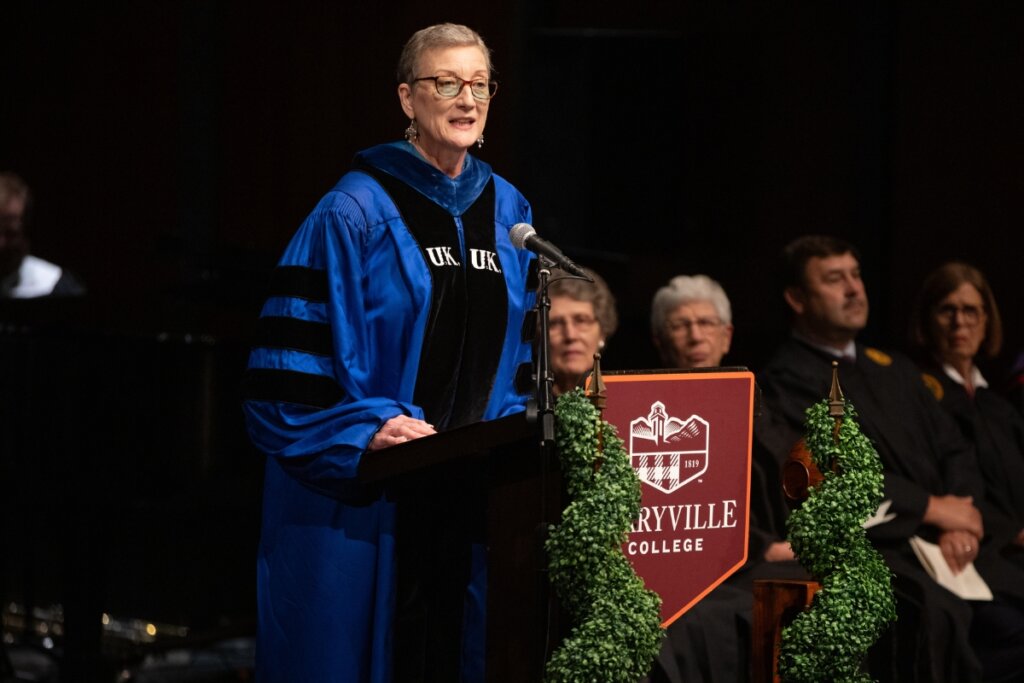
Maryville College Senior Lecturer of Music Dr. Alicia Massie-Legg, who retired at the end of the 2024-25 academic year, was selected to deliver the Baccalaureate sermon to the Maryville College Class of 2025 on May 2, 2025, in the Clayton Center for the Arts. Here is the full text, titled “The Tapestry of Your Life.”
Before we begin, I would like to express my appreciation to (Maryville College President) Dr. (Bryan) Coker, our Maryville College faculty, and you, our wonderful graduates, for this opportunity to speak to you on this important celebration of your graduation, one of the most important milestones of your life.
When I was invited to deliver the Baccalaureate sermon, my immediate response was a feeling of profound inadequacy. While I may have a few extra years of experience — just a few — I am far from an expert at approaching the challenges and opportunities that arise in life. I am here before you, not as someone who has all the answers, but as someone who is striving to learn life’s important lessons. Like most older adults, I have experienced both triumph and failure in my life and career. I have made good decisions, but I have also made many mistakes. Life is a journey of continuous travel, and the road is not always a smooth one. All of us in this auditorium are following our unique paths. Not a soul present here today has it all figured out. And yet, there are some truths that I humbly offer in hopes that you will find something I say today that resonates with your own experience as you navigate your journey.
I like to envision life as a tapestry that is only completed once we pass on from this life to the next. It’s a tapestry woven of heartbreak, laughter, tears, triumphs, defeats, successes, and failures. Each of these threads contributes to the final design, and none is wasted. Sometimes, we have the liberty of choosing the colors we will use, but other times, we are forced to continue weaving with what is available to us, what life has served us. Some sections of our tapestry will be characterized by rich jewel tones of joy, sunshine, and happy experiences. Others will perhaps be more muted in tone, shadowed by the sorrows and difficulties that may come our way.
One thing we can be certain of, however. Our tapestry will always change, moment by moment, as we navigate the phases of our lives. Singer-songwriter Carole King wrote in one of her most well-known songs, “Tapestry”: “My life has been a tapestry of rich and royal hue, an everlasting vision of the ever-changing view.” This ongoing activity of weaving the threads into our tapestry will sometimes proceed smoothly and seemingly without effort. Other times, we might have to undo entire sections of our artwork and reweave them. Still other times, we may have to sever threads that have become snarled and start over again. But there is beauty in the ongoing process of shaping this unique story of our lives. Hopefully, your time here at Maryville College has equipped you with the skills you need as you take your next steps into a new phase of your life.
As we form our life disciplines and opinions, we rely on the wisdom that parents, teachers, mentors, friends, colleagues, and spiritual guides offer us. With further education, we also avail ourselves of the accumulated knowledge from those who have come before us. Some find guidance in the writings of Ancient Greece, such as those of Aristotle and Plato. Others turn to spiritual and philosophical writings from Eastern Religions, Islam, and diverse traditions. For those of us who are Christian, the Bible is an unparalleled source of support and wisdom, for we believe that this is God’s communication to us.
The Apostle Paul, in his letter to the Romans, Chapter 15, verse 4, wrote, “For everything that was written in the past was written to teach us, so that through the endurance taught in the Scriptures and the encouragement they provide we might have hope.” I believe that there are important truths from several scripture passages that will be helpful as we contemplate this learning journey, this ongoing tapestry. The framework I will use for this sermon is a short list of three “May You” aspirations. Please understand that I don’t present these as something I have mastered, but rather as a hope that we will all continue striving to incorporate these principles into our lives.
1. May you learn to cultivate the art of contentment and gratitude while entering a career that will require you to show up on time, work hard, and be conscientious.
There is meaning in hard work, no matter what career we pursue. Paul tells us in Colossians 3:23, “Whatever you do, work at it with all your heart, as working for the Lord, not for human masters.” The development of a strong work ethic rewards us by building our characters. In addition, we have the opportunity to gain a sense of accomplishment when we know that we have carried out our duties in a responsible manner.
At the same time, we need to pay attention to our attitude. In Philippians 4:12-13, Paul writes, “I know what it is to be in need, and I know what it is to have plenty. I have learned the secret of being content in any and every situation, whether well fed or hungry, whether living in plenty or in want.” He “learned the secret of being content.” It is apparent that contentment is not a gift we are born with, but rather a skill. That skill is honed through perseverance and practice. By learning to be emotionally resilient when we face the stresses of fulfilling our responsibilities in our careers and in our personal lives, we begin to lay the groundwork for contentment.
Contentment isn’t a passive state of being, but rather something that we must constantly strive to weave into our life’s tapestry. It is natural for humans to be restless in our quest to achieve. While ambition can be a positive thing when kept in balance, we must also fix our attention on those daily gifts that make our lives rich: our ability to breathe air and eat nourishing food, to joyfully observe beautiful sunrises and breathtaking sunsets, to delight in the interplay of light and shadow on the mountains as clouds scud along the sky, to bathe in the devotion of a beloved pet, to laugh with friends, and to be grateful for the sanctuary of a home and family. When we recognize that these are precious gifts, we can experience a deeper contentment. We are reminded by the Teacher who wrote Ecclesiastes, in chapter 3, verse 20, “all go to the same place; all come from dust, and to dust all return.” This brings to light a fundamental truth, we enter and leave this world with no possessions. When we get caught up in the whirlwind of deadlines, personal finances, health concerns, and responsibilities, it’s easy to lose sight of the good things in our lives. When we focus on only the spectacular, we become blind to the mundane joys available to us. By learning to cherish our present, being grateful for moments of joy, we weave the threads of contentment into our lives.
2. May you extend love to those who are different and cultivate the art of kindness.
When we learn to love and respect those who are different, we will be far more successful in our work and in our personal lives. Our society is quickly becoming global. All individuals deserve recognition of their inherent dignity and autonomy. When we act callously toward someone simply because their culture and world view differ from our own, we reveal a deficiency in our own character development.
Paul offers profound wisdom in Romans 14:1-4: “Accept the one whose faith is weak, without quarreling over disputable matters. One person’s faith allows them to eat anything, but another, whose faith is weak, eats only vegetables. The one who eats everything must not treat with contempt the one who does not, and the one who does not eat everything must not judge the one who does, for God has accepted them. Who are you to judge someone else’s servant?” He was speaking to a group of people obsessed with criticizing others simply because they didn’t dress, eat, or act like them. The correlation to current social behavior is obvious.
I fear that, in our culture, we find it far easier to condemn diversity than to remain open to learning more about those who are different. However, true strength of character lies in tolerating diverse opinions without resorting to fear or anger, in treating others with respect even though we may disagree with them.
In the same way, kindness is a skill that we must continually foster so that it becomes a way of life. Kindness often comes easily when we anticipate a positive response. However, if we are Christian, we are called to choose kindness even in the face of suspicion and belligerence. According to the Apostle Peter in 1 Peter 3:9: “Do not repay evil with evil or insult with insult. On the contrary, repay evil with blessing, because to this you were called so that you may inherit a blessing.” We may not be immediately rewarded or blessed when we are truly kind to others, but the act itself can bring a blessing to us. By carefully weaving compassion and kindness into our tapestry, we keep our minds open to new thoughts and cultures. We remain open to the joyful discoveries to be found in coming to know others.
3. May you learn the art of moderation.
Moderation is not a popular word nowadays. Politics, lifestyles, and religion have become increasingly polarized in broadcast media, movies, television series, and social platforms. Agitated and angry people are more malleable than someone who approaches issues by considering all aspects before making decisions. Extremism is more profitable than moderation.
Accordingly, our society seems to actively encourage this polarization in all things. The pursuit of unnatural beauty leads to self-disfigurement and self-obsession. The amount of money spent annually on beauty products, unsustainable fad diets, and fast fashion is staggering. Women and men who are striving to gain a sense of self-worth by meeting societal demands for beauty not only go to great expense in buying products but also by undergoing dangerous medical procedures. In the fitness industry, a constant drive to push to more and more demanding weight-training and cardio exercise has led to constant exhaustion and, for some unfortunate individuals, death. At the same time, those who don’t live up to the latest standards in beauty, fitness, or youth are reviled.
But this issue goes beyond an obsession with outward appearance. Too often, we bring this same tendency to extremism into our mental processes. I do believe that it is important to clearly define your beliefs, but rigidly and unquestioningly holding to a personal creed without being open to positive change can damage harmony in the workplace, destroy friendships, and break family relationships. A static life can be a stuck life. An inflexible mindset prone to extremes without allowing for restraint creates instability, harming not only ourselves, but also others. It will create social limitations in our lives, harm our progress in our professions, and stifle personal growth. If we close ourselves off to change, we are robbing ourselves of the broad spectrum of colors that we may add to our life’s tapestry.
In conclusion, the choices we make as we weave the tapestries of our lives can set us up for success. Graduates, as you move forward from your time at Maryville College to enter your next phase, whatever that might entail, may you learn to be content by appreciating those intangible gifts that every day brings to us. May you open your heart to others and seek the understanding that can lead to kindness toward others and create harmony in your relationships. May you cultivate the art of moderation and restraint, even when doing so puts you at odds with current societal trends.
Your hard work here as students has helped you develop the tools you need to continue weaving your tapestry so that it becomes a rich-hued variety of unique beauty and texture. It is my hope that you will embrace this journey of life with enthusiasm and courage.
To quote an Irish blessing, “May the road rise up to meet you. May the wind be always at your back. May the sun shine warm upon your face, and rains fall soft upon your fields.”
Congratulations to you, Maryville College Class of 2025, and God bless!