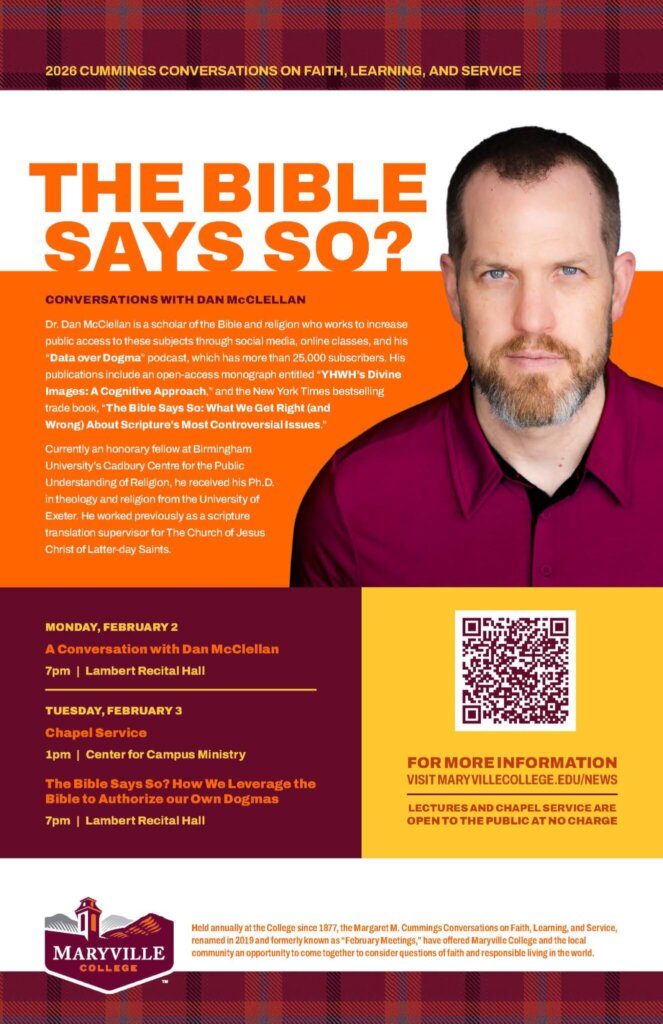
Questioning Scripture, inviting dialogue: Dan McClellan to lead Cummings Conversations at Maryville College Feb. 1-3
Jan. 15, 2026
EDITOR’S NOTE: Due to the inclement weather, the Cummings Conversations event with Dan McClellan scheduled for 7 p.m., Monday, Feb. 2, has been moved from the Lambert Recital Hall to the Samuel Tyndale Wilson Center for Campus Ministry (CCM). Parking will be in the lot between Fayerweather Hall and Cooper Athletic Center. Directional signs to the CCM will be posted. Tuesday events are expected to continue as announced. This story has been edited to reflect the location change.
For many Christians, the Holy Bible is considered the infallible, inerrant word of God, and to question any of its content is to border on the blasphemous.
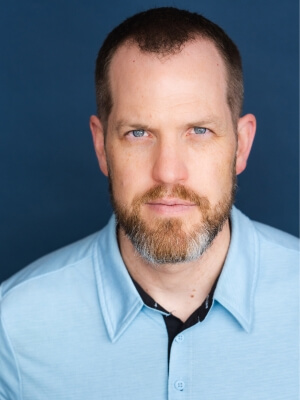
Dan McClellan, however, thinks otherwise. A biblical scholar whose work is centered around the academic study of Christianity’s holiest book, as well as pushing back against misinformation and misinterpretation of the texts contained therein, McClellan will serve as this year’s Cummings Conversations speaker, with several opportunities for the College community and members of the public to attend his talks when he visits Maryville College on Feb. 1-3.
The title of his 2025 book, “The Bible Says So: What We Get Right (and Wrong) About Scripture’s Most Controversial Issues,” will serve as the theme of this year’s Cummings Conversations. During a visit that will include three lectures that are open to the public, McClellan will lead an undoubtedly spirited and spiritual discussion of the ways that the Bible both informs faith and is shaped by history, culture and human interpretation — challenging audiences to consider not just what the Bible says, but how and why it has been used to justify belief, authority and action.
What the Bible ‘says’ — and who decides
“One of the central points of my book is that the Bible is a text that cannot speak for itself, and only has meaning to the degree a reader, listener or viewer generates meaning in the process of interpretation, which I describe as a negotiation between a variety of different factors, including our social, historical, and rhetorical circumstances, any received tradition, and our rhetorical goals,” McClellan said. “As a result, what the Bible seems to ‘say,’ particularly on more important social and moral issues, is more accurately what we are saying with the Bible as our authorization.”
Known as the Margaret M. Cummings Conversations on Faith, Learning and Service, the annual event is an opportunity for the College community to explore the intersections of faith and service, stemming from the charge by the institution’s founder, the Rev. Isaac Anderson, to “do good on the largest possible scale.” Formerly known as the February Meetings, the series was renamed in 2019 and gives an opportunity for guest lecturers from all corners of theology and academia to offer their perspectives via free lectures open to the public and the MC community.
McClellan earned his Ph.D. in theology and religion from the University of Exeter, and his research specializations focus on the conceptualization of deity, scripture and religious identity through the methodological lenses of critical Biblical studies, cognitive linguistics and the cognitive science of religion. In addition to a number of journal articles, book chapters, and dictionary and encyclopedia entries, he’s the author of “YHWH’s Divine Images: A Cognitive Approach,” and last year’s nonfiction book was a New York Times bestseller.
“We are excited to welcome Dan McClellan to campus to engage with our students, staff, faculty and the greater community,” said the Rev. Jessica Kitchens Lewis ’07, Maryville College chaplain and director of campus ministry. “He has an amazing way of making theology and religion accessible through a variety of media forms, and his approach to honest and civil discourse is refreshing. We hope his visit and speaking engagements will inspire others to dive deeper into scripture, but in a larger way, I hope his authentic and civil way of discussing hot topics will encourage all of us to speak with others across lines of division, no matter what they may be; to seek to understand one another; to share our perspectives; and to learn to listen curiously.”
“An awful lot of people have questions, doubts and concerns about the religious environments in which they were raised and/or in which they operate, but often don’t feel at liberty to express them, or sometimes even to privately entertain them,” McClellan added. “Just demonstrating that many of the kinds of disagreements that are discussed in my book are not only possible, but are standard fare for experts on these issues, can help broaden the horizons of those whose traditions may impose a degree of myopia or may make individuals feel like they don’t have permission to explore these issues.
“There is a large gulf between the way these issues are thought and talked about among scholars and the way they are thought and talked about in the streets and the pews. Closing that gap is one of the central motivations of my public scholarship.”
Permission to question
In other words, discussion of the Bible as a living, breathing document — open to interpretation, discussion and even debate — isn’t just permissible; it’s encouraged, and the first step for those who wrestle with issues of scriptural dogma is to give themselves permission to engage in such conversations. Even then, McClellan pointed out, there are some Christians who can’t bring themselves to critically examine the assumptions they’ve inherited about the Bible’s authority, origins and purpose, because doing so can feel like crossing an emotional or spiritual boundary that has long gone unquestioned.
“The Bible has long been understood as an inspired and inerrant document that rests at the foundation of billions of Christians’ understanding of humanity’s origins, purposes, and responsibilities,” McClellan said. “It is so deeply embedded in the worldviews and self-understandings of so many people around the world that thinking critically about challenges to that nature, origin, and function is just going to be a subconscious bridge too far for many people.”
Those up to the task, however, often find McClellan’s observations to be a discerning and dialectical guide to understanding persona biases that may cloud Biblical interpretation, as well as intellectual hurdles that stem from misunderstood semantics and contextual distinctions that don’t take into account the differences in interpretation and nuance between a writer in 1611, when the King James Version of the Bible was published, and a Christian experiencing life through a 21st century lens.
“Three of the most common presuppositions that modern readers of the Bible impose onto the text are those of inspiration, inerrancy and univocality,” McClellan said. “These largely derive from centuries of theological debate, but they’ve become embedded enough within the worldviews of most Christians today that they are intuitive and unquestioned, which means they operate as interpretive lenses that readers often don’t even realize are there.
“In addition to these broader assumptions, if we understand the Bible to divine guidance intended in some way for us, we’re going to project our own experiences and circumstances onto the text and interpret them in ways that make them maximally meaningful and useful to us, which is overwhelmingly going to distort what the original authors and editors were trying to accomplish with their texts.”
A great many Biblical intellectuals and scholars find such discussions to be invigorating, but there are a number of other Christians, McClellan points out, who feel as if his work is somehow an “attack” on the holy book of one of the world’s great religions. Nothing, he emphasized, could be further from the truth — and those who interpret it as such, he added, often conflate scholarly discourse with an agenda that’s actually a reflection of their own ideology.
“I certainly don’t intend to destabilize faith, and am a person of faith myself, but that does seem to be how a lot of people understand the impact of my work,” he said. “I would be lying if I said my work is entirely consonant with everyone’s faith, but I also hear from multiple people every day that my work has helped them to restore or renew their faith. I’m trying my best to accurately represent the data and the current state of the scholarship, which needs to have a seat at the table of public discourse.
“The folks who feel most threatened by that tend to be those whose faiths prioritize dogmas that facilitate the structuring of power, values, and boundaries in ways that serve their own interests. So in my experience, it’s more threatening to identity politics than to faith in and of itself.”
As a primer for this year’s Cummings Conversations, McClellan invites those on the fence about attending to engage with his content on social media and seek out portions of his book online. Such exposure, he said, will “give someone a pretty good sense of what I’ll be talking about and where I’ll be taking things,” and more importantly, should give those who wish to attend and engage a clear-eyed sense of what to expect from the conversation — one grounded not in provocation for its own sake, but in careful, historically informed scholarship that values curiosity over certainty and invites participants to think more deeply about how sacred texts are read, understood and used.
“More than anything else, I’d like people to walk away realizing the Bible is so much more fascinating and complex than they may have imagined before attending the event,” he said. “If I can help make people excited to learn more about the Bible through the lenses of critical scholarship, I will consider my job to have been successfully done.”
Cummings Conversations events open to the public include “A Conversation with Dan McClellan and Dr. Phillip Sherman” at 7 p.m. Monday, Feb. 2 in the Samuel Tyndale Wilson Center for Campus Ministry (CCM) (Sherman is a professor of religion and chair of the Division of Humanities at Maryville College); a chapel service at 1 p.m. Tuesday, Feb. 3 in the CCM; and a lecture at 7 p.m. Tuesday, Feb. 3, in the Lambert Recital Hall of the Clayton Center for the Arts.
For more information, email Lewis at jessica.lewis@maryvillecollege.edu.