


Text: The Nature Conservancy’s Jennifer Morris delivers the 2026 Maryville College Commencement address
May 11, 2026
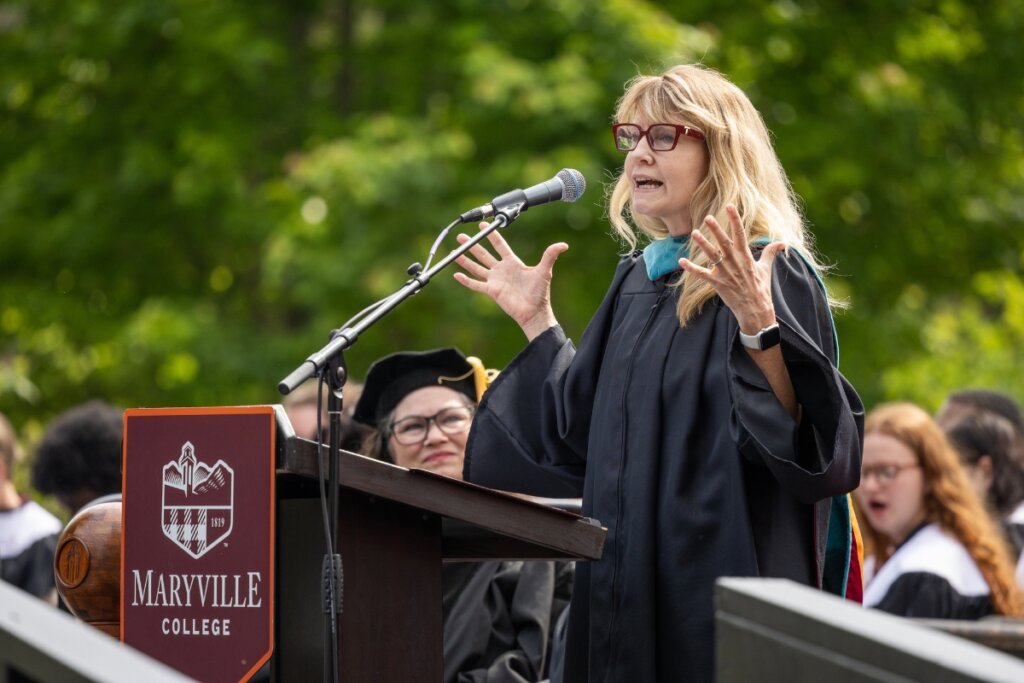
Jennifer Morris, CEO of The Nature Conservancy, who leads a team of almost 6,000 staff working in more than 80 countries and territories to tackle the dual crises of climate emergency and biodiversity loss, delivered the Maryville College Commencement address to the Class of 2026 on May 9, 2026, in Humphreys Court on the Maryville College campus. Here is the full text of her address.
Hello, Maryville Class of 2026!
And good morning to the faculty and staff who have guided these students, to the parents and families who have supported them, and most importantly — congrats to the 207th graduating class of Maryville College, on this beautiful spring morning in the Great Smoky Mountains.
Thank you, Sen. (Bill) Frist, for that generous introduction, and thank you to President (Bryan) Coker for this wonderful invitation.
I am truly honored to be here with you today to share just how essential YOU ARE to the world that you are about to inherit.
As the CEO of The Nature Conservancy, the largest environmental nonprofit in the world, you might expect me to talk about the climate crisis, or the urgent loss of biodiversity.
Or perhaps about the Appalachians themselves — this awe-inspiring, ancient web of mountains, streams, valleys, and forests, stitched together over millions of years into a living landscape where water, plants, wildlife, and people are beautifully connected.
And while these topics matter deeply to me, today — here, now — I believe that in order to do the work needed to care for this beautiful planet we call home, there is something even more important to talk about.
And that is courage. Specifically, what it means to lead with courage.
I sometimes describe myself as an unlikely CEO. Because when I was sitting where you are, listening to my own commencement address, I had absolutely no idea that my path would lead me here. But I can tell you this: a defining part of my journey was learning how to crush fear.
And the only way to crush fear … is with courage.
Today, I want to talk with you about three kinds of courage that have served me well:
The courage to say yes,
The courage to say no, and often the hardest one …
The courage to say I don’t know.
So first — to have the courage to say yes — you must believe that your dreams, and the steps required to reach them, are bigger than your fear of the unknown.
For me, that meant leaving home at 21 after my own college graduation to live in a tiny town in Japan where almost no one spoke English — and I spoke only halting Japanese.
Back then, there was no Google Translate. No smartphones. Just lots and lots of discomfort and a ton of humility.
Later, it meant saving the money I had earned in Japan to fulfill a lifelong dream to live in Africa, and moving to a remote village in northern Namibia — trying to learn yet another local language, and joining a community in which I was very much a stranger.
None of that felt safe.
But my dreams were indeed bigger than my fears.
When you’re young, your risk tolerance should be very high. Find the dreams that are bigger than your fears.
The courage to say yes is what launches your journey.
And one yes, usually leads to another — and every one of those “yeses” shaped who I became.
Closer to home, we’ve seen this kind of courage right here at Maryville.
When President Coker began his role in 2020, he stepped into leadership at one of the most difficult moments imaginable. Campuses were shutting down. Budgets were strained. Leaders everywhere were being told to simply play it safe.
Early on, I understand your President faced a decision about RT Lodge — a historic place deeply woven into the college’s identity. The easier path would have been to walk away. Many leaders would have.
Instead, he asked a different question: What kind of college do we want to be when things get hard?
He chose to stand up for something that mattered. It required courage — the kind that chooses long-term values over short-term comfort.
Today, I understand, RT Lodge is thriving. And that story reflects a truth you’ll encounter again and again: saying yes often means accepting risk — but also opening the door to becoming the fullest version of yourself.
Now, the second kind of courage I want to share is the courage to say no.
In life, the things you choose not to do matter just as much as the things you choose to do. And the moments when you refuse to go along with the crowd — those moments shape who you become.
In this audience today is someone who understands this deeply: Lamar Alexander.
Throughout his career — as Governor of Tennessee, president of the University of Tennessee, U.S. Secretary of Education, and U.S. Senator — he repeatedly faced moments where the right decision was not the popular one.
He stepped into office during a political crisis because restoring trust mattered more than avoiding controversy. He pushed for education reforms that challenged entrenched systems because progress requires discomfort.
Again and again, Lamar chose long-term impact over short-term approval. And because of that, millions of doors were opened for students and families.
Leadership will ask this of you too.
There will be moments when saying no costs you something. But those are often the moments that define you the most. In fact, leadership in our polarized world will challenge you in new and often unexpected ways.
You are graduating into a complex world. A world shaped by technological change, geopolitical tension, climate disruption, and deepening division—not because of one single crisis, but because many challenges are colliding at once.
That is exactly why courageous leadership now is so important.
The greatest risks we face are not just external threats. They also include:
- The failure to cooperate when collaboration is harder,
- The failure to tell the truth when misinformation spreads faster,
- The failure to invest in the long term when short-term fixes feel easier.
Courageous leadership does not mean having all the answers. It means being willing to act anyway. To stand up for facts, for people, and for the future — even when doing so is uncomfortable or uncertain.
And in this context, I don’t think it is possible to send you out into the world without a brief word on AI.
There is no doubt that the changes that are coming to the job market feel scary.
However, I believe — and I am sure that President Coker and your professors also believe — that there is good news for Maryville graduates.
And that good news is that employers increasingly cite liberal arts majors as well-suited for the technological upheaval facing our world.
Your foundation in critical thinking will help you master complexities and apply your skills to policy interpretation, ethics and complex communications, caring for and educating your communities – areas where human intelligence is far superior to artificial intelligence.
And I have a challenge to you all — and that is to have the courage to step away from your computers and screens and open your ears and simply listen.
My mom, who has Appalachian roots, shared these poignantly succinct words with me when I was about your age — she said, “Jennifer, I never learn much when I am talking.”
But as I have learned, deep listening isn’t just about being quiet — it means challenging your own worldview and being able to admit when you might be wrong. This is something we should all aspire to — both in our closest relationships and in our careers.
This is the third kind of courage — the courage to simply say, “I don’t know.”
In the conservation sector, we need to do this all the time.
One of my mentors and The Nature Conservancy board member, Fawn Sharp, reminds me of this. Fawn is a tribal leader from the Quinault nation in Washington state and a passionate international activist and legal scholar.
Fawn has shared with me that if you are not Native American, you will never know, can never know, the inter-generational trauma of indigenous people.
But she showed me that if you can have the courage to admit you don’t know — and can simply listen to the needs of others, then you can help in a powerful way.
For me, that action has turned into a personal passion.
At The Nature Conservancy, we now have a commitment to returning tribal land and bison back to their original stewards.
As The Nature Conservancy celebrates its 75th year, my hope is that this kind of intentional action will be a legacy for people and nature — and inform our path for the next 75 years.
This is one of many ways in which I needed the courage to say that I won’t ever really know, but I can act — and so can you — in wherever your path leads you.
Now, when we talk about courage, it’s easy to imagine it showing up later — when you have a title, or experience, or authority. But some of the most important moments show up much earlier than that.
In the years leading to this day, your courage was demonstrated raising your hand in class even when you weren’t sure if you had exactly the right answer.
Or the courage to get out of your comfort zone and make a new friend who had different beliefs from you, or importantly, simply to ask for help.
Courage shows up when you seek clarity instead of staying silent.
Courage comes forward when you need to respectfully disagree — not to win, but to understand.
And yet again, this is where your education shines.
Because what shaped you here at Maryville is not just what you studied — but where you studied it.
Place matters.
The Appalachians are not just a backdrop to your education. They are a teacher.
As you all know, the Appalachian region is of the most climate-resilient, biologically diverse, and carbon-rich landscapes in the world. As King Charles reminded the US Congress during his state visit: Once joined with Scotland millions of years ago, this ancient chain of forested mountains, valleys, wetlands and rivers nurtures a rich variety of wildlife, cultures and communities.
That’s why this place is so rare — and why it matters far beyond Tennessee: it’s a living reminder of our planet’s natural riches, and the climate resilience we need to safeguard as the world changes.
Whether seeking refuge from warming temperatures and extreme weather events, or migrating along an ancient flyway, this region provides wildlife with a healthy and connected network of lands and waters — but only if we protect it.
These mountains carry a long memory — of resilience and hardship, of community and craft, of people who learned to rely on each other and to live with a deep respect for the land that sustains them.
Here, history isn’t abstract. It’s personal.
Community isn’t a slogan. It’s a practice.
That unique blend of people, place, and perspective has a way of shaping you.
It teaches patience in a world that rushes. Humility in a national culture that currently rewards certainty.
And responsibility — to one another, and to the places we call home.
At Maryville, you learned how to listen carefully, think critically, and speak thoughtfully — not just in classrooms, but in community.
At Maryville you built the foundation for moral courage — which requires learning how to use your voice responsibly, even when your knees shake a little.
My own road started with a liberal arts degree in Political Science and English. I am proof that this education will serve you throughout your life and even sometimes surprise you.
In fact, even classes that you or your parents aren’t quite sure will be of any use to you in life might surprise you.
For example, I will never forget when I called my parents from college to tell them that I was really excited about an anthropology class I was taking — called Tribal Peoples of Papua New Guinea – and the very long silence on the phone from my engineer father said it all.
But, years later, I called him back from Papua New Guinea where I was working to tell him how much that class I helped me in my work — so you just never know!
I now have the honor of sitting with political leaders around the world, CEOs, tribal leaders, teachers, scientists, artists and I can tell you that the ones who make the greatest difference are not the loudest.
They are the ones willing to lean into hard decisions. To sit with nuance when simplicity is tempting. To lead with integrity when certainty is impossible.
To make human connections.
In April of this year, we all witnessed something that brought the whole planet together for a moment — the Artemis II mission. Much like generations before, we got a chance to witness a moment of both human ingenuity and the human spirit.
I found the reflections of one of the astronauts — Victor Glover — incredibly touching.
He described what it feels like to see Earth from space. He shared that from above our planet isn’t divided or busy or loud. It’s one whole thing — small, fragile, and alive — surrounded by vast darkness. An oasis. A single home. And all of us, together, the crew of what he termed “Spaceship Earth.”
That perspective stayed with me because it’s not just beautiful — it’s bracing. It reminds us that there is no backup planet. No other crew. The future of this place depends on what we choose to do for one another, and for this world, right now.
As you leave here today, stepping into a world that can feel complicated and divided, I hope you remember that bigger view. And the work ahead — protecting what is beautiful, fragile, and shared — will require your courage:
To say yes, to say no, and to say I don’t know.
So, to the Maryville graduating Class of 2026: The future of Spaceship Earth is in your hands.
And remember: the only day MORE exciting than today, is TOMORROW. Go grab it! Congratulations to you all!