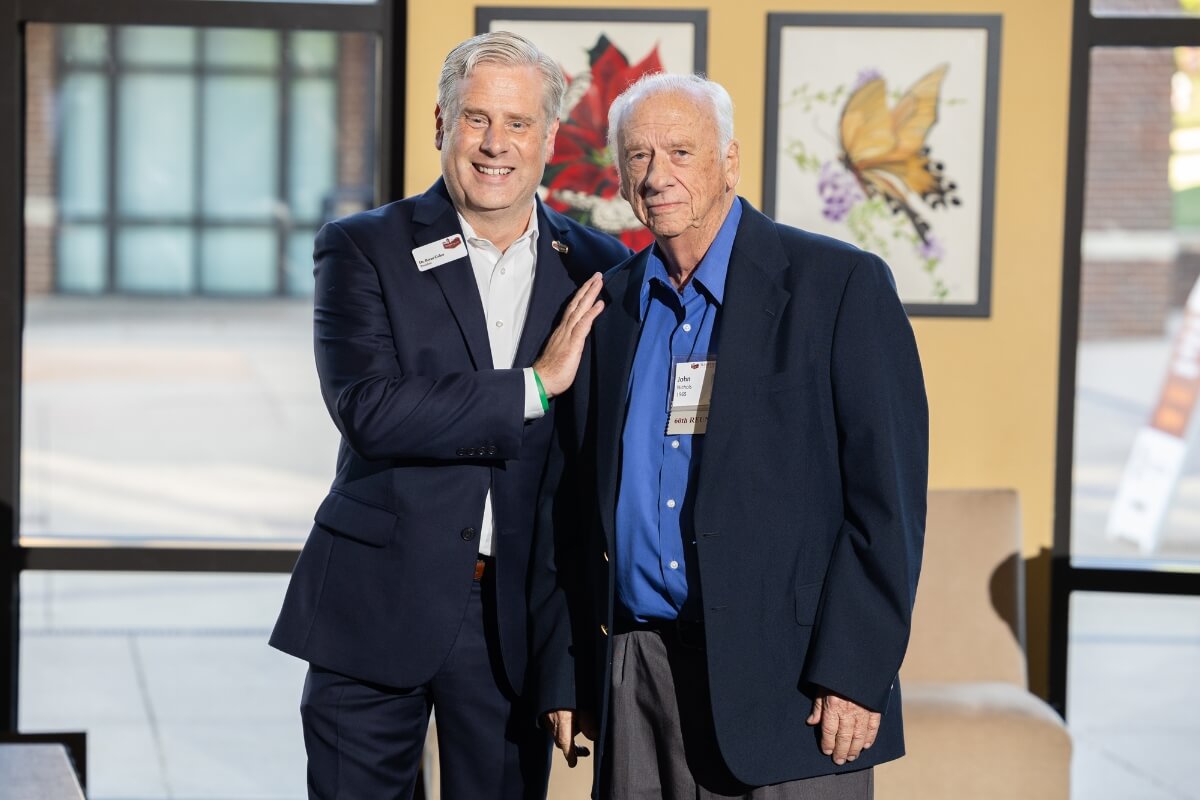
John Nichols ’65 establishes scholarship endowment for top mathematics, computer science students
Nov. 10, 2025
The decision Dr. John Nichols ’65 made recently to endow awards for students in math, computer science and statistics at Maryville College was influenced more by a dean’s introduction in orientation class 60 years ago than what he learned in the upper-level algebra and geometry classes that played such a role in his life as a student and professor.
“They had the whole freshman class in Wilson Chapel, and Dean [Frank] McClelland talked with us,” Nichols remembered. “He said, ‘This is a liberal arts college, and we are going to liberate you from previous prejudices and things you may have picked up from your families or communities. We’re going to educate you, free you up, liberate you’ — he emphasized liberate — ‘to make your own decisions in life.’ And that I have never forgotten. A liberal arts education opened my mind.”
Preparing for his 60th class reunion earlier this year, the 82-year-old, who retired from MC in 2012 as professor emeritus of mathematics and computer science, decided to make a donation in support of an institution that is still committed to opening minds.
“It just helps you deal with life in the world and all the issues that you face,” he said of his liberal arts education. “I had the freedom to be a learner.”
Nichols’s endowment is also in support of a discipline and division near and dear to his heart. He joined the faculty in 1967 and, except for two years off to earn his doctorate, taught continuously for the next 44 years. He said he hopes the Dr. John Nichols Award for Excellence will reward high-achieving students in math, computer science, and statistics with a scholarship that gives them the encouragement and financial assistance to persist to graduation.
Those are, after all, what he received from Maryville College as an undergraduate. Today, he considers them miracles.
From ignored to valedictorian
“I was a poor kid,” Nichols said of his childhood in nearby Walland. “I didn’t dress well compared to other students, and I was kind of looked down upon.”
Looking back, Nichols said his elementary school teachers largely ignored him, rarely helping him catch up to the academic levels of his classmates. However, a high school math teacher who was unconcerned with Nichols’s socio-economic status and background discovered and nurtured the adolescent’s aptitude for math.
For several years, that teacher entered Nichols into the Tennessee Math Teachers Association (TMTA)’s regional math contests held at Maryville College. There, Nichols met his future mentor, Dr. Marion “Mac” Tolar, for the first time. Nichols never took home a trophy, but the competitions helped him see himself as a serious, capable student. He graduated valedictorian of Walland High School in 1961 and enrolled at Maryville College that fall.
Miracles recognized
“I came to Maryville College, wanting to major in math, and I did score high enough to get in the advanced math class as a freshman,” Nichols said. “There were blackboards all the way around this classroom in Fayerweather Hall. On the first day of class, Dr. Tolar did sort of like a TV game – tossing out questions to us at the blackboard, and whoever got it first, moved up. Well, at the end of that first day, I was dead last, and I was so depressed.”
After making a D minus on an exam, Tolar called Nichols to his office.
“He said, ‘I’ve been watching you. Your algebra background is not as good as these other students.’ And he pulled a book off his shelf and said, ‘Every minute you have free, catch up.’ And I did. I think I made a B plus in that class, but then I moved to the top, and then got the top award as a senior in mathematics.”
This MC alumnus counts his relationship with Mac Tolar among the miracles in his life.
Another miracle presented itself when, as a junior, he ran out of money but secured a loan that helped him not only continue his education but continue on to a master’s degree.
A commuter at MC for all four years, Nichols worked weekends and summers for the Jarvis Family, then owners of Blackberry Farm, helping with the operations of the hotel.
“That was my source of income,” he explained. “I got one $500 scholarship from a local organization, and other than that, I paid every penny for books and tuition. I flat ran out of money in the middle of my junior year. I went to the College’s Financial Aid Office, and they helped me apply for a new federal grant. It was called the National Defense Loan. I was able to get the money to finish college and didn’t have to start paying it back until after I got out of graduate school or the military.”
As an undergraduate, Nichols’s plan was to become a high school math teacher, but student teaching revealed that was not the path for him. Teaching at the college level, however, did interest him, and a teaching assistantship at the University of Tennessee-Knoxville confirmed his plans. Earning a master’s degree in 1967, he soon returned to his alma mater as instructor of mathematics.
Another door opened in 1969 when he and four other MC professors received grants and time off to complete their doctorates through the National Teaching Fellows Program. Nichols finished at UTK and added “Ph.D.” to his name in 1972. The following year, he earned tenure.
Additional contributions
Nichols’s contributions to his alma mater didn’t start with the 2025 endowment donation.
He was instrumental in the development of programs and curricula offered by the current Math and Computer Science Division. Soon after he joined the faculty, he and colleague Dr. William Dent ’57 established a dual-degree engineering major with Georgia Tech that eventually expanded to other universities. They also collaborated on new majors in computer science and courses in statistics that were available to all majors. In addition to teaching and advising in the fall and spring semesters, his Interim (three-week) experiential courses explored Colonial Williamsburg, taught students basic car mechanics, and showed students how to build a dulcimer.
He chaired his division from 1999 until 2010, hiring many of the faculty who now teach math, computer science and statistics inside Sutton Science Center. He devoted years to collecting and analyzing data regarding faculty salaries and student retention, then wrote reports that empowered administrators to make informed decisions about resources.
Nichols also wrote or helped write grant proposals that provided funds for research, professional development and much-needed technology. And in what must have repeatedly felt like a full-circle moment, he coordinated the Section E-6 testing for the TMTA’s annual state-wide high-school math contest (the same one that introduced him to Mac Tolar) for several years.
He described Maryville College as his “second home” and is grateful for it. He was proud to see daughter Melissa Nichols McLaughlin ’93 follow in his footsteps as a Scot, and he enjoyed friendships with faculty and staff colleagues across the campus.
“I’ve not become a billionaire or anything like that, but I’ve lived a good life. I enjoyed everything there is about life – art and history, my science fields and everything, and the college liberated me from previous beliefs and ways of thinking and gave me a future,” he said. “I wanted to give back.”
Rewards and awards
Nichols regularly checks in with Dr. Jeff Bay, current chair of the Math and Computer Science Division, to ask about enrollment, innovations and opportunities. Satisfied and thankful that the College still values its liberal arts foundation and commitments to undergraduate teaching and research, Nichols began talking months ago with Bay and Professor of Mathematics Dr. Maria Siopsis about a donation. Working together and with Eric Bellah, director of development, they drafted a plan to recognize outstanding sophomore and junior students in the division.
The first Dr. John Nichols Awards for Excellence will be announced at the Celebration of Student Achievement in April 2026, with tuition dollars dispersed to winners’ accounts for the following fall semester.
“I wanted to reward people who were really doing well, encourage them to stay in math, you know, because I loved it so much,” he said. “And it’s a very important field. Mathematics is the language of science – without it, you could not have physics, chemistry, biology, or even some social sciences now.”
Maryville College President Dr. Bryan F. Coker led the applause for Nichols during the October Founder’s Day Showcase, when the endowment was publicly announced and the professor emeritus was recognized for his donation.
“Throughout his 44-year career at Maryville College, John Nichols was incredibly generous to his alma mater with gifts of time, talent and treasure, and it is humbling to see that, years after his retirement, John remains as committed to this place,” Coker said. “The establishment of the Dr. John Nichols Award for Excellence will result in financial assistance to deserving students, and I hope recipients will also be inspired by John’s own career in mathematics and his passion for the liberal arts.”
To donate to the Dr. John Nichols Award for Excellence or request information about establishing an endowment, contact Eric Bellah at 865-981-8225 or eric.bellah@maryvillecollege.edu.