


‘Pretty music’ for a good cause: Maryville College’s Dr. Hugh McCampbell ’66 gives back for a life so well-lived
Feb. 16, 2024
Even before he got to Maryville College, Dr. Hugh McCampbell ’66 wanted to experience everything life had to offer.
Growing up on a dairy farm in northeast Knox County, Tennessee, he loved animals and people, music and athletics, hard work and having fun. Those are traits that have remained lifelong ones, and while he may be a retired large animal veterinarian, he still works hard — to entertain and make folks laugh, but also to “do good on the largest possible scale.”
With a servant’s heart born of a deep and abiding faith, honed through an education at MC that was accompanied by some of the best times of his life, he remains committed to that credo. At 7 p.m. March 16, McCampbell will perform his 16th Annual Benefit Veterinary Piano Concert in the auditorium of Sweetwater Elementary School, 301 Broad St. in Sweetwater. (Tickets are $15 for adults, $10 for students and free for small children.)
It’s a way of giving back, he says, that allows him to live his faith out loud … and have a good time doing so.
“I’m paraphrasing here, but 1 Peter 4:10 says to use all of your gifts, abilities, talents and experiences for the benefit of others,” McCampbell says. “We had four courses in Bible at Maryville College back then. Two of these I took were the Old Testament Book Studies and the Study of Paul’s Letters. Paul’s letters will teach you how to live, and I kind of took to that.
“Being a large animal veterinarian, you’re helping people make a living, and if you choose that lifestyle, you must attend. I’d get a call about a colic horse at 2:30 in the morning up in the mountains, and when I’d get there, some folks expected me to be mad about getting called out in the middle of the night. And the first thing I’d do is say, ‘Well, animals sure can’t tell time, can they?’ And I’d give them a big grin and just do the best job I could.”
A Maryville College heritage
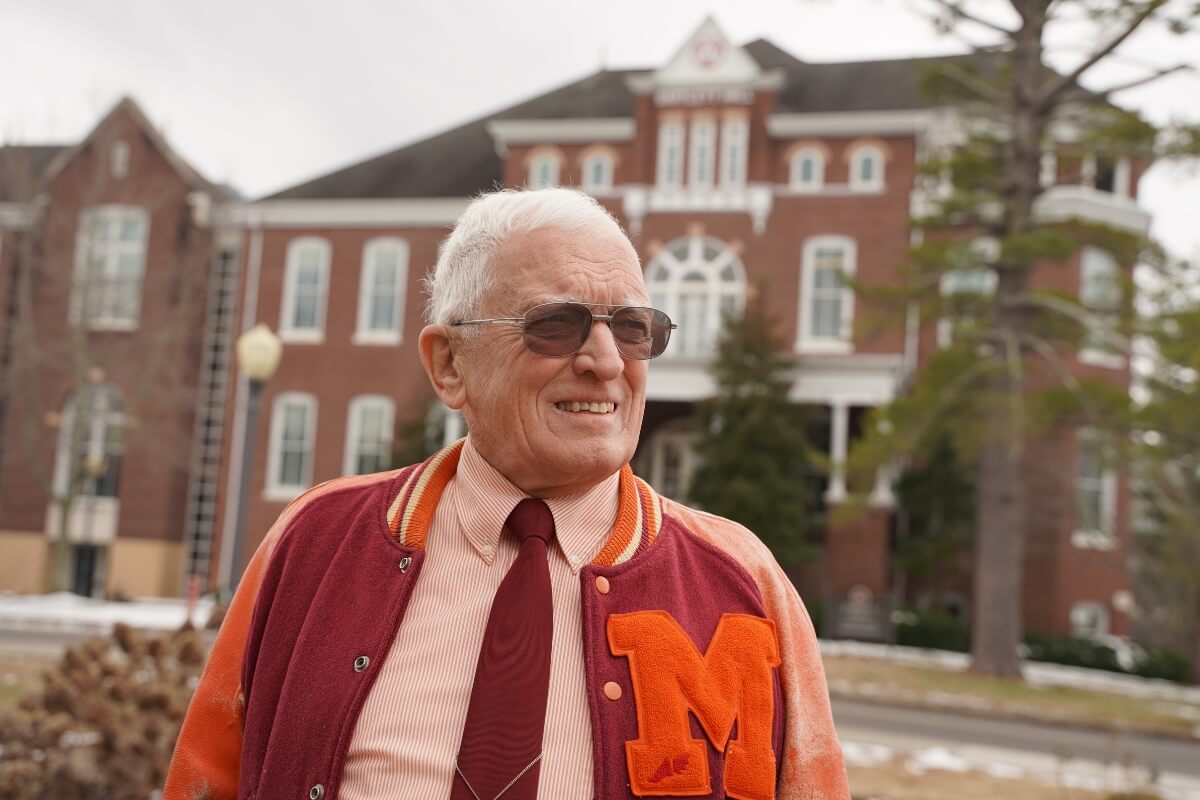
In a way, McCampbell seemed destined to go to Maryville College. The school founder — Rev. Isaac Anderson of the “do good on the largest possible scale” credo that continues to inform the school’s mission — is his great-great-great uncle, and the traditional log home in which he lived before founding the College sat about two miles from where Hugh McCampbell grew up. (Thanks to the efforts of College and area preservationists, it was moved to and restored at the Great Smoky Mountains Heritage Center in Townsend in 2019.)
“The Andersons and the McCampbells intermarried and were neighbors forever in Northeast Knox County, and he was just somebody that people would talk about,” McCampbell says. “I went to Shannondale Presbyterian Church, which the McCampbells gave part of the land for, and sometimes a pastor from Maryville College would come over to preach. And then my great-aunt, Nellie McCampbell, was the private secretary to Susan Wiley Walker (who built the Morningside manor now known as RT Lodge) and taught Latin at the College, so I was always hearing something about Maryville.”
Though small in stature — starting high school at roughly 97 pounds, he adds with a chuckle — he could run, and on the track team, he enjoyed a modicum of success. A smaller school, he reckoned, might give him an opportunity to step out of the shadows of his bigger peers, and so at MC he started out playing football during his first year on what was nicknamed “the hamburger squad.”
One afternoon while lifting weights in the old Bartlett Hall gym, Coach John “J.D.” Davis ’30, himself a former standout Scot in three sports, encouraged him to give wrestling a try, and he joined that team for two years. He used wrestling to prepare for track season, where he ran the half mile, the mile and the two-mile at most meets. He didn’t set any records, he says, but scored quite a few points.
A French horn player after switching over from trumpet, he was at a reception for new students his first Sunday on campus when John Roberts, director of the MC band and orchestra, also recruited him for his instrumental abilities.
At Maryville College, he says, he learned to try a little bit of everything in order to prepare him for anything … another slogan still practiced today by current Scots.
“I made good friends here, too, and a very important thing to me today is keeping up with my Maryville College friends,” he says.
And so began a routine in which McCampbell, in addition to carrying a full class load, would hustle from football practice to orchestra rehearsal with a short pitstop for dinner in Pearsons Hall. Roberts recognized his natural musical talent and began to recruit him for other roles as well, including playing guitar in the orchestra pit for campus musical productions like “The Fantasticks,” “Sound of Music” and “Bye Bye Birdie.”
“Folk music was the craze back then, so everybody could play guitar or banjo. I’m sure there were other Maryville College guitar players who could read music, but I was already in the orchestra,” McCampbell says. “Some of these pieces were in odd keys, which are difficult for some people, and that really helped me when I started playing the piano. I learned chord progressions and different keys through playing the guitar in Maryville College musicals.”
Music and more as an MC Scot
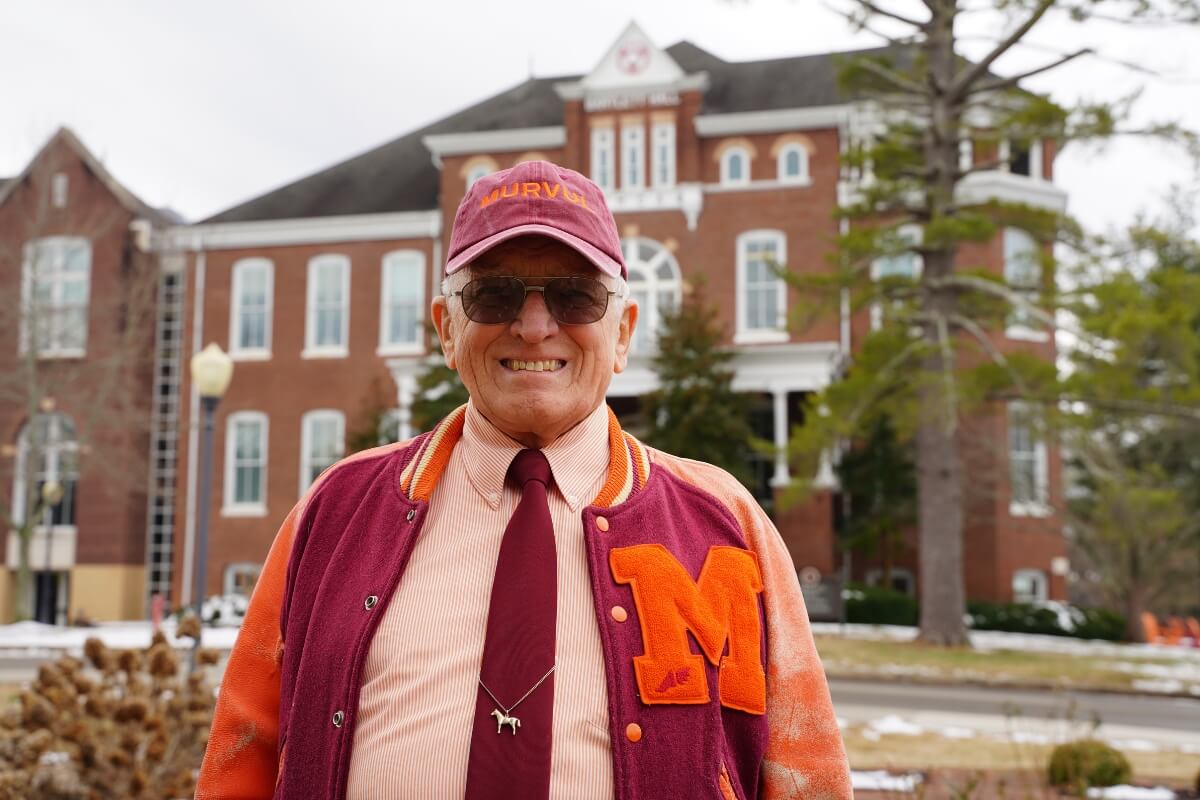
It was also during his freshman year that McCampbell and some friends decided to put together a rock ‘n’ roll band for an MC freshman talent show. The acoustic guitars were swapped for electric ones, and along with George Derbyshire ’66, Sonny Hughes ’66, Pridi Malasitt ’66 and fellow first-years Bob Dunsmore and Cliff Henderson, The Blue Shades became a hit in the spring of 1963.
“The personnel would change from year to year, but we played for high school formal dances, UT fraternity parties a time or two, and a lot of dances here on campus,” McCampbell says. “In the old intramural gym, there used to be an after-dinner dance every night after supper, from 6:30 to 7:15. They had a disc jockey, but frequently, The Blue Shades would play, and a lot of the student body would turn out to dance.”
In 2011, for the Class of 1966’s 45-year anniversary, the 1964-65 version of the band reunited to play at Maryville College’s Homecoming. McCampbell was joined at the time by Dr. Rolland Prudhon ’65, Russ Bright ’68 and the Rev. Dr. Ken Arentson ’67. In dusting off classics by Buddy Holly and the Beatles, they rolled back time for a little while that day at Homecoming 2011, remembering the halcyon times of the early 1960s when social societies like Kappa Phi-Chi Beta and Alpha Sigma-Theta Epsilon were still an active part of MC social life.
“We would practice at the Alpha Sigma house (a small building on campus at the time, he recalls) many Thursday nights starting at 9:30, and back then, the girls had to be back to the dorms by 10:30,” he says. “People would stand on the couches and dance, because there wasn’t a lot of room, and then about 10:27, the girls would start sprinting back to the dorm.”
Along the way, McCampbell worked toward a biology degree, carrying out practical research in addition to hitting the books. He points to a tree near the Center for Campus Ministry and recalls how as part of his independent studies, he noticed that the ground beneath the tree was bare. Capturing runoff from it, he tested the difference between water filtered through the beech tree and unfiltered rainwater on grass seed germination.
“I got a good foundation in the sciences with biology and chemistry,” he said. “I came to Maryville College wanting to be a park ranger, because I loved the Boy Scouts, and I loved being in the woods. But then I realized you couldn’t make much money until you get more and more of a desk job, so I left here wanting to become a college professor.”
A full-circle journey
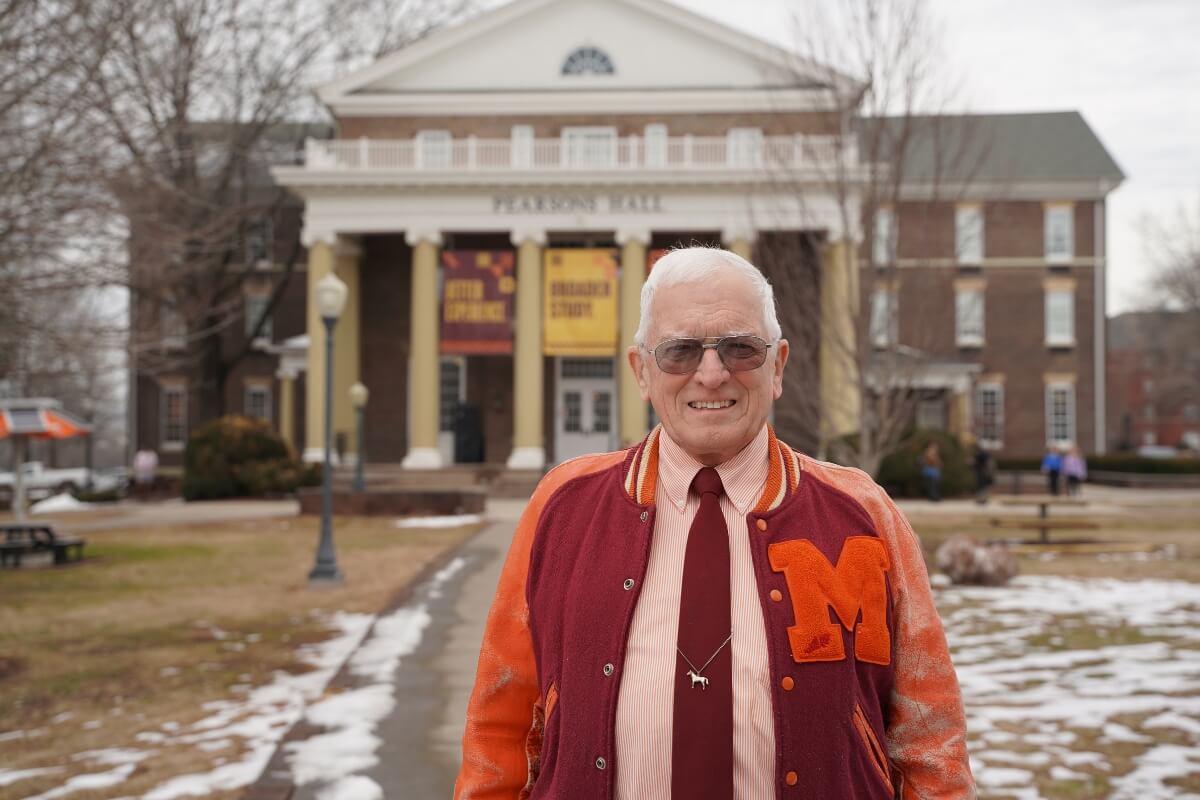
He thought he had it all figured out: He’d get a master’s and a Ph.D. and teach at a small school, maybe even back at MC. He’d coach track and play in the orchestra and own a little farm outside of town, where he’d invite students over to learn and work and mentor. Life, however, had other plans, and after graduation in 1966, he went to Iowa State University, where he completed his master’s in biochemistry and entomology. It was there he met his wife, Marty, whom he married in 1968. They moved to Alabama, where he enrolled in Auburn University’s College of Veterinary Medicine. To avoid being drafted out of school, he took advantage of the U.S. Army’s early commissioning program to finish his doctor of veterinary medicine and serve two years in the U.S. Army Veterinary Corps, where he earned a pilot’s license and learned to calf rope, team rope steers and make saddles.
After being discharged, he worked with beef cattle and horses in Oklahoma and continued his quest of lifelong learning. By 1975, the McCampbell family was headed back to Tennessee, where he opened the Sweetwater Veterinary Clinic in 1975 … after renovating a Western wear store. Over the next several decades, he became one of the preeminent large animal veterinarians in East Tennessee, earning a teaching spot at the University of Tennessee for 13 years before returning to private practice in the late 1990s.
Although he retired in 2013, he remains involved with various professional organizations and local civic groups and even competes in swimming in the Tennessee Senior Olympics. From mission trips with the Christian Veterinary Mission to the Pine Ridge, South Dakota reservation of the Sioux to the piano bench for Christ Presbyterian Church in Sweetwater, he continues to try to do good … and that’s where the idea for the Benefit Veterinary Piano Concert came from, he says.
In 2007, the Tennessee Maiji Gakuin High School — a Japanese-style school for children of Japanese individuals and families living in the United States that acquired the old Tennessee Military Institute campus in Sweetwater — closed its doors for good and donated a Yamaha grand piano to the Sweetwater school system. It gave McCampbell an idea: a concert that would raise money for the Prostate Cancer Foundation — himself a 2007 prostate cancer survivor — as well as the local Boy Scouts and the Sweetwater Valley Citizens for the Arts, all organizations near and dear to his heart.
He held his first concert in 2008 in the old Sweetwater Elementary auditorium, and to his delight and gratitude, his mother was able to be in the audience for that one. She would die the next year, but to introduce one of her original songs, and then to ask her to stand and acknowledge the applause — which she did with a prim nod — which he found very gratifying and makes him grin today.
“I try not to play all the same songs I played last year, and I have all my flow charts from previous concerts to refer to,” he says. “I put together a mixture of piano and banjo songs and tales that I hope everyone will enjoy.”
It’s a conversation, of sorts, that tells his life story — a rich one indeed, accompanied by the “pretty music,” he jokes, that he started learning to play while at Maryville College. And despite the occasional downs, it’s been a life mostly of ups, and for that, he remains eternally grateful … and always on the lookout to “do good on the largest possible scale.”
“In 2022, I almost died from perforated diverticulitis,” he says. “I remember lying there in the hospital, planning my funeral, and on the fourth or fifth day, I woke up from a nap, and I felt so heavy, like I’d taken one of those three-hour Sunday afternoon naps. And then I felt something wrapping around me, starting down at my legs and working up my whole body, and that’s when I quit planning my funeral. It was the healing hand of the Lord … and it was real.”
He’s in tears at the recollection, but they’re ones of joy. It was, he believes, a gift of the divine, an acknowledgment from God that he would be OK, and that his work isn’t done. And just like all the ones before, he’s continued to try and make every moment count.
“I just look for things to do for people,” he says. “The way I look at it, the Lord let me keep living, and that’s a bit of a way to show gratitude. Growing up on a dairy farm where we worked just as a family, my daddy taught us how to work and enjoy it. Doing a job right the first time, and making it easier for someone else, was the thing he really emphasized. You only have one life to try and be a good friend to good ol’ friends.”