Alumna funds endowment to benefit Maryville College’s American Sign Language programs
Nov. 5, 2024
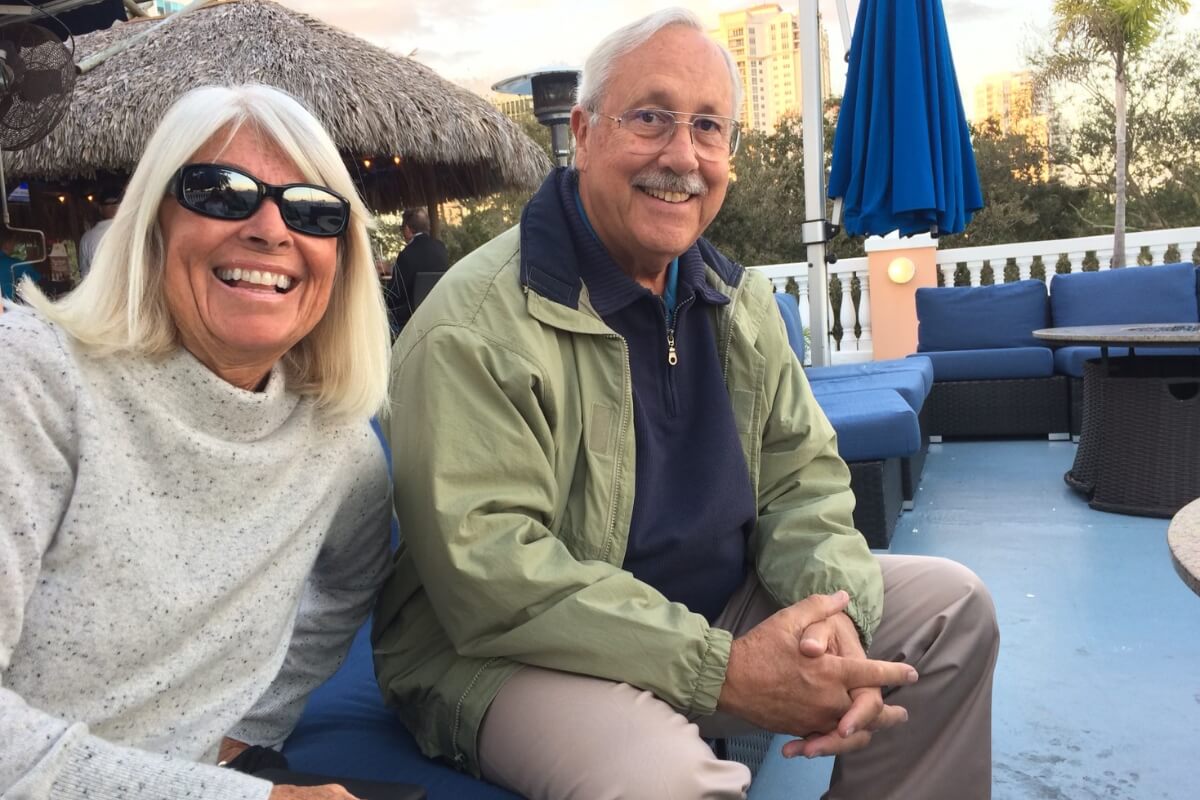
It wasn’t too long after she graduated from Maryville College that Gail Bock Garlinghouse ’68 realized there was something different about her baby boy.
A year after Jeff Garlinghouse was born, his parents moved to Southern California, where his father, Roland, went to work for the family business. Roland’s grandfather, Les, launched Garlinghouse Brothers — Gar-Bro Manufacturing — in 1923 to provide specialty equipment and engineering services to the construction industry.
Roland would eventually take over as owner of Gar-Bro from his own father, but in those early years, he worked in both design and shop management. One afternoon, he returned home from work and greeted his wife and infant son. The former acknowledged him; the latter did not.
“He was sitting in his high chair, with his back to the door leading from the garage, when his dad came in and announced he was home,” Gail says. “Jeff never turned around at the sound of his father’s voice.”
Once his dad entered his field of vision, he lit up, and the Garlinghouses realized that Jeff couldn’t hear. A visit to Children’s Hospital in Los Angeles revealed that he was “profoundly deaf,” Gail adds.
Empowered by this information, the couple immediately set out to help Jeff acclimate to the hearing world, and to teach him ways to embrace his deafness as a character trait rather than a deficiency. As an infant, he was enrolled in a program for deaf babies in Pasadena; afterward, he went to the Oralingua School in Whittier, California, until he was 10.
At that point, Roland had taken over as the president of Gar-Bro, and the city of Los Angeles no longer appealed to him as a business owner. When Jeff was 10, the Garlinghouses moved to Heber Springs, Arkansas, chosen as a place near the middle of the country where Gar-Bro had supplied equipment for a major dam construction project.
“Heber Springs was, and still is, a small town, and the schools there, and all the local residents, were always supportive of Jeff,” his mom says.
Jeff went to public school and excelled on the football field; at home, he and his father bonded over machines, a hobby that would lead to a lifelong love of motorcycles and snowmobiles, among other things.
“The bottom line is that my dad is my role model, and the key player who encouraged me to fall in love with anything motor-related,” Jeff says. “My dad believed in me and did not discourage me from trying those things due to my deafness. I have not experienced any stigma associated with the ability to drive those machines. You don’t have to worry about anything with these machines; you need only enjoy the vibration of the horsepower!”
No stopping ‘Jammin’ Jeff’
For years, Jeff was a competitive rider known as “Jammin’ Jeff,” competing primarily at Champion Speedway in Oswego, New York, often wearing the sponsorship patches of his dad’s company. He moved to New York to attend college at the National Technical Institute for the Deaf (NTID) at Rochester Institute of Technology, where he graduated with a degree in manufacturing processing. He spent 32 years as a CNC lathe machinist, eventually retiring in 2023.
Five years ago, he met his long-term girlfriend, Mistie Munton, through a Deaf social event in Rochester. A former American Sign Language instructor who also helped train medical students how to better communicate with Deaf patients, she’s helped Jeff develop a better understanding of Deaf culture, he adds.
“I feel so much better having a Deaf partner who understands where I come from, and we communicate much better through sign language,” he says. “Even my ASL has improved from being with her, because she grew up going to Deaf schools and was exposed to a lot of Deaf events, and she’s very familiar with Deaf culture.”
Today, Jeff and Mistie live in Fayetteville, Arkansas, where Jeff has a 22-year-old son who is hearing and also lives there. The couple found a church with interpreting services, but because it’s one of only a few in Fayetteville, Gail began to understand just how important ASL interpreting has been for their son’s success, and how the establishment of the Gail Garlinghouse endowment would fulfill critical needs for individuals like her son.
“He needed them for meetings at Kodak and later companies he worked for, at medical appointments, and at board meetings for Gar-Bro Manufacturing, where he is part of the board of directors,” she says. “Interpreters were fairly easy to obtain in Rochester, but not in other states.”
It felt like the right fit, then, that upon exploring ways to support her alma mater with staff members in the Maryville College Office of Advancement, the ASL-English Interpreting program — founded 50 years ago this year — became a possibility. Through talks with Director of Major Gifts Diana Canacaris ’02, Gail and Roland decided to fund the Gail Garlinghouse ’68 American Sign Language/Deaf Studies Endowment, the goal of which will be to strengthen the ASL-EI program by attracting more students and increasing its visibility, the goal of which is to “prepare skilled and qualified interpreters to work in a variety of interpreting environments.”
The $50,000 endowment was announced during Homecoming 2024 activities, and while the Garlinghouses were unable to attend, the ability to boost a program of study that might benefit future Jeffs felt too serendipitous to pass up, Gail says. Her son’s deafness didn’t define him, and it certainly never slowed him down, she says — “He never shies away from a new experience, whether it’s traveling around the country with friends, racing his Speedway motorcycle, or inviting family and friends to come over for dinner,” she says — but it did open a door for his parents to “do good on the largest possible scale,” according to Jeff.
“Mom feels strongly about establishing an endowment to strengthen and expand the interpreting program at Maryville College,” he says. “I remember growing up that mom talked about how much she loved this small, intimate college, and the program is doing necessary work. Interpreting is a demanding sort of job, and many parts of the country are in need of interpreting and interpreters.
“For example, in Rochester, there are roughly 60,000 Deaf and Hard-of-Hearing individuals, and because the National Institute for the Deaf is there, interpreters are plentiful. In contrast, Northwest Arkansas, where Mistie and I currently reside, has a very limited number of interpreters available, and many of them are older. We haven’t seen many diverse or young interpreters around here.”
And no matter how advanced technology becomes, there will always be a need for human interpreting, he adds. Knowing that his mother will help ensure MC produces them through the Gail Garlinghouse endowment is quite an honor, he says.
“Now, with technology so readily available nationwide, it makes everything much easier — but people shouldn’t think technology solves all communication problems for Deaf people, because we’re still in dire need of in-person interpreting,” he says. “What’s most important is that you reach out and communicate. I tell folks, just try to avoid assumptions and approach us to see if we’re able to communicate. We’ll usually let hearing people know what to expect when it comes to communication with us. The biggest thing is not to be afraid of Deaf people — we won’t bite!”
Donations to the Gail Garlinghouse ’68 American Sign Language / Deaf Studies Endowment can be made by contacting the Office of Advancement at advancement@maryvillecollege.edu or 865-981-8200.