Evil, hell and murder: Maryville College senior takes on a troubling trifecta of Humanities courses
Nov. 7, 2024
“But could you see its opposition / come rising up sometimes / seen its dreadful and position / come blacking in my mind / and that I see a darkness …” — Bonnie “Prince” Billy, “I See a Darkness”
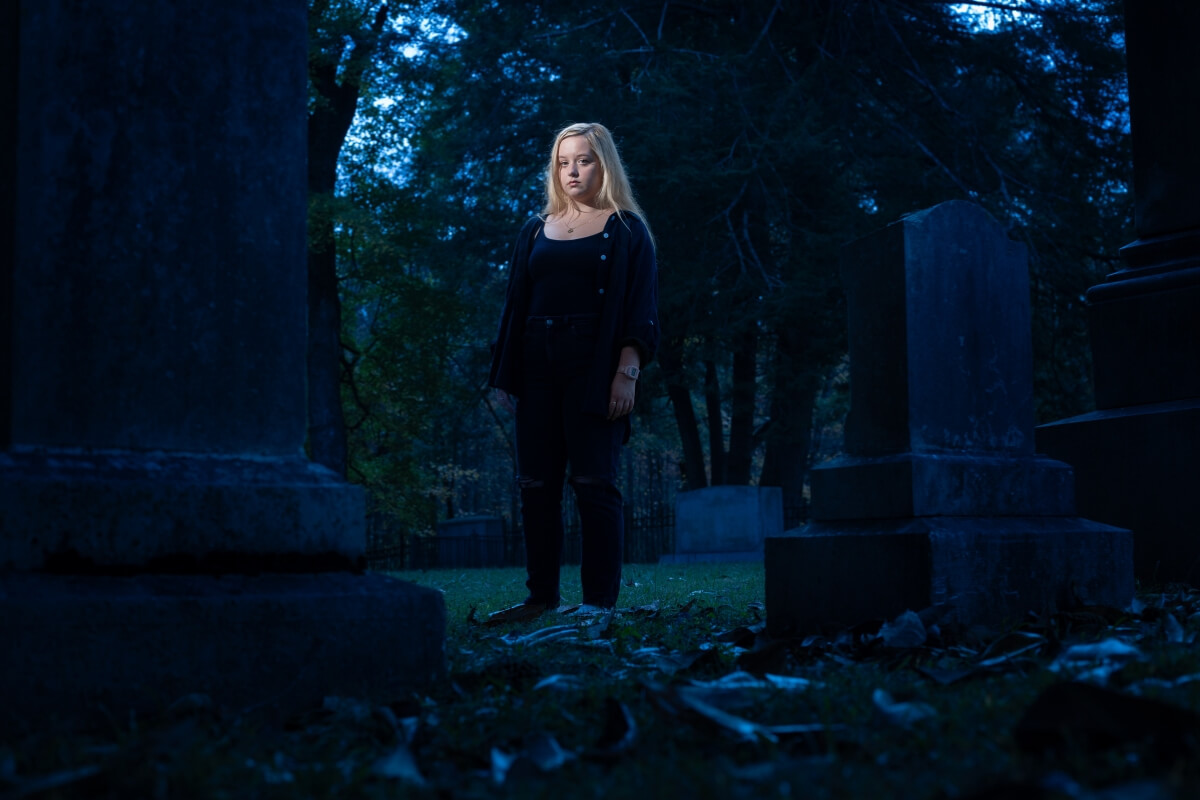
It’s been a quarter century since singer-songwriter Will Oldham, the artist known as Bonnie “Prince” Billy, penned the indie-folk lamentation “I See a Darkness,” but it could easily serve as a theme song, of sorts, for Grace Rubel ’24 this semester.
The Nebraska native, who completes her coursework and is on track to graduate in December, is bringing her Maryville College career to a close with three courses that make for about as bleak a schedule as Dr. Phillip Sherman, professor of religion and chair of the Maryville College Division of Humanities, has ever seen: PHL-205: Early Modern Philosophy (colloquially known as the “History of Evil”); REL-348: History of Hell (Postmortem Punishment in the History of Religions); and HIS-349: The History of Murder.
“My schedule was not necessarily intentional — for my major requirements, I had to take History of Hell and Early Modern Philosophy,” Rubel says. “That said, I did choose to take History of Murder, though it is not required of me because I thought it would tie in well with my other classes and perhaps add some contributions to my Senior Study.”
Rubel’s capstone thesis, unique to Maryville College and a project that many undergraduates complete in their degree field with the guidance of a faculty supervisor, is titled “The Ultimate Right: Human Dignity and the Moral Imperative to Uphold It,” in which she explores “what makes humans dignified beings deserving of basic rights and how we address wrongs done to said dignity,” she writes.
Even her Senior Study is “a dark and sometimes disconcerting topic,” she points out, and as far as Sherman can tell, to have a single student tackle three philosophically weighty Humanities subjects in a single semester is almost unheard of.
“I was absolutely shocked when I put together that we had an unholy trinity of course offerings in the Humanities this semester … and I made the schedule!” says Sherman, who teaches REL-348, while his colleagues Dr. Andrew Irvine, professor of philosophy and religion, teaches PHIL-205 and History Professor Dr. Nancy Locklin-Sofer teaches the HIS-349 course.
“I do think there is real value when students can explore related topics and content across multiple courses,” Sherman adds. “It is even better when students from different disciplinary perspectives have the chance to explore the largest and most pressing questions together. It is why a liberal arts education is so important.”
Out of darkness, an intellectual challenge
While the subject matter is indeed dark, Rubel adds, there’s merit in studying such subjects, especially for a Philosophy major in the Maryville College Division of Humanities who seeks to balance traditional schools of philosophical thought about human nature and how scholars come to understand it with the study of the moral underpinnings of it.
“I believe philosophy ought to be chiefly concerned with moral thought and behavior. Frankly, it matters more that we strive to make the world better for the people in it rather than ponder about why we are here in the first place — not that this is an unimportant endeavor,” she says. “I think one of philosophy’s biggest issues and the reason why it is overlooked so much is that it tends to relegate itself to some vague realm of abstract reality instead of addressing the practical and moral implications of our thoughts and actions.
“To start to examine these problems — for example, evil — one has to reflect on the ‘darkness’ and suffering in the world. The foundation of ethics is distinguishing between what is and how things should be. We cannot contribute to the reduction of suffering if we deny or ignore its existence. Because the classes I am taking are primarily focused on the darkness of the world and our perceptions of it, I believe that they are helping me actively flesh out my own view of evil and suffering and what can be done to alleviate it to some extent.”
By growing her understanding of these various facets of suffering, or at least the human ideas ascribed to suffering through moral and religious lenses, Rubel hopes to discover insight into ways individuals can adjust their respective moral compasses in order to improve their own lives, and those with whom they share their corners of the world. Thus far, she adds, the History of Hell has proven to be the most interesting of her troubling trifecta of fall semester courses, especially given that students and their professor, Sherman, don’t debate the existence of hell but instead explore where the origins of such a realm originate, and how ideas about it have changed over the course of centuries and millennia.
“We have explored a variety of cultural views of hell ranging from the Mesopotamians to the ancient Israelites and now to medieval Christendom, and exploring these different perspectives is an interesting examination of what social, cultural, and political influences contribute to a given hellscape,” she says. “It’s truly a fascinating class no matter what background you come from, so I would highly recommend it to anyone who has even an iota of interest.”
The subject matter, however, isn’t something to be taken lightly. While she enjoys crafts like cross-stitch and knitting as a way to distract from the thoughts and ideas influenced by her Humanities studies at Maryville College, their weight has grown heavier as the semester has progressed.
“ I won’t lie — these classes have certainly taken a toll on me,” she says. “Going from History of Murder talking about serial killers, then going home and writing about how people deserve to be treated, is intellectually stimulating but also disappointing. There is a lot of suffering and injustice in this world and these courses, for better and for worse, force confrontation of that fact.”
At the same time, her personal experiences have forced her to confront both her preconceptions and the changing nature of them as new information is revealed. Her father died last December, she says, and the loss has manifested “struggles with mortality that I bring into the classroom that make it difficult for me to talk dispassionately about murder, hell and evil,” she says.
“These subjects aren’t ones you study during the day and leave at school for the night — you take them with you and mull over them,” she says. “All I can really do is be gentle with myself and take some time to breathe and live in the present, but it’s definitely hard. At the end of the day, though, I find that emotionally and spiritually heavy classes stimulate the most growth.
“When my thoughts aren’t challenged and my intellect isn’t pushed, I feel like my education has no real purpose … (and) I want my degree to really mean something. I want it to reflect that I have developed stronger critical thinking skills, thought more about my place in the world and with others, and made a concerted effort to realize more of my potential.”
Intellectual exploration in the Humanities
The Maryville College Division of Humanities, she adds, has certainly allowed her to flourish intellectually. The size of the school, as well as the lower number of Philosophy majors, means that some courses are offered at irregular intervals, and the ones that are taught might be outside her fields of interest. What she’s discovered, however, is that there are no “bad” classes when it comes to intellectual stimulation in the Humanities.
“Every class, even the most mundane-sounding ones, have pushed me to think more seriously and consider topics I had never even heard of before,” she says. “For me, Humanities courses have been active exercises in both academic and personal development and have helped me develop the perspective of someone who can find value in any learning opportunity — even classes I don’t have any particular interest in.
“I think this is the most apparent value of philosophy and the humanities in general. By being taught how to think (not what to think!) and being introduced to different perspectives, one is better equipped to navigate life in any way they find it — personally, academically, professionally, etc. Moreover, my professors have consistently taken me seriously and helped me develop as a student and a person.”
Sherman and Irvine, in particular, have helped shape her MC experience, as has Dr. William Meyer, professor of philosophy and the Ralph W. Beeson Professor of Religion. The classes they helm, she points out, never fail to stimulate insight and greater understanding, because their classes focus on spirited discussion as much as they do academic discourse.
“When your professors care about you as a human being, it becomes much easier to engage with and be able to navigate heavy subject matter with them,” she says. “When considered alongside other classes I have taken here at Maryville College, the courses I am taking now have significantly affected my worldview. Like I said, this school has helped me learn how to think rather than what to think, and the freedom that comes along with that has allowed me to experiment with multiple different ways of looking at the world and my place within it.
“Ultimately, I am grateful for the opportunity to write a thesis that can explore these different topics and allow me to present my own arguments, and I would like to think that my thesis is accomplishing that. Human dignity means a lot to me, and being able to comprehend it by referring to various different perspectives and traditions is a privilege I do not take lightly.”
For Rubel, the route to her undergraduate degree has been a circuitous one replete with several major changes over five to six years. Philosophy, however, is where her heart belongs, even if the heaviness of this semester’s courseload occasionally feels overwhelming. The classes are difficult, but they’re also challenging — and not just in terms of academic rigor. They challenge her belief systems, and they allow her to bring her own perspective to bear on topics that benefit from each individual’s contributions to justice, dignity and knowledge, all of which are noble counterbalances to hell, evil and murder.
“To do good on the largest possible scale and contribute to the alleviation of suffering requires an understanding of what is wrong,” she says, alluding to the charge of MC founder Rev. Isaac Anderson. “You can’t really get rid of the discomfort or dejection that classes focused on heavy subject matters inevitably impart on you. But I don’t think this is necessarily a bad thing — I would encourage people to sit with these emotions and really consider why they feel that way and how it affects them.
“Certainly, do not let your life be taken over by despair, but one of the best things you can do to further develop yourself as a human being is to sit with negative emotions and consider what they contribute. Life is really hard, and learning to sit with these emotions now can help you better navigate them in the future. What you cannot let happen, though, is to remain stagnant — both happiness and sadness can lead to complacency in life, and I firmly believe that this complacency is antithetical to life.
“We are meant to grow and develop ourselves, and if you ever find yourself in a place where you feel stuck, try to find something that can help you get out of that,” she adds. “I realize this is easier said than done, but even mundane things like picking up a new hobby or trying something different for dinner can make a world of difference.”