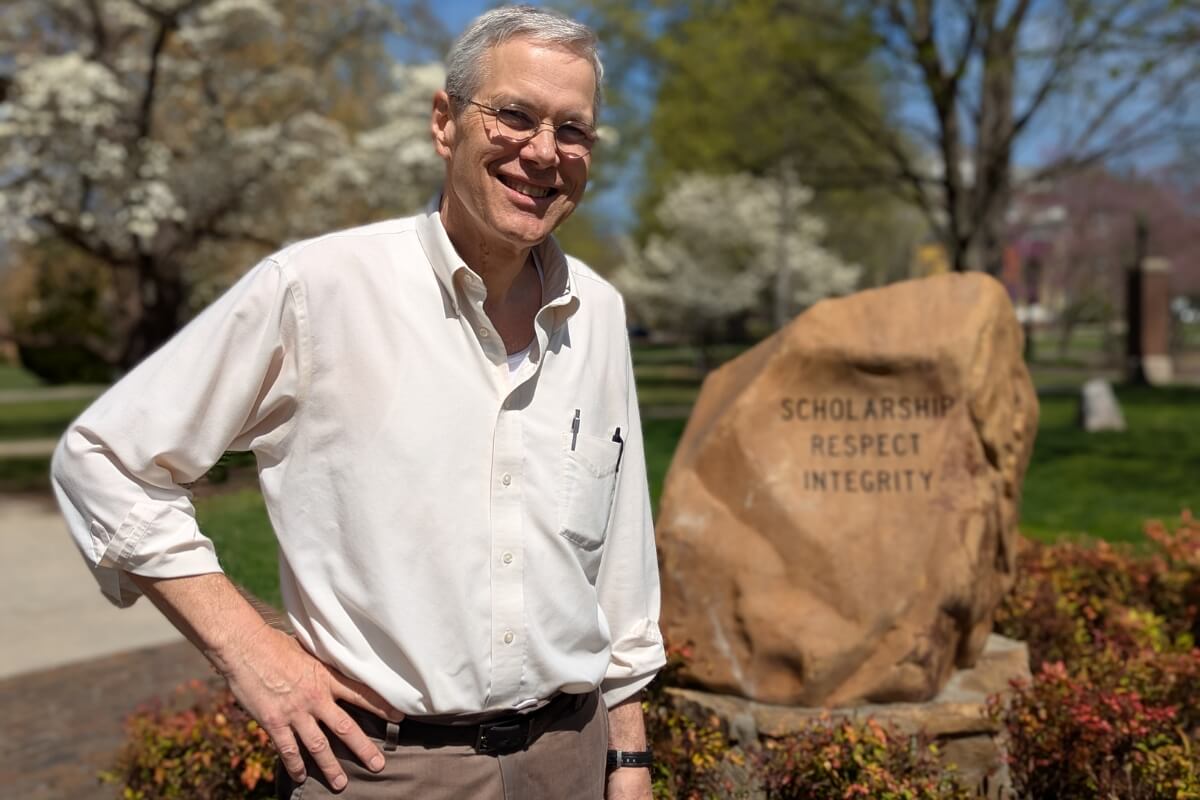
Maryville College’s Dr. Sam Overstreet, a legend among Scots for more than three decades, decides it’s time to retire
April 9, 2025
In the end, it won’t be a bang or a whimper with which Dr. Sam Overstreet makes the final walk from Anderson Hall to his car, his rolling briefcase clicking over the expansion joints of the College’s sidewalks, and the hat so many students say reminds them of Indiana Jones atop his head.
Unexpected? Most definitely. Disappointing? Perhaps. But there’s no banging of fists or whimpering fits to be found in the disposition of the faculty member who’s taught at Maryville College the longest. Because ever since Overstreet arrived at MC back in 1990, he’s made it his life’s work to serve, and 35 years of that service has brought him joy in abundance. His retirement at the end of the 2024-25 academic year because of medical reasons, he says, is simply the next step on a journey that’s been rewarding beyond measure at an institution beyond compare.
“It’s a small liberal arts campus that pays attention to students very seriously and gives you an opportunity to have a personal interaction with students, which is exceedingly rare,” Overstreet says on a sunny early April afternoon, having returned to campus mid-sabbatical to begin the process of clearing out his office. The predetermined leave of absence was originally designed to give him time to research and write the introduction to the electronic edition of one manuscript of William Langland’s Middle English allegorical narrative poem “Piers Plowman.”
“Some of the students who spent the most time in my office became good friends after graduation, and staying in touch with them has been rewarding,” he added. “It’s a church-related school, which I found attractive, and though the pay might have been lower than at other schools when I first received the offer, that was OK. When I chose to study literature as a profession, I realized that if I’m diligent, and I trust God, I can trust God to provide me with a decent living and not worry about pay.”
The gratitude of generations
As it turns out, the pay involved so much more than money, and the spiritual currency he’s accumulated over the past three-plus decades is a direct result of lessons imparted both inside and outside the classroom.
Dr. Will Phillips, a professor of English and currently serving as the interim chair of the Maryville College Division of Languages and Literature, arrived at the College in 2001, and Overstreet served as something of a mentor in those early years.
“Sam’s devotion to a life of scholarship has included a deep delight in sharing that scholarship with students and colleagues,” Phillips said. “He’s shown me ways that care for students and the standards of good work can be balanced and even fun.”
Now an associate professor in Writing/Communication, Christina Seymour began her tenure at the College in 2014, and before she even had an office in Anderson Hall, Overstreet was going out of his way to make her feel at home.
“When I needed a copy of the required text for Composition, he drove the book over to my new apartment,” Seymour says. “This is the kind of colleague Sam is. I always think of the word ‘conscientious’ when I think of Sam. In addition, Sam’s devotion to teaching well has inspired me on days when it was a struggle. In a Zoom interview in a faculty search, for instance, he said something so meaningful about our impact on students that it moved me to tears.
“His genuine enthusiasm for literature and language is contagious for students. While he demonstrates such welcoming kindness to students like screening Shakespeare films at his home, he also maintains rigor in his courses like his infamously nicknamed course ‘HEL,’ or History of the English Language. Sam’s unique contributions to our division and Maryville College will be very missed.”
Despite the intimidating nature of the acronym, Scots who signed up for HEL found that it wasn’t just an arduous survey course; it provided them with additional tools that helped them develop as better writers. Rebecca Raney ’23, a Writing/Communication major now working as a full-time journalist with The Daily Times newspaper of Maryville, says that a great deal of her own growth as a writer, and as an individual, can be traced back to lessons learned in HEL.
“It’s only looking back that I appreciate how much Dr. Overstreet put into challenging and encouraging us,” Raney says. “His courses were not designed to pass you through; he wanted you to think, and think critically, about the material and what was and wasn’t present in it. In truth, he was one of the most rigorous professors I’ve ever had the pleasure to learn under.”
Such sentiment isn’t a new phenomenon: Karen Beaty Eldridge ’94, executive director of Marketing & Communications at Maryville College, recalls her own stint in HEL, but more importantly, the ways in which he pushed her to consider the ways that contemporary language, in all of its various media, can often be traced back to classic works throughout mankind’s history.
“When I told him I wanted to focus my senior thesis on the effects of mass media on presidential speechwriting through different eras of U.S. history, he recommended that I judge the text against Aristotle’s ‘The Art of Rhetoric’ — an idea I NEVER would have come up with — and together, we read speeches from the likes of FDR and Kennedy to find alignment with the ancient Greek philosopher’s work,” she says. “Dr. Overstreet’s intellect and authentic curiosity were apparent to me then, as a young adult, but today I recognize and appreciate those qualities even more, especially seeing how these spring from a deep and abiding Christian faith. He is, to me, the personification of knowledge, of humility, of kindness, of fairness, of patience. When I think about people on this campus who truly and consistently exhibit wisdom, Sam Overstreet stands alone.”
More than three decades later, those traits are still winning the hearts and minds of Scots in the Division of Languages and Literature. Julia Jeffress ’25, who graduates in May with a degree in English, is grateful that her own College career coincided with the sunset of Overstreet’s. As it was for her peers and predecessors, Overstreet’s ability to turn seemingly stodgy subject matter into lively discourse and interesting assignments was a continual source of wonder in every class, Jeffress says.
“His passion for what he does is so evident every time he’s teaching, and his excitement about the study of English is contagious,” she says. “The first class I took with him was Advanced Rhetoric and Grammar — a class I never imagined I’d enjoy so much from the title, but it ended up being one of my favorites. I remember being so excited to go to class every day because I knew that he’d make sentence diagramming and recognizing types of clauses so much fun.
“I don’t know anyone in the English department who would disagree when I say that Dr. Overstreet has been such a positive influence throughout my years here, and I’m grateful to have gotten to learn from him.”
Clearly, the love Scots have for Sam Overstreet can’t be overstated. On the popular student-facing higher ed website Rate My Professors, he’s assigned a difficulty rating of four (out of five) … but 100% of respondents say they would take his class again. In a 2013 news feature in the campus newspaper The Highland Echo, Taylor Wilson ’13 writes that Scots know Overstreet as “a man of passion and brilliance” who “takes topics that may seem dry at times and keeps students engaged and informed.”
Overstreet grins widely at the stroll down memory lane. It’s clear that knowing he’s made an impact brings him a great deal of gratitude for both the fruits of his labor, and for his own trust in the divine providence that guided his early career decisions.
A teacher finds his classroom
After graduating from Yale University, Overstreet enrolled in the Ph.D. program at Cornell University in upstate New York. It was there that he taught his own freshman seminar session, but while he demonstrated a mastery of the subject matter, the art of teaching was still years in his future. He learned nothing about the nuances of imparting his knowledge upon those who sat before him, primarily because those who supervised and taught him were research scholars, he says. That realization led to something of a crossroads when it came time to consider his future.
“When I was a year from finishing my Ph.D., and it was time to look at the job market, I grew disillusioned from research-oriented careers,” he says. “Everybody I knew was aiming for a position at an R1 (designated as a doctoral university with very high research activity by the Carnegie Classification of Institutions of Higher Education), where they would teach two courses a semester and publish a lot, and that seemed like a rat race to me.
“At that point, I committed, for lack of a better term, professional suicide by deciding I was not going into the job market. My advisors and professors were aggrieved but were far more understanding than I expected them to be, so I worked in a library at Cornell for two years while I figured out what was next.”
In the end, he came up with two options — urban youth ministry (“Which I’m glad I didn’t do, because I use too many big words and don’t play basketball well, so I was ill-suited for it,” he says with a chuckle), or overseas work as an English teacher and self-supporting lay Christian witness. He ultimately chose the latter, and he and his wife, Marjorie, headed for China for two years. Before they departed, however, he had a classroom experience that made a profound impact while preparing to teach English as a second language (ESL). Part of that training involved three classroom visits to educators already teaching ESL, and in two of them, he learned more about good teaching than all three years of serving as a Cornell teaching assistant, he says.
“There was one guy, and he was an OK teacher, but by contrast, there was a young woman teaching the class who was pregnant with her second child,” he says. “Because of that, she didn’t have much time to focus on student homework, so she had them do more work in class and encouraged them to check one another. And if someone gave a wrong answer, she would squirt them with a squirt gun!
“I thought, ‘This is rather bold and daring!’ But it showed me that she knew them all by name, and she clearly loved them, and they clearly loved her, enough that they tolerated being squirted by her squirt gun. That was the kind of relationship she cultivated.”
Teaching in China, he adds, made him realize that it was something he enjoyed, more so than research, and thus began the job hunt (after a one-year detour into seminary) that ultimately led to East Tennessee.
“Maryville College felt like a really, really super good fit, because they value teaching above research, as I do, and I knew that if I spent time in my office talking to students about major life issues, that was considered an important part of my job,” he says. “Because of those things, it’s been a great, great place that I have loved to be.”
Flamingos galore
And while his career never involved squirt guns, there were flamingos. Pink ones, actually, and a whole lot of them. It’s one of dozens of stories Overstreet can tell about his time at Maryville College, but it exemplifies the impact he’s had and the relationships he’s cultivated like no other.
Back around the turn of the century, Overstreet served as the faculty advisor to a now-defunct student organization known as the Dead Theologians Society, in which lively discussions about philosophy and religion were an active part of every meeting. At one such gathering, Overstreet recalls, someone made a comparison between the works of Southern gothic novelist Flannery O’Connor and life in a trailer park in the contemporary South. Pink flamingos were mentioned, and Overstreet’s visceral, whole-body grimace at the mental image of those gaudy plastic lawn ornaments led to such student amusement that they started showing up … everywhere.
He woke up one Saturday morning to find nine of them in his front yard and one in the back. Some of the students convinced an MC security officer to give them access to his Anderson Hall office, where they replaced the lightbulb of a lamp with a pink flamingo bulb, complete with a pink filament and a palm tree. They managed to get roof access to Anderson and suspended one outside his window using fishing line. They even managed for him to receive an envelope filled with synthetic pink flamingo feathers … postmarked from Long Beach, California.
He knew who the culprits were, of course, but the ever-expanding scope of the gags was too much fun to put a stop to, he says. For one of the instigators — Teresa Dibble Hicks ’01, an English major who now serves as the vice president and National Health Systems Practice lead for the Nashville-based healthcare communications organization Jarrard Inc. — needling Overstreet with the garish avians is a cherished memory, but it takes second place behind his abilities in the classroom.
“I don’t even remember the original comment he made about disliking the lawn ornaments, but I know our goal was to fill his life with so many flamingos that they would continue to pursue him long after we were gone,” she says. “(The Dead Theologians Society) was some of the richest discovery and debate of my entire time at MC, and I believe the students who participated were there because they wanted to be challenged by and learn more from Sam. More than two decades after graduation, Sam remains one of the mentors who has had the greatest influence on my life.
“One of the things that was so special about Maryville College was the focus on not just learning the curriculum but allowing yourself to be changed by knowledge and discovery. During my time there, a guest speaker once said that the purpose of a liberal arts education is to furnish your mind in such a way as to make it a place you’d like to live for the rest of your life, and Sam’s style truly embodied that philosophy. To this day, many of my favorite furnishings are gifts from him.”
Despite his professorial disposition, Overstreet got his “revenge,” so to speak. When Hicks and her husband, Scott, got married, he was a guest at the wedding … and brought along every pink flamingo with which he’d been gifted, along with some white and black fabric. After the wedding but before the reception started, he gathered other Scots, and together they fashioned the fabric into a “bridal gown” and “tuxedo” for two of the flamingos. Hicks and her husband were so tickled, he says, that afterward they affixed the flamboyant fowl to the grill of Scott’s truck and drove off to their honeymoon.
“Those are the most delightful relationships that I’ve found here, because they turn into such rich friendships,” he says. “And one of the things that’s so great about teaching literature is that it’s such a fully orbed way of dealing with life. There is no aspect that isn’t treated somewhere in world-class literature.
“I don’t want students to take my classes and come out parroting what I say a literary work means; I want them to form their own interpretations and be able to defend them with textual evidence — and it’s even better when an insight that comes from their interpretation of that piece of literature is making a difference in that student’s worldview and their way of approaching life.
“Those big questions are the reasons I thought it was worthwhile to study literature in the first place, and why I thought it would be good to teach,” he adds.
An academic life well-lived
That he spent all of his career at Maryville College, he says, is yet another spiritual gift he credits to his reliance on faith when faced with questions ranging from the vocational to the existential. That he would stay at MC, he adds, became apparent around 1993, when an afternoon drive up to Look Rock, off Foothills Parkway in the Great Smoky Mountains National Park, led to a couple of hours of contemplation about whether it was time to commit or to depart.
“I knew that it’s about the mid-point to tenure review when you need to decide whether to stay or put probes back out in the job market,” he says. “I knew the usual trajectory for research-oriented academics was that the first job you get is probably the highest point of your career … but then you don’t get tenure, and you go falling down the staircase to the next school, and then the next, and then the next, until you reach the right place.
“And I thought, I could do that, but I really enjoy teaching more than research, and I don’t want to be in a publish-or-perish environment. So why don’t I go ahead and affirm a place at a school that values teaching, because that’s what I enjoy? It wasn’t hard, because this is a delightful place.”
And while research may have led to many more scholarly accolades, a certain Biblical proverb has been something of a guide for Overstreet, he adds: “When pride comes, then comes dishonor, but with the humble is wisdom” (Proverbs 11:2). Humility has served him well over the years, he says, primarily in the way his teaching methods have evolved. In the beginning, he did more lecturing than listening, but as he began to try more active learning techniques, the more his students seemed to pick up on the wisdom he hoped to impart.
And every so often, some of them wind up in his office, gushing without pause over the insight gleaned from certain texts through his guidance.
“If a teacher has a good rapport with students, they will learn anything,” he says. “I think every professor loves it when there’s a lightbulb that comes on — that moment when something a student wasn’t getting suddenly becomes something they get,” he says. “Those are the moments we teach for, and when it becomes a discouraging profession, those are the moments that keep you going.”
A reception to celebrate Overstreet’s career and toast his impending retirement will be held from 2-4 p.m. Thursday, April 24, in the Maryville College Center for Campus Ministry. It’s open to the public, and alumni and former students are encouraged to attend.