


MC students study chemistry of beer, learn brewing
June 24, 2021
What do beer and the liberal arts have in common? A lot, actually, according to Dr. Nathan Duncan.
“Beer is a true liberal arts subject,” said Duncan, associate professor of chemistry at Maryville College. “We aim to prepare students to be able to approach any subject from a variety of disciplines, and beer is one of those subjects that you can devise an entire liberal arts core curriculum around – it includes science, economics, statistics, religion, laws, social science, history and mathematics and many other areas.”
Every aspect of human history is closely related to beer, he said, adding that the oldest known written recipe is a recipe for beer, and the oldest records of commerce and tax receipts from ancient Mesopotamia all deal with beer brewing. There’s evidence that early agriculture and the development of civilizations include beer making – and it might be that “agriculture and civilization itself exist because of beer,” he said.
“When you start talking about beer brewing, you’re talking about something that’s way bigger than just the idea of an alcoholic beverage that people consume,” the professor said. “Pretty much any civilization around the world at some point in time has harnessed the power of fermentation, and it’s had cultural, religious or social significance wherever it’s been.”
Duncan added that the field of statistics was created by a brewer at the Guinness Brewery in Ireland in order to evaluate consistency during production, which led to the t-test that is used in statistics today.
“And of course, there’s the science, which is a really important part of it,” Duncan said. “A lot of the early precursor studies that led to modern biology, microbiology and chemistry came out of breweries looking at the consistency of things. So, when you look at how this connects to every single other field – why would a liberal arts college not have a beer brewing course?”
The Chemistry of Beer
Duncan, who primarily teaches organic chemistry for science majors in pre-health and in the core curriculum, offers two courses related to beer and brewing: “CHM149: Chemistry of Beer,” which focuses on the science of beer brewing and its connections to society, and a lab-based “EXP200: Introduction to Brewing” course, which is an upper-level course for students 21 and older and focuses on the brewing process. The first class provides a great foundation for the brewing course, he said.
“In our Chemistry of Beer course, we cover a little bit of what a science major would cover in general chemistry, organic chemistry, biochemistry and microbiology, and we take a little bit from all of them and kind of fulfill that goal of making connections of the science and the connections to society,” he said.
Duncan first got involved in brewing as a senior at Baylor University, when the popularity of craft brewing was starting to rise. He became hooked and has been brewing ever since. After he started teaching at MC, he was excited when his students started asking him to teach about the beer making process. It started four years ago with a few lectures, and the demand grew.
“I said, ‘If you find enough people that are interested in it, I’ll ask the College if we can do it,’ and it got approved. After that, it just really started to take off,” he said, adding that he envisions many opportunities for growth in the future – both on the academic side and the research side.
Duncan said that many students who might have had difficulty with chemistry in the past often find that learning chemistry in a different context – such as beer brewing – makes it easier to learn.
“If you start teaching it in the context of something that they have some familiarity with or that seems a little bit more tangible than a bunch of letters that are symbols that represent elements that you can’t physically see or maybe are hard to relate to, they find the science itself to be more accessible,” he said. “It’s a great tool for teaching some of the some of the concepts that you’d find in a regular chemistry class.”
While the courses give students a greater appreciation of the history of beer, its importance to society and the process of making it, many students who take the “Introduction to Brewing” course find that their beer preferences change.
“Well, most college students are really only aware of the typical American lager style, the Budweiser, Miller, Coors – the common beers that you’d find in the grocery store,” Duncan said. “Now, craft brewing is definitely taking off. More people know about that, but they really don’t understand what the styles are, so that’s another thing that students really get out of it. Now, when we’re talking about the experiential course, the best part of that class is watching their tastes change over the course of bottle shares to where they’re finding things that they really, really like. I have students that take the beer brewing class and on the first day, they say ‘Yeah, I don’t like beer. I’ve never had a beer that I like,’ and some of them we make converts out of. Some of them are just like, ‘Yeah, I really enjoy the process but not so much the beer.’ Or you have the students that can’t tolerate any really hoppy beers at the beginning of it that by the end of the course, all they want to do is brew overly hopped IPAs, because they just fall in love with the hops aspect of it.”
Research Opportunities
Since Maryville College is an institution that values and promotes undergraduate research, Duncan has already thought of numerous ideas for beer-related research – and two of his students have already jumped on projects for this summer.
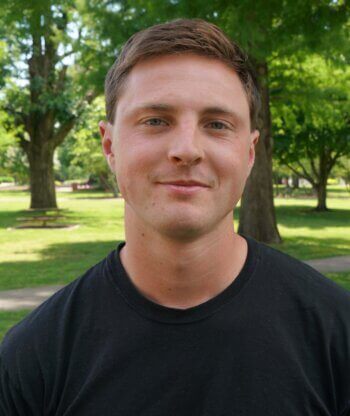
David Clark ’21, a senior biochemistry major from Kingston, Tenn., is spending the summer in Duncan’s lab, conducting research for his Senior Study. One of the distinctive features of a Maryville education, the Senior Study requirement calls for students to complete a two-semester research and writing project that is guided by a faculty supervisor.
Clark is studying how yeast changes terpenes during the fermentation process.
“Beer is made with water, malt, hops and yeast, and in in the hops, the main active ingredient is terpenes,” he said. “I’m looking at how the yeast affects those terpenes structurally during the fermentation process.”

Mackenzie Lamb ’23, a chemistry major from Powell, Tenn., is also conducting research on terpenes, and she received a Ledford Scholarship from the Appalachian College Association (ACA) to support her summer research.
Named for Colonel Lee B. Ledford, the scholarship program offers financial assistance for summer research projects to undergraduate students enrolled at ACA member institutions. Working closely with a faculty mentor, students engage in significant research projects, supported by program stipend and research reimbursements.
“I’m going to be looking at the bioconversion of terpenes in the fermentation process, but I’m specifically looking at the hops rather than the beer itself,” Lamb said. “So, right now, I’ve been running lots of extractions on different strains and varieties of hops. That way, we can create basic terpene profiles right now from that – and then probably build off of David’s work and look at our finished beers and see how the terpene profiles match up.”
Lamb said she approached Duncan about research opportunities, and when he told her about the beer project, she found it really interesting. She hopes to keep working on it throughout her time at MC and “make it almost three years’ worth of work as a Senior Study.”
“I’m starting to fall in love with this side of it, because it’s not something that I’ve been exposed to – in general chemistry and organic lab, you don’t really get that full lab experience – now that I’m in the lab every day, I just love it,” she said. “I’m getting so much instrumentation experience that a lot of people don’t even get as an undergrad, not to mention just the research experience itself. All these things that I can add onto a resume whenever I’m applying to grad schools and different jobs, too. I think it’s going to be huge for me.”
MC Invited to Participate in Beer Festival
This year, Duncan was able to purchase a 27-gallon brewery system from a brewing center in Knoxville that was upgrading its brewing equipment, which has enabled Duncan and his students to brew on a larger scale – and it has already been put to use.
Duncan, who is a volunteer with the annual Hops in the Hills Craft Beer Festival in Maryville, was able to add Maryville College to the list of breweries that will be offering beer samples during this year’s festival on June 26. He and his summer research students – along with help from some alumni – have been busy brewing batches of beer to serve at the festival. The first is a stout that was the first beer Duncan brewed on campus as a demonstration, “so we had to include that one.” The second is an India Pale Ale brewed with hops from New Zealand – a nod to Maryville College’s international programming, which includes a “New Zealand Ecology and Culture” travel-study course led by Dr. Dave Unger, MC associate professor of biology.
“When Dr. Unger took the trip in 2018, I had been kind of investigating the new and growing New Zealand hop industry, so I convinced him to bring back some New Zealand hops that weren’t available in the U.S. at the time,” Duncan said. “Since then, that whole scene has exploded, so we’ve been able to get some of the same hops domestically, but they’ve been exported from New Zealand. We’re brewing our New Zealand IPA with the same hop varieties that Dr. Unger brought back that from that first New Zealand study abroad trip.”
Duncan’s summer research students have been assisting with brewing the beer for the festival – and two of Duncan’s former students even came back to campus to help. Chris Fraley ’20 majored in biochemistry at MC and is attending nursing school. When he heard that Duncan was brewing for the beer festival, he decided to come back and help, along with Brock Hodges ’20, who majored in biochemistry and plans to start medical school in the fall. Both alumni took Duncan’s “Introduction to Brewing” course, and both were inspired to start home brewing after taking the class.
“Dr. Duncan taught us the basics, and we came back to keep learning from him so we can make better beer,” Fraley said. “I didn’t know about craft beer when I started, and I learned that there are way more types of beer out there than I realized. It’s also way more complicated than I realized. I started to want to brew my own and give it my own personal touch.”
Duncan said he’s glad to have the opportunity to serve “Maryville College beer” along with the breweries that are participating in the “Hops in the Hills” festival.
“There are some Maryville College alums that are involved in different breweries around our region as well, so we’re just happy to be a part of that and hope that if folks come by, they’ll sample our beers,” he said. “I’m hoping to talk a little bit about our vision for the future and our brewing analysis lab at that event to just kind of show some of the science that we’re doing, too –because I can’t not teach.”