


Lessons from Sept. 11, 21 years later: ‘Never forget’ takes on new meaning, MC officials say
For those who were alive on Sept. 11, 2001, the world changed at 8:46 a.m., and every year on the anniversary, they remember exactly where they were when they heard news of the terrorist attacks that destroyed the World Trade Center towers and damaged the Pentagon.
Dave Daniels, Maryville College’s director of military outreach and transfer recruiting, was an E-5 aboard the aircraft carrier USS Nimitz, headed to the showers to begin his morning aboard the vessel, docked in Coronado, California. His fellow sailors were crowded around the television in the berthing area, he recalled, all eyes glued to the television.
“I thought everybody was watching a ‘Die Hard’ movie, because that’s what it looked like,” Daniels said. “I was like, ‘What movie is this?’ Somebody told me, ‘Bro, this is happening right now. Shut up and watch.’ I remember watching the second tower fall, and I went and got cleaned up, and about two hours later, all military bases were shut down, all leave was recalled and if you were in the military, you had 24 hours to get to the closest base you could find.”
Maryville College President Dr. Bryan Coker was the director of Student Judicial Affairs at the University of Tennessee-Knoxville at the time, and when one of the school’s law students informed him of the news, he spent the morning scrolling the internet for the latest updates. Back home at lunch, he remembers watching his young daughter, Caroline, while staring at the images of destruction on TV and wondering what sort of world she would grow up in.
Maryville College and 9/11
Twenty-one years later, Sept. 11 is burned into the national consciousness, but many undergraduates at Maryville College and at schools around the country weren’t even born when it took place. Commemoration and remembrance, Daniels and Coker said, are more important than ever so that members of Generation Z and all those who follow understand what a monumental turning point it was in the nation’s history.
“The most important thing I would want people to acknowledge and remember is that 9/11 happened, and we are not immune from it happening again,” Daniels said. “We have much better communication and much stronger safeguards in place today, so the chances of it happening again may be limited, but it could still happen. We, as a people and as a society, should never forget that, but at the same time, we can’t live in fear.”
“I think, for me, Sept. 11 signified the beginning of a vulnerability that I don’t think our nation had felt before,” Coker added. “Previously, war was something that either happened in other countries or in history books. It was really the beginning of a new type of vulnerability and a significant change in how wars are fought.”
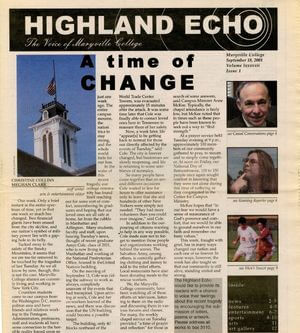
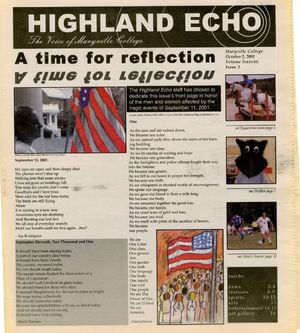
Those realizations were brought into stark focus at Maryville College on the days and weeks after the Sept. 11 attacks. According to an article in The Daily Times newspaper of Maryville, MC held a worship service that night in the Center for Campus Ministry, counseling services were offered to students, processing group discussions were held in residence hall lobbies, and in publishing its first post-attack edition a week later, MC’s campus newspaper The Highland Echo acknowledged the event’s impact on the campus community.
“Tucked away in the safety of the Smoky Mountains, it seems that we are too far removed to be touched by the tragedies of last Tuesday,” student reporters wrote at the time. “As we all know by now, though, this is not the case. Maryville College alumni are currently living and working in New York City. Countless students come to our campus from the Washington, D.C., metropolitan area and have friends and relatives working in the Pentagon. Administrators, professors, staff and students all have some connection to the horrible reality forced upon us just one week ago.”
On Sept. 25 of that year, students, faculty, staff and friends climbed the Mountain Challenge Alpine Tower, where they recorded thoughts, feelings and prayers in a journal that was sent to Red Cross relief workers in New York and Washington. The Oct. 2 edition of The Highland Echo featured poems written about the tragedy by students, and in November, after a period of reflection, then President Gerald Gibson sent out a response to the tragedy.
“Back in March … I noted that ‘the effects of the sixties left the College — and the larger American society — changed forever.’ Change in both the College and American society is just as certainly wrought by the events of September 11th,” Gibson wrote. “This time it has, however, happened suddenly, and the outcome remains unsure. I am nonetheless sure that the Maryville College community weathered that week in a heartening way.
“In the (Highland) Echo, student writers … close their ‘Time of Change’ article with this: ‘In some ways … the week has also taught us that our community is still alive, standing united and strong.’ I think they got it right. And in this changed world, I am convinced that there is no better place to prepare students for building community than in this liberal arts college.”
Loss, change and resilience
For Daniels, those changes included adjustments to Navy life designed to protect American interests and service personnel: Deployments were extended and port visits by off-duty sailors were restricted. Despite the thanks he receives for his service, however, there were even greater heroes then and now that deserve equal recognition, he said.
“I think it’s important to differentiate between what I did and what first responders did,” he said. “My job was to deploy for war. The first responders, some of whom are still suffering today, are who keep us safe here at home. They’re the ones who answered the call then and continue to answer the call, and that’s something else we can’t forget — that many of them continue to suffer from the effects of 9/11.”
As do families with direct connections to the crash sites in New York, Washington and Shanksville, Pennsylvania. That’s something Coker remembers keenly from his time as vice president and dean of students at Goucher College in Baltimore, which attracted numerous undergraduates who had lost loved ones in both the Twin Towers and the Pentagon. Although they may have been too young to remember the events of Sept. 11, they suffered trauma from it nevertheless.
“It changed us all,” Coker said. “The loss was incredible, and that generation still suffered even if they don’t remember it. It changed all of us forever, and it’s an event we should always take a few moments and reflect upon every year.”