


Psychology professor, Neurosciences program founder Dr. Lori Schmied to retire after 33 years at MC
March 18, 2022
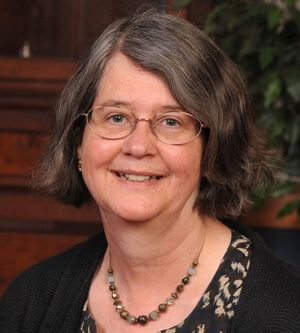
It was an uneasy match at first between Dr. Lori Schmied and Maryville College, the institution from which she’ll retire after 33 years at the end of the semester.
At the time, Schmied says, the MC Division of Behavioral Sciences was in dire need of a psychology professor. The year was 1989, and a faculty search had proven fruitless — as had her search for a full-time teaching position. Having earned her doctorate four years earlier, she was teaching part-time but longed to find a forever home in academia.
“I had been searching unsuccessfully for a full-time job because my husband was already at the University of Tennessee, so I was what they labeled a permanent adjunct. I was still doing lab work and collaborating with my doctoral supervisor, but it was really tough,” she says, reflecting on her tenure at the College from her office in the Sutton Science Center, a narrow room overflowing with books relevant to her position as professor of psychology and coordinator of the College Neurosciences program.
“Bob Naylor was a chemistry professor at the time (and would go on to serve as vice president and dean of the College), and his wife worked in the lab next to mine, and she told me, ‘There’s a position at Maryville College, and you need to apply for it,’” Schmied adds. “I looked at the job advertisement, and there was not even a single course that I had taught or was even in my area — subjects like personality theories, which I had never taken myself.
“It was what I would call a desperation hire, and I didn’t even interview for the position until after graduation, which is way, way late in the academic calendar. But once I got here, I really fell in love with the place.”
From a seed grows a robust program
From the beginning, Schmied put in the work that would lead her to a position as one of the most respected faculty members in her division. She was initially hired as a one-year visiting professor, and she chuckles at the stress of teaching two night classes lasting from 6-10 p.m. and having to return the next morning to campus for an 8 a.m. lecture — all while raising a daughter who was 4 years old at the time.
When it came time to reapply for the position, however, the work — and her dedication to it — proved to be a year-long showcase of her abilities, and she was hired as a permanent member of a small team of faculty members, she recalls.
“It was a Psychology Department of two faculty — I was the third — and we had a total of about 40 students,” she says. “What I saw, though, was that while good students thrive wherever they are, what Maryville College did and still does is help the average student thrive. I realized it was possible to not just convey the facts and teach the material of my field, which I enjoy doing, but to see the effects of this education and this culture.
“For at least 20 years, I taught Psychology 101 and the first-year seminar, and seeing the development of students, especially from first year to senior year, was really gratifying. Today, we have eight faculty members and triple the number of majors. That was another thing that was exciting during those early years: I came on board when things were really growing.”
Her biggest accomplishment, outside of the thousands of young minds she helped sharpen over her three-plus decades, has been the establishment of Neurosciences as a separate discipline. As a specialty, it didn’t exist while she was in graduate school, she says; therefore, her areas of focus were in psychophysiology, psychopharmacology and health psychology. At Maryville College, she found upon arrival that there was a single course — biopsychology, which was taught by a biologist in the College’s Division of Natural Sciences. When that professor retired, she claimed the subject and began to nurture it with supplemental coursework.
“The field of psychology has grown in the last few decades to stress three components: applied clinical counseling; experimental psychology, which increasingly focused on community engagement and real social issues in cognitive, developmental and social psychology; and neuroscience, which is the biological basis of behavior,” she said. “Maryville College’s strengths have always included cognitive-related courses and classes with good statistical foundations, and we knew from the beginning that neuroscience was going to be an interdisciplinary major.”
A new major is born
The pre-existing biopsychology course was redeveloped as Introduction to Neuroscience, followed by a new course in Advanced Neuroscience. In addition, Schmied has also regularly taught Drugs and Behavior, Theories of Personality, History and Systems, and Contemporary and Professional Issues in Psychology.
“I really enjoy teaching the history of psychology, and I keep up-to-date with current developments through lots of readings and going to conferences,” she says. “I finally collated conference papers into a more formal book, and the process of doing that has really helped me stay abreast of developments as well as see the historical perspective.”
“The Advance of Neuroscience,” published in 2019, “explores topics on the brain, psychoactive drugs, and a variety of human behaviors and experiences — such as music and sleep — taking into consideration the importance of historical roots of neuroscience, which have been largely unexamined before now,” according to its description. In focusing on Victorian-era development of theories of the nervous system, she makes connections to neuroscientific concepts and elements that may seem new but have actually been a part of the discipline’s zeitgeist for quite some time, she adds.
“While chair of the Division for 13 or 14 years, I led my colleagues in a major revision of the psychology curriculum, creating the track in counseling and the neuroscience major,” says Schmied, who adds that another honor she treasures was being elected chair of the MC faculty on three different occasions. “The opportunities for collaboration across campus and interdisciplinary work are far greater in a college like this. One begins an academic career typically with a very narrow focus of research and teaching area, but regular opportunities to teach in the Core and interact with colleagues in different fields provide cross-fertilization of ideas.
“Maryville College enabled me not only to be a better psychologist because of the breadth of coursework I had to teach and the variety of senior thesis topics to supervise, it also gave me opportunities to do research, create travel-study programs and develop curriculum with colleagues from other disciplines and divisions.”
Case in point: Schmied and her fellow psychology professor, Dr. Ariane Schratter, will lead a 10-day Advanced Study of International Child Welfare to Switzerland this summer, a short-term travel study program designed as an interactive learning experience — the eighth such international travel study by MC students that she’s led.
International education has been a lifelong passion for Schmied, who was hired, in part, because of her experience in the international office at the University of Tennessee, and from the early days of her Maryville College career, she was involved with the International Programming Committee.
“I’ve had the privilege of watching transform what used to be a small group of faculty helping students study abroad into a professional center for study abroad and serving our international students,” she says. “One of the things I’ll be doing in retirement is staying involved in Global+ initiatives through the Maryville College Center for Global Engagement. We received a grant in March 2020, but because of COVID, a two-year grant stretched into three years, and possibly a fourth, so I’ll be staying on as head of that.”
Stepping down, but not stepping away
Neuroscience, however, is a field she’ll give up, at least as far as the rigorous discipline required to stay abreast and on top of rapidly changing theories, advances in the field and statistical methods. When she first arrived on the MC campus in 1989, she recalls, faculty members had just received desktop computers that had to be booted up with 5-inch floppy disks, and while she’s managed to roll with technological changes in the years since, doing so takes away from what she loves most: engaging students and colleagues in spirited, lively and thoughtful discussions about the biological mechanisms that are fundamental to humankind’s interaction with one another and the world.
“I want to get back to travel, especially the luxury to travel at non-peak travel times, and there are writing projects I would like to continue with,” she says. “I’m someone who’s never bored: I love to cook, and I have a great garden, and I’m looking forward to spending more time with the Global+ initiative. And while it will be nice to be unscheduled, I will miss the daily interactions with students and colleagues.
“But what I’ve contributed will live on through my students, and in what they contribute in their own lives through the careers and roles they want to do after they graduate.”
From 3-5 p.m. April 27 on the plaza of the Clayton Center for the Arts on the MC campus, a reception will be held to honor Schmied’s tenure. A brief program of reflections gathered from faculty, staff, students and community members will begin at 3:30 p.m.
To contribute a special group gift to honor Dr. Schmied’s time at Maryville College, donate (any amount is welcomed) online at https://maryvillecollege.edu/givetoday. Be sure to ad “Dr. Lori Schmied retirement” in the comment box under “gift preferences.” If you would like to contribute in another way, please contact Eric Bellah at eric.bellah@maryvillecollege.edu or at 865-981-8225. Please make any contribution by April 4 so that organizers can make arrangements to pay tribute to Dr. Schmied.
For other opportunities to recognize her, email Dr. Crystal Colter at crystal.colter@maryvillecollege.edu.