


Gone fishing: MC’s Alonso Angel ’24 supports conservation efforts as part of summer internship
July 5, 2023
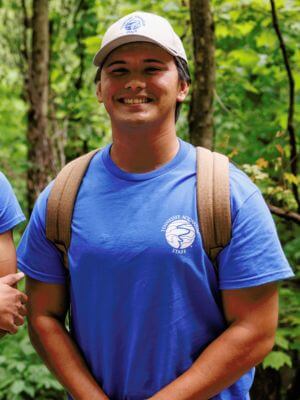
Based on the location of his summer internship alone — the Tennessee Aquarium, on the banks of the Tennessee River in downtown Chattanooga — one might be led to believe that Alonso Angel ’24 spends his days in a monogrammed polo, giving tours to school groups and dispensing scientific facts while kids pet stingrays.
One would be mistaken, however. Instead, Angel — an Outdoor Studies and Tourism major from White House, Tennessee, located roughly 30 minutes north of Nashville — is spending his days working with research teams as part of the Tennessee Aquarium Conservation Institute (TNACI), which “furthers the aquarium’s impact by conducting scientific studies, restoring our region’s natural ecosystems and educating members of the public to take conservation action,” according to the organization’s website.
From the winding bends of the Red River in Eastern Kentucky to the Green River in the south-central part of the Bluegrass State … from Walden Ridge on the eastern edge of Tennessee’s Cumberland Plateau to the Coosa River in Alabama … Angel has, since May 15, taken part in conservation fieldwork that’s an outgrowth of the opportunities he’s been given at MC and a potential launchpad for a future career.
“I definitely want to go to graduate school for sure, and I want to work with fish,” he said. “I’ve loved this internship, and my coworkers are amazing. They’re constantly teaching me things, and it’s a really great place to be interning this summer.
“It’s just so much fun, and I love getting to see all of the work I do actually making a difference and helping out the environment. With some of these projects, we won’t see the results until much later, but you know that what you’re doing is helping out a good cause and making a difference in the environment.”
Doing good on the largest possible scale
A member of the Scots soccer team, Angel grew up loving the outdoors and fascinated by wildlife. The opportunity to play for Coach Pepe Fernandez at MC, along with the school’s proximity to the Great Smoky Mountains National Park, made it an ideal choice for college, but once here, he took his time deciding on a permanent major.
“Originally, I was majoring in Exercise Science because I work out a lot and play soccer, so it made sense for me to do that,” he said. “Then I changed it to Health and Wellness Promotion, but because I love to be outdoors and hike, and I love wildlife, I changed it to Outdoor Studies and Tourism, because I want to be somewhere I can work with nature and wildlife.”
A field trip last semester to Conservation Fisheries Inc. as a student of Dr. Drew Crain, MC professor of biology, sparked an interest in all things ichthyoidal, and Crain recommended he apply for a fellowship with the Tennessee Aquarium’s conservation arm. TNACI works toward a number of goals, including native animal protection (with an emphasis on native fish of the Southeast), conservation planning, and education and outreach. As a Jim Hill Fellow for Conservation, Angel has spent his summer so far in the field.
“It’s a lot of collecting data in the field and then inputting it, depending on what the project is,” he said. “In Kentucky and Alabama, I was working with a Ph.D. student associated with the institute, testing the thermal tolerance of sand darters (a species of small freshwater fish), and we would use seine nets to sweep certain areas of the creeks or rivers to pull them out.”
For the Walden Ridge project, he added, the TNACI partnered with another organization to track the movement of fish in Duskin Creek. A culvert diverting the creek beneath Walden Mountain Road is scheduled to be replaced, and both organizations want to study how it may or may not improve the migration of fish in the waterway.
“We have three pools in this creek — one downstream, one right at the culvert, and one upstream,” he said. “Since April, they’ve tagged 50 fish in each pool once a month, and the next day we come back and seine in parts of the creek 100 meters upstream and downstream from the study pools. If we catch a fish that’s already tagged, we can see where they’re originally from and where they’ve moved to.”
Counting fish and so much more
The goal, he added, is to study the numbers of all fish, but specifically the Tennessee dace, another small, freshwater fish found in the South. Their numbers are lower than average, and by mapping fish movement in the creek before the culvert’s replacement, and then doing so afterward, conservationists can get a clearer picture of whether the improvement has aided the ability of fish to move more or less freely along the creek. Angel’s scientific aptitude was boosted in Dr. Crain’s Environmental Science class this past spring, he added, which has served him well during his fellowship fieldwork.
“He taught us how to collect data in the field and do lab reports, and so I was introduced to the skills I needed for this internship,” he said. “Now, I’m learning a lot of other really useful skills, like seining for fish and tagging fish. It’s really great on-the-job training for what I want to do.”
And, he emphasized, it’s work that will help conservation efforts in a part of the state that’s become a second home. And that, pointed out Dr. Jennifer Oody — Angel’s Senior Study advisor and an associate professor of exercise science at MC — is the epitome of the Maryville College credo as put forth by the school’s founder, the Rev. Isaac Anderson, to do good on the largest possible scale.
Angel’s conservation efforts will also extend well beyond this summer. For his Senior Study, he’s studying the impacts of human interactions with black bears and bison in national parks. One of the distinctive features of an MC education, the Senior Study requirement calls for students to complete a two-semester research and writing project guided by a faculty advisor. According to the College’s catalog, the project “facilitates the scholarship of discovery within the major field and integrates those methods with the educational goals fostered through the Maryville Curriculum.”
“Alonso has always been passionate about the environment and a huge heart for conservation, going so far as to explore the impacts of human interactions with black bears and bison in the national parks for his thesis,” Oody said. “It is always a lot of fun to have a student so excited about their topic. Alonso worked really hard to secure such a notable internship, and we’re all looking forward to hearing about how his summer went.”