


Scots Science Scholars use Maryville College FIPSE grant as springboard for summer research projects
Aug. 13, 2024
Talk about a bang for its buck: Last summer, the U.S. Department of Education awarded Maryville College a $645,000 FIPSE grant to support and enhance the Scots Science Scholars (S3) program, and this summer, the organization’s members are putting those dollars to work through internships and research projects.
The federal money, administered through the Department of Education’s Fund to Improve Post-Secondary Education (FIPSE), was earmarked to expand the capacity of the S3 program and build on the STEM initiatives provided by the College to “increase access to hands-on experiences and industry exposure, with a focus on addressing emerging technologies and scientific innovation in natural sciences, computational science and engineering,” according to Dr. Angelia Gibson, a professor of chemistry and one of the leaders of the S3 program.
The FIPSE funding, added Dr. Maria Siopsis — Gibson’s faculty co-chair of the program and a professor of mathematics — has opened doors that were previously closed due to financial limitations. Grant monies were put to work almost immediately for the 2023-24 academic year, she said, and will continue to serve as a source of financial backing for the coming year as well.
“Several of the students have presented their research at professional meetings, and I expect many more will do so in the coming months,” Siopsis said. “All of the students get the experience of speaking about their research on campus during the academic year through our STEM event series. These lunchtime talks allow current students and other members of the MC community to learn about the kinds of research students can be involved in, and will hopefully inspire them to seek out research opportunities, too. Creating this kind of community around STEM is one of the goals of the Scots Science Scholars program.”
Before they present those roundtables, however, current MC undergrads are spending the summer months in the field and in the laboratory, working with outside partners such as Oak Ridge National Laboratory and other College faculty members in the Division of Natural Sciences, like Dr. Drew Crain, Dr. Nathan Duncan and former faculty member Dr. Anne Rea. Maryville College’s approach to education, such as smaller class sizes and close working relationships between students and faculty members, has given those participants opportunities they may not have found at other schools, Siopsis pointed out.
“We know how important and transformative undergraduate research can be for undergraduate students, and we also know our talented colleagues have lots of ongoing research projects as well as excellent new ideas, so when we wrote the grant proposal, we included funding specifically for supporting student research projects,” she said. “Those funds include stipends for the students and supervising faculty as well as money for supplies and travel. This means everyone gets compensated for their time, and it eliminates financial barriers for students who need to use the summer to earn money. We’ve been able to support 20 projects that include 10 different MC STEM faculty and 26 students, so far.
“The projects showcase the wide variety of research expertise of our faculty spanning computer science, field biology, biochemistry and more, and several are of direct interest to our local community. We were even able to leverage an alumni connection with the cybersecurity division at Oak Ridge National Lab to support five students who are working under the supervision of ORNL scientists.”
It has been, in other words, a FIPSE summer of discovery for several Scots, whose research and work have been paid for out of last year’s grant. This multi-part series serves to highlight the work of those individuals, including:
Jordan Crain ’26: MC’s Chalcone Library
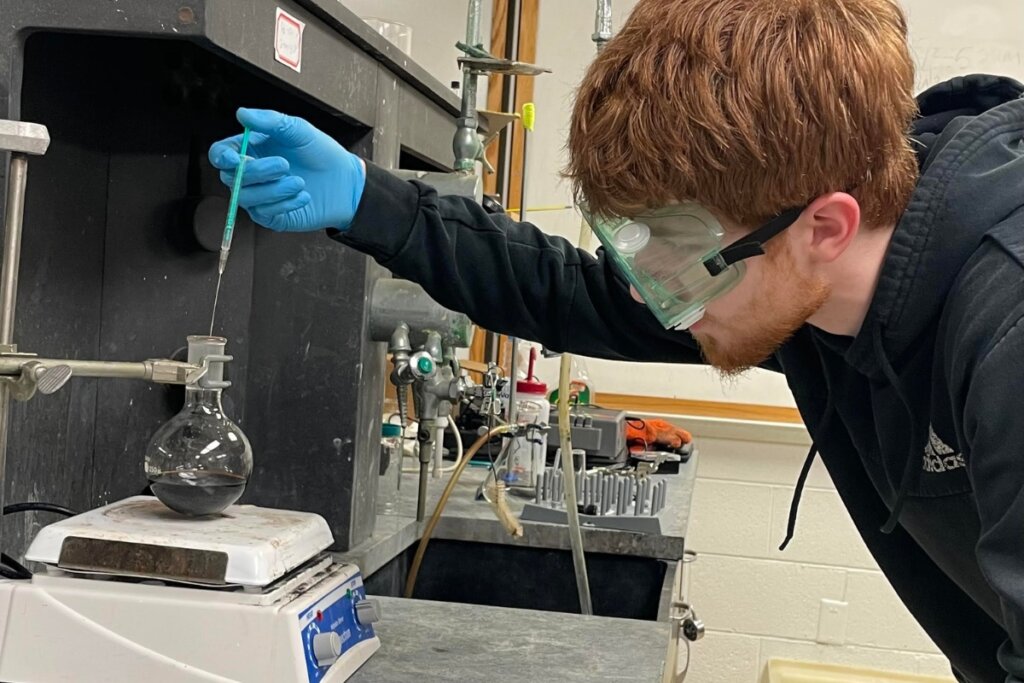
To understand the nature of Jordan Crain ‘26’s work this summer with Duncan, a chemistry professor at MC, one has to first know the definition of a “chalcone.” After all, Crain is helping to catalog and organize the College’s “Chalcone Library,” which sounds like a forgotten wing of the Citadel, that ancient place of wisdom and medicine in the fantasy series “Game of Thrones.”
It’s nothing as arcane as all that, Crain said.
“The Chalcone Library is a collection of stored chemicals at Maryville College that have been used to synthesize various chalones, a specific type of α, β-unsaturated ketones,” he said. “There are two types of chemicals within the library that we use to synthesize chalcones, which are benzaldehyde and acetophenone. When combined, these two chemicals can form a chalcone.”
The library goes back to Duncan’s work several years ago with an organic chemistry class, and it’s been paying dividends for MC science students ever since.
“In organic chemistry, when a structure has the label “R” on it, that means it is a variable (like ‘x’ or ‘y’ in math) and that signifies that you are working with a series of compounds that all differ by different groups attached to the structure,” he said. “A classic reaction that many students do in organic chemistry is one called the aldol condensation, which forms a new carbon-carbon bond between two carbonyl-containing molecules — carbonyl being a term for that carbon-oxygen double bond.
“One classic example of the aldol condensation is the synthesis of chalcone from benzaldehyde and acetophenone. It usually works really well, it’s an overall fast reaction. Several years ago, I decided to switch things up, and we purchased some substituted benzaldehydes and acetophenones so that we had six total benzaldehydes and five total acetophenones, and every student in the lab (there were 24 that year) had a totally unique compound.”
Most of the compounds were common, at least by organic chemistry standards, but some of the them, he said, were new, as in they hadn’t been published in any scientific literature. Members of the class were assigned a “major, in-depth lab report” on these compounds, Duncan added, which led them to do extensive research on the practical application of synthetic chalcones, and in so doing, the students discovered that many of the synthetic compounds had different biological activity.
“This makes sense since some plants make chalcones or chalcone-like compounds that have been shown to be antibacterial, antifungal, cytotoxic, etc.,” Duncan said. “We had essentially created a library of closely related compounds (24 at that point) and in drug discovery, there is a term called SAR (Structure Activity Relationship), which essentially deals with trying to understand what atoms, groups of atoms, functional groups, etc., in a molecule are responsible for the compound’s biological activity. So when developing drugs, scientists will create libraries of compounds with very minor structural differences to find out not just if a compound has a desired activity, but why.”
The excessive number of unique compounds, students discovered, would make ideal springboards for their Senior Study projects, a Maryville College distinctive in which degree candidates complete a project in their majors with faculty guidance and supervision that can often lead to publication in peer-reviewed scientific journals. That first year, Ashley Lebeau ’20 worked with Dr. Jennifer Brigati, chair of the Division of Natural Sciences and a biology professor, to study antibiotic-resistant bacteria. Brock Hodges ’20 and Joe Logsdon ’20 worked with Gibson in examining inhibition of certain proteins. The budding library, Duncan realized, might serve MC STEM students and faculty members well for years to come.
The next year, the library grew to include 30 compounds, more students used it for their Senior Studies, and every discovery — including assays (a test of substance to determine purity) that revealed relevance in the field of cancer treatment — led to the proposal of additional compounds that might be useful for future projects. And that, Duncan added, is where Crain’s work in evaluating compounds to add on to the protein inhibition screening project began by Anya Dunn ’21 is critical.
“Jordan is helping to both fill in the gaps in our library — compounds that were never made with the combination of building blocks we have on hand, and taking the big step into making new building blocks that aren’t commercially available to try to extend our library to contain new compounds that are predicted to be even more potent in the screening assays we are doing,” he said. “The hope is that we can fill in some missing data — some things that would be too small for a single Senior Study, but get the work that we have already done finished to a point where we could publish some or most of it.
“We aren’t likely creating or discovering any new drugs, but we are doing something pretty cool where undergrads get an exposure into the process that drug discovery scientists use to create important medicinal compounds. Overall, this work benefits our division because it provides a ready, go-to library of compounds suitable for a wide variety of research, and the library of compounds is available to the other professors in the division to use in their research.”
And Crain’s findings, the rising junior added, will make it possible for his STEM peers to springboard into their own areas of scientific study. The FIPSE grant is funding his research, and while the opportunity to get paid for his work is nice, the experience is worth more than money. There’s no way to put a price, he added, on true lab work that requires rigorous methods of data collection and analysis that must be presented and replicated in order to be considered scientific.
“Being a student at a smaller college such as Maryville College has offered me the ability to gain closer relationships and connections with my professors and peers, which is one of the main reasons why I have the amazing opportunity to work with Dr. Duncan on this research project,” Crain said. “After I graduate from Maryville College, I plan to pursue an M.D./Ph.D. program, with my long-term goal being to apply both my chemical and medical knowledge to help save lives. I hope to obtain my Ph.D. in synthetic chemistry and to attain an M.D. in pathology to work as both a medicinal chemist and pathologist.”
Up next: Wildflowers in the woods, with Camden Johnson ’25!