A childhood love becomes an Ivy League career: The career path of Dr. Ben Taylor ’06 goes from the Maryville College Woods to Harvard
July 3, 2024
Somewhere in the Maryville College Woods, the boy he once was runs wild and free, an Appalachian version of Mowgli from Rudyard Kipling’s “The Jungle Book,” clambering over fallen trees and wading against the current of Duncan Branch in search of adventure.
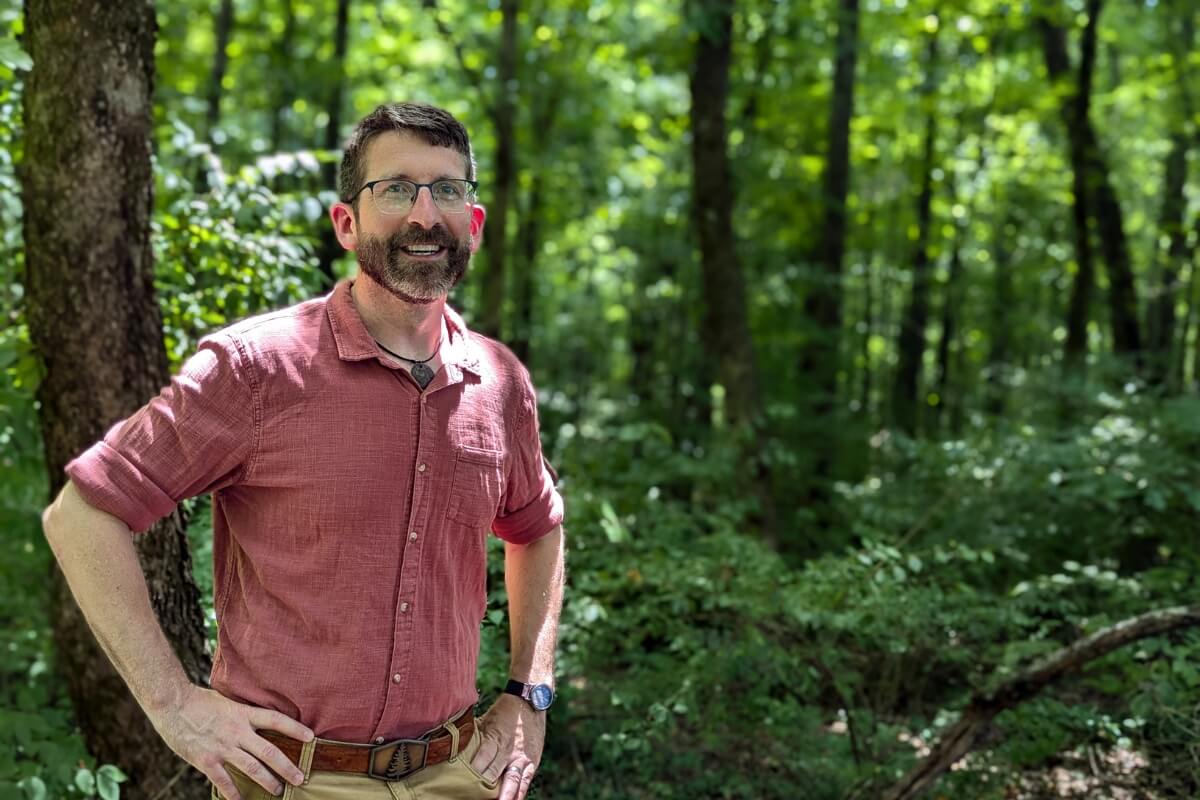
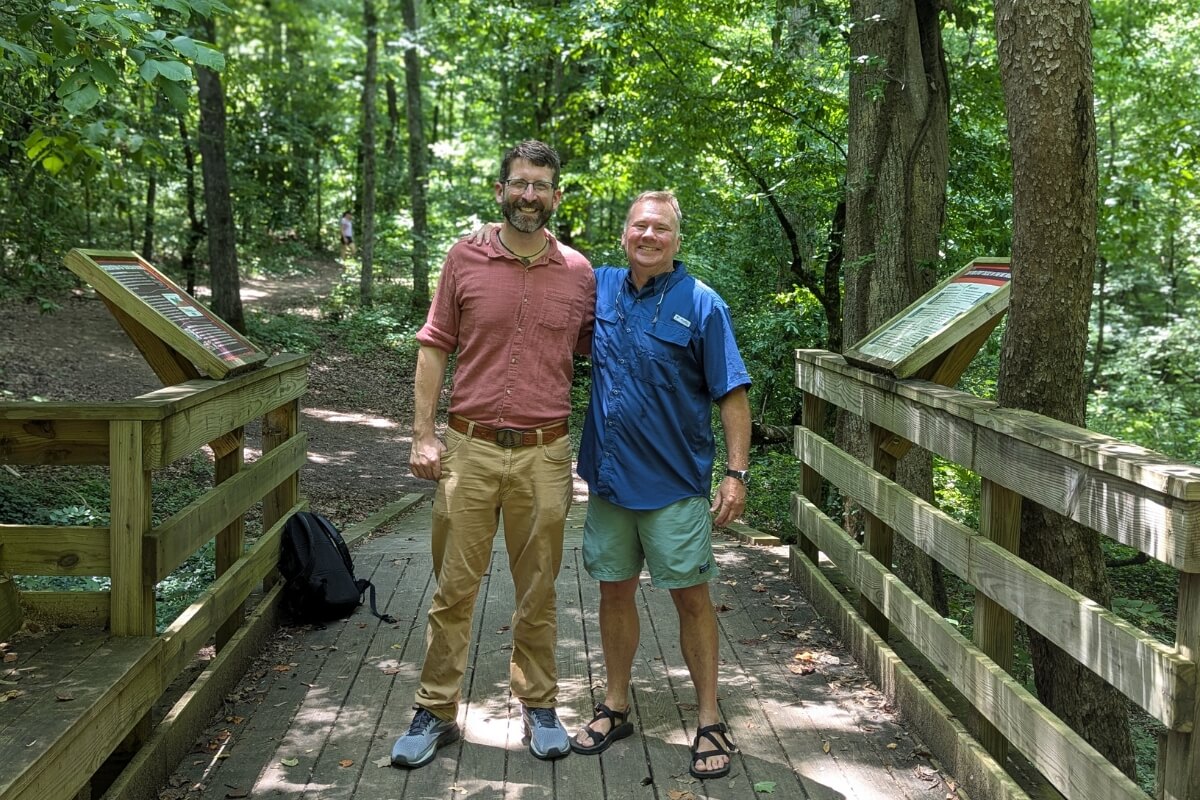
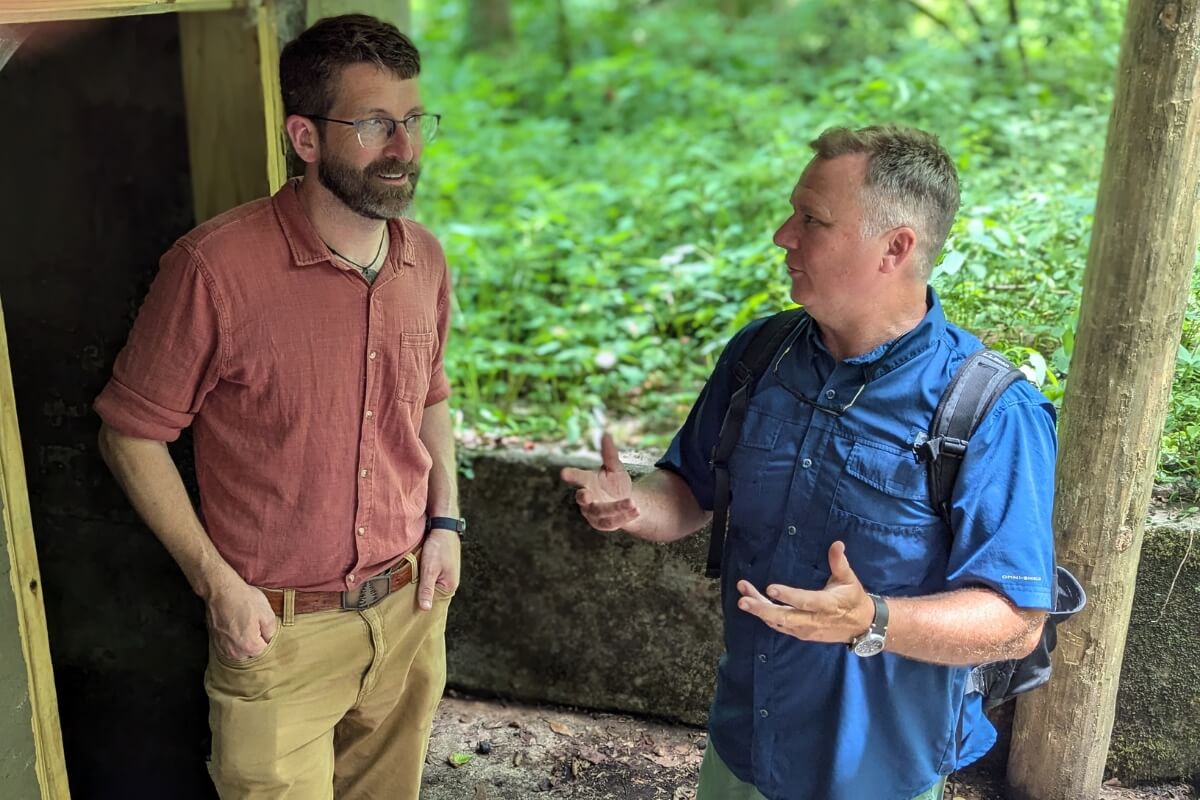
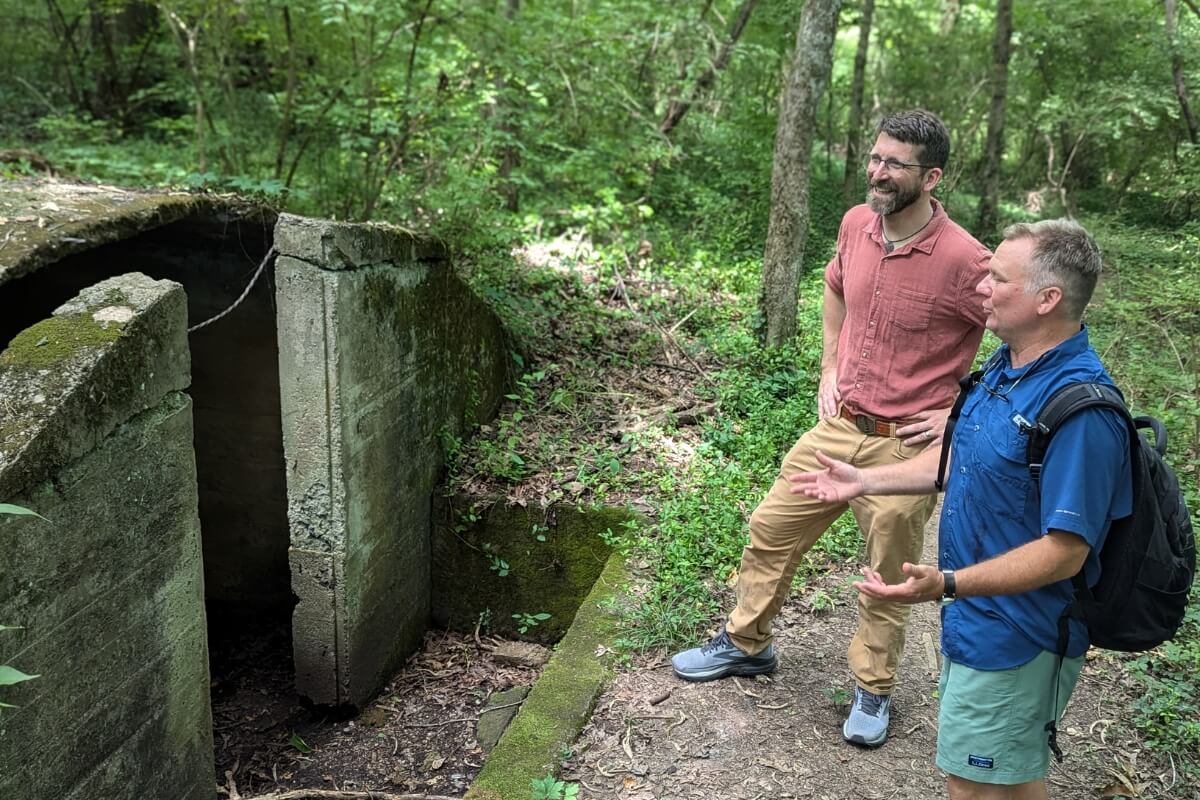
Dr. Benton Taylor ’06 — Ben to friends and family — rediscovers him each time he returns to East Tennessee from the stately grounds of Harvard University, where he serves as an assistant professor of organismic and evolutionary biology. As soon as he crosses the treeline, the temperature drops a good 10 degrees thanks to the verdant canopy that hides the sun, and a rolling tide of nostalgia carries him back to a time when he ran those 140 acres daily.
It was, he recalls, a time of wonder and discovery that played a pivotal role in the work he conducts today as both a scientist and an educator, and whenever he comes home, he feels called to return to that urban forest he knows with a sacred intimacy.
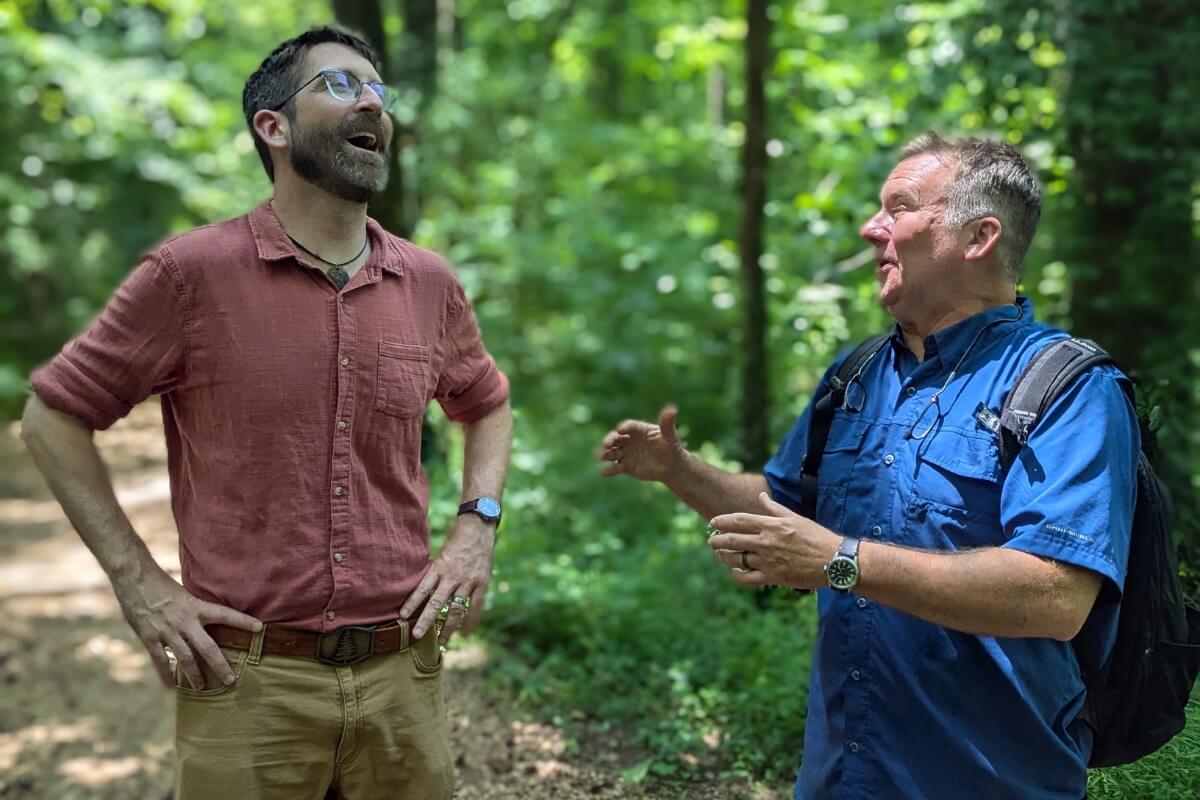
“Me and my best friend, we would walk home from Fort Craig (Elementary School in Maryville) and cross the pedestrian bridge, and our rules as children were that the boundaries of the College were our boundaries,” Taylor says. “Our parents didn’t want us crossing public streets, but other than that, we had full run of the campus, and we spent most of that time in the woods. We would walk to Morningside, drop off our backpacks, and that was it: Every afternoon was spent in there, and I can still tell you every single inch of the College Woods. It was a very formative place for me.”
It’s little wonder his parents gave young Ben, as he’s known to his friends, full run of the College grounds: Tom Taylor ’72 and Nan Krause Taylor ’68 owned and operated a restaurant at Morningside Inn, the boutique hotel now known as RT Lodge and built in the MC Woods in 1932 by Susan Wiley Cooper Walker. Their ties to the historic home-turned-inn is just a small part of their connection to the greater Maryville community: First elected to the Maryville City Council in 2001, Tom Taylor would go on to serve as the city’s mayor for 12 years. His ties to MC were deep ones, Ben said, that date back several generations.
“Both my parents and my brother (Robert Taylor ’03) went to Maryville College, but so did my grandfather (Wilson Taylor ’33), and we lived across the street from the College,” he says. “Just as importantly, or perhaps more importantly, my parents at the time ran Morningside, and my brother and I had a room upstairs where we would sleep when our parents had to work until the wee hours of the morning. Between the Woods and the hospital (Blount Memorial) I was born in, Maryville College was the epicenter of my entire being up until my high school graduation.”
A lifelong love of the forest
It’s not lost on Taylor just how big of an impact his time in those woods has resonated through the years, and the research he carries out on top of a course load of classes he teaches is a reflection of his childhood love of that place. He and his wife, Dr. Sarah Johnson Taylor, have two daughters, and as they grow older, their curiosity is like looking through a mirrored portal to the afternoons he spent there.
“When I come back to Maryville, and I’m walking around in the Woods, I’m constantly flooded by memories all the time, more and more of them from my childhood,” he says. “I have a 4-year-old and a 2-year-old, and a lot of the things I used to do as a kid walking around in the College Woods, they’ve started doing as well, and if I really want to get into the higher-tier philosophical realm, the reason I do what I do — the work on forests and global change — is completely driven by trying to understand and figure out how to deal with and manage and mitigate really intense changes coming down the line for us, and what that will mean for our kids and grandkids.”
That work involves an exploration of the ways that carbon dioxide affects plants, and what the increase in CO2 emissions globally means for the future health of forests and woodlands around the globe. It’s a bit of a paradox, he points out, in that the common knowledge that CO2 is vital for plant growth isn’t wrong … but it also doesn’t mean that boundless amounts of CO2 is a good thing, either.
“Plants tend to grow better when they have more CO2 and they’re warmer, and that would lead you to believe that the higher CO2 levels are in the atmosphere, and the warmer the temperatures are, the better that will be for plant growth. This is a phenomenon called the CO2 fertilization effect,” he says. “The bigger our forests grow and the more carbon dioxide we pump out of our tailpipes, the more it gets captured in the leaves and biomass of trees. This is currently helping to slow the pace of climate change substantially, but this effect won’t last forever.
“How long do we expect this CO2 fertilization effect to continue? What might lead it to go away at some point? Because while the additional plant growth every year is sucking up that CO2, it’s also sucking up all of the nitrogen and phosphorus out of the soil, and if they absorb it all, then we’re sunk. We’re already worried about the pace of climate change, and if that CO2 fertilization effect goes away, that’s going to ramp up climate change a lot. A lot of the work I do is understanding when this CO2 fertilization effect might stop, and if there’s a way to overcome the effects when it does.”
It’s important work, so much so that the May-June issue of Harvard Magazine featured his research as its cover story. “Capturing Carbon: Can trees combat climate change?” is an in-depth look at the research, but more importantly, it’s a look at the man conducting it … and the journey he undertook from the planting of seeds of interest as a boy in the MC Woods to his life as an educator and researcher at the most prestigious Ivy League school in the nation.
“At some point, it really, really clicked for me, that figuring out answers to questions nobody had ever answered before was really, really satisfying,” he says. “I really believe in the type of research I’m doing, which is understanding how nature is going to respond to all of these human-caused changes to the world. It’s something I’m fundamentally passionate about, and that passion led me to be a scientist, and it’s scratching the itch of identifying a question that doesn’t have an answer and going and figuring out the answer.
“That’s just super-satisfying for my brain, and it’s one of the most fun things about the job. At some point, I gained enough skill in the research realm to be able to do that, and to do it well … which is something I learned at Maryville College: If you enjoy something and you pursue it, you’re going to get better at it.”
A legacy of MC excellence
While it may seem like manifest destiny that the road to Harvard should have led through Maryville College, Taylor’s decision to attend the same school as his father, mother, grandfather and older brother was actually a last-minute one, made around the time he graduated from Maryville High. It wasn’t that he didn’t want to attend, he says; like most teens, the call of the open road and adventures beyond the protective eyes and stifling reach of parents was a tempting one.
“I did want to go to a small liberal arts college, and I liked the feel of MC, but I didn’t particularly want to be right across the street from my parents,” he says. “I actually wanted to go to Brevard (College in North Carolina), but it became clear there was a palpable difference in the academic rigors between Maryville and Brevard, and I wanted that. It took some assurances by my parents that they wouldn’t be breathing down my neck, but I decided to come to Maryville, and I’m so, so glad I did.
“My experience was great, and I’ve been to a bunch of different universities since I left Maryville. And what I’ve found is that it is every bit as good as any other place. If I’m here in Boston and tell people I went to Maryville College, not a lot of people have heard of it, but when I look at the quality of teachers and students at Maryville vs. the Ivy League schools I’ve kicked around in for the last 10 years or so, they’re on par with each other. Maryville is just a really wonderful place.”
Attending MC gave him an opportunity to become even more familiar with the College Woods, especially as it compared to another forest he knew intimately: that of the Appalachian foothills surrounding the Taylor family cabin at the end of West Millers Cove Road in nearby Walland, Tennessee, past the luxury resort Blackberry Farm and only a few miles outside the boundary of the Great Smoky Mountains National Park. The forests around the cabin were also fair game for unsupervised childhood roaming, he says, and as he began to drill down into his desire to become an ecologist through his MC studies, he began to notice the remarkable differences between the two tracts.
“For example, in the stream that flows through the Maryville College Woods, there were all of these little freshwater mussels that were nowhere to be found in the Smokies,” he says. “I would collect them all the time at the College, but I could never find them in the mountains. The other big difference was the English ivy that used to carpet everything in the Maryville College Woods. I have to give a huge shout-out to (Dr.) Drew Crain, who organized the cleanup of a lot of that, but there was not one strand of English ivy (an invasive ornamental species) in the West Millers Cove area.”
Spotting those differences … and more importantly, being trained to spot them … was just one of the scientific tools he collected during his time as an undergraduate. The fact that he was as comfortable roaming the College Woods as he was in a classroom in Anderson Hall or a lab in the Sutton Science Center also gave him an advantage, and MC faculty members recognized his curious mind and willingness for fieldwork right away.
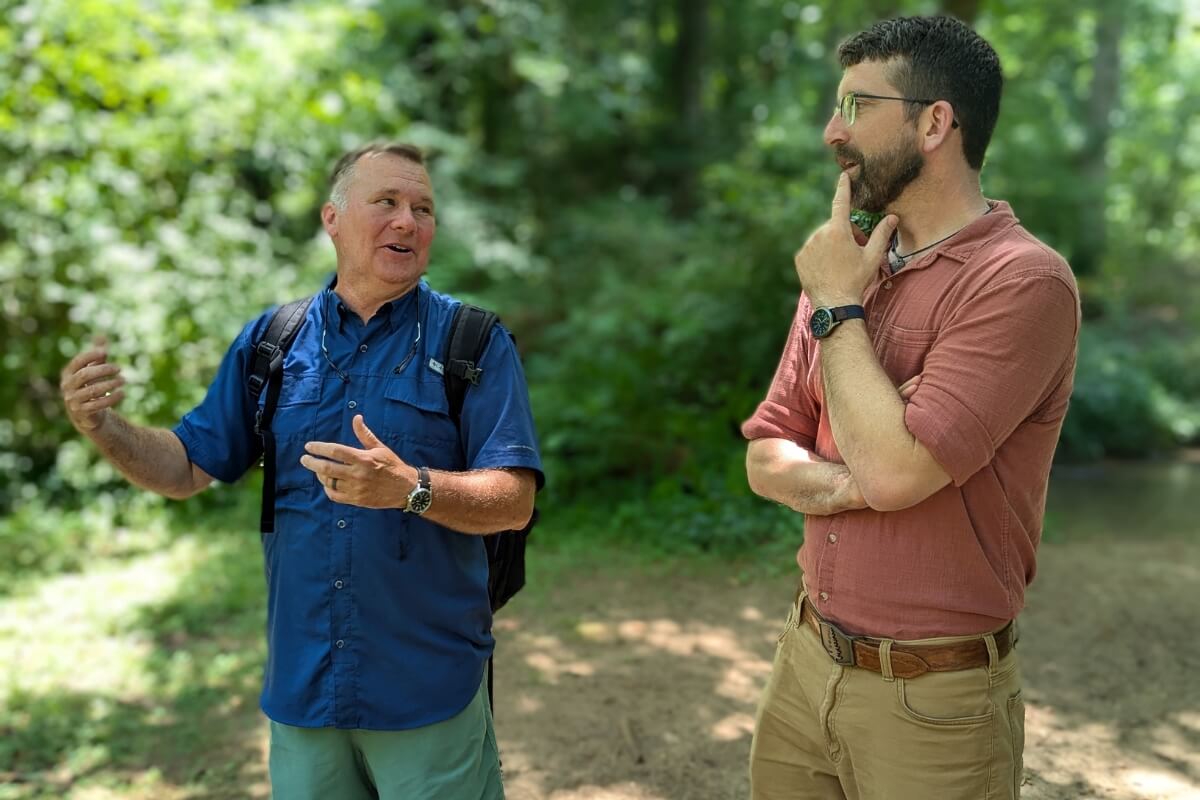
“What I remember about Ben was his genuine curiosity and enthusiasm for everything we studied,” says Dr. Jerilyn Swann, the associate academic dean and director of institutional research at Maryville College who taught as a professor of biology during Taylor’s time as a student.
“ He was interested and inquisitive about every topic, fearless in the pursuit of truth — the ideal student!” she adds. “His fascination was infectious, contributing to the positive atmosphere in class and in lab. He paid attention and delighted in making connections with content in his other classes, all of them, whether they were science courses or other general education courses. He helped make class fun for everyone, including me, and we all learned a lot together.”
Taylor, adds Crain — professor of biology and one of Taylor’s mentors during his time as a student — thrived under the liberal arts curriculum at MC, drawing parallels between courses in the humanities and in science and using both as a springboard to greater things.
“Ben truly embraced the liberal arts, learning from many different fields to address problems facing humanity,” Crain says. “Students like Ben do not take classes just to pass or get a diploma; they take classes to gain information, but also to gain knowledge and techniques that foster lifelong learning.”
That love of the liberal arts, Crain points out, is articulated in a value statement of the laboratory at Harvard that bears Taylor’s name, which he set up in the university’s Weld Hill Research Building, located in the Arnold Arboretum, where his work on plants and the impact changing climate has on them continues: “We believe that great science is built on the pillars of inquiry, reason, and ethics. These pillars transcend the boundaries of race, gender, religion, sexual orientation and socio-economic background. Diversity, after all, is the greatest wonder of the natural world.”
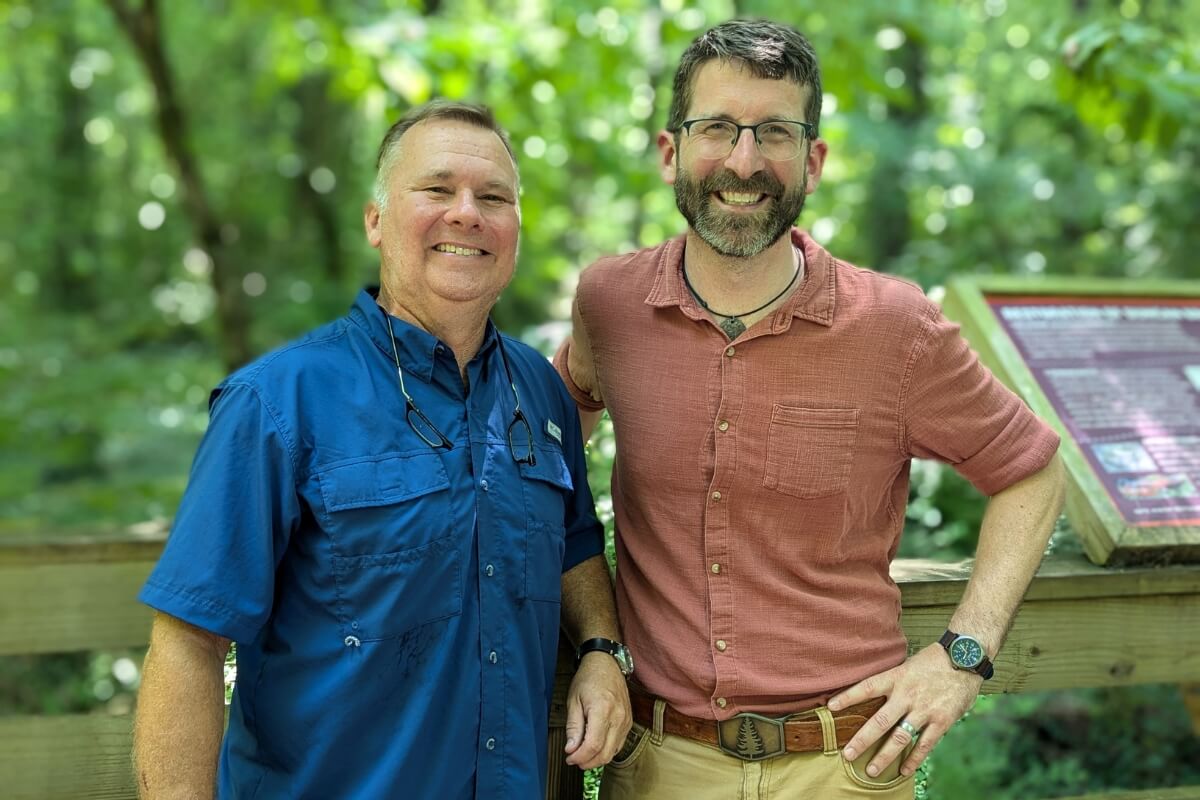
Swann and Crain are just two of the numerous faculty members who made an impact on Taylor during his time as a Scot. Dr. Ben Cash (former MC biology professor) and Dr. Terry Bunde (professor emeritus of chemistry) were equally influential, he says, but Crain’s tutelage was the tipping point.
“I was very ecology-driven when I was in college, but frankly, I wasn’t a very good student,” he says with a chuckle. “Dr. Crain’s physiology classes cracked that sphere, because it led to me actually understanding how the insides of these plants and animals work, which is really important to understanding how they interact with the environment around them. That speaks to how good of a teacher he was in that he made that interesting to me. And the other thing about his classes is that I read a scientific paper in his class, and even for dry scientific papers, it was a really cool one about how if you expose frogs to certain chemicals, they change gender.
“I just thought that was incredible, and then in passing, Dr. Crain mentioned he either was friends with or had been students with the author of that paper, and that blew my mind, that the names on these papers that produced what I thought of as the truth of scientific knowledge were actual people who had friends, and that one of them might be Drew Crain. That he knew people publishing these big, cool papers was so mind-blowing to me, because it really opened up my exposure to the field of science and the act of generating papers.”
A Harvard man by way of East Tennessee
Today, he sees a great deal of Crain in his own approach to both research and teaching. Faculty members at similar-sized institutions to Maryville College — especially smaller, liberal arts-focused ones — focus on honing their teaching skills, which is an honorable aspect of the profession. Crain demonstrated that one could teach and do so in a way that made learning fun, but could also continue to conduct fieldwork that contributes to science as well.
“In the Division of Natural Sciences at Maryville College, we do not just present information about science to our students; we teach them that science is a verb,” Crain says. “ Science is not something that was discovered; it is something that is continuing to be discovered. We teach this in our teaching labs and in our numerous undergraduate research projects. By getting to work with students on research projects, whether they are first-year students or seniors, our faculty members are stimulated to continue learning, and our students become active participants in the field of science. I remember Ben Taylor embracing this wholeheartedly, and he has certainly taken this to another level.”
At the same time, there are some aspects of his MC experience that were wholly unique, Taylor adds. The size of Maryville College, as well as the culture of more elite institutions like Harvard, make relationships like the ones he had with Crain and Swann impossible to replicate as a professor, and impossible to find as a lifelong learner. After knocking around Australia for a few months following Commencement (Taylor was also named the Maryville College Outstanding Senior for 2006), he obtained his master’s degree at Clemson University, and then pursued the girl who’s now his wife to Charleston, South Carolina. There, he got involved in a research project based out of Duke University and eventually landed at Columbia University to earn his Ph.D. Following two years of post-doctoral studies at the Smithsonian in Washington, D.C., he arrived at Harvard in 2020.
“Initially, it was a little terrifying,” he adds with a laugh. “I worried about a lot of things, one of which was fitting in. I don’t want to create a narrative of growing up in some super-disadvantaged Southern Appalachian upbringing, but there aren’t a lot of people here with my backstory. Most have parents who went to Ivy League schools and grew up around the Ivy League for their entire lives. I guess you could say I worried about not being smart enough.”
He needn’t have worried: Crain and Swann and Bunde and Cash and so many others outside of the Division of Natural Sciences had prepared him well. Dr. John Gallagher, retired professor of management, is another example, he adds: In Gallagher’s first-year ethics class, he learned how to evaluate ideas, articulate for his positions and curate conversations that led to excellence for both parties involved.
“Initially, any time I had any success at Maryville College, there was always this question in the back of my mind: Am I successful because I’m in a pool of 950 students, or am I going to be way behind if I go to Columbia for a Ph.D.?” he says. “But what I’ve found, whether it’s at Columbia or Harvard or even the Smithsonian, is that the students at Maryville College are every bit as good as the students anywhere else. And I don’t think I ever doubted that, but I wasn’t sure, because Maryville is something of a small pond. But it turns out that it’s a really, really good pond!”
“Through the years, Maryville College has produced many leaders in science, and Ben is included in that list,” Crain adds. “From students who have gone on to name new turtle species (Dr. Josh Ennen ’03) to those who have helped cure diseases (the late Dr. Charlton Mabry ’50) and established clinics for spaying and neutering pets (Dr. Erin French Dols ’08) to nationally recognized experts on heart disease and Alzheimer’s (Dr. Robert Mahley ’63) … the list goes on and on and on, and I am so proud of the impact that the Maryville College Division of Natural Sciences is having on the field of science.”