Maryville College Computer Science major lands job as firmware engineer — and he’s only a junior
Dec. 13, 2024
The late Eldria Hurst didn’t live long enough to see his grandson rise through the ranks of Maryville College students to land a job in his career field by his junior year as a sterling example of the school’s STEM success, but no doubt he’s proud.
For 36 years, the elder Hurst was part of the security team at MC, retiring in 1998 as chief. He and his wife, Etta Sue — herself a longtime member of the College’s housekeeping staff — moved into the Alexander House on campus, which now serves as the Center for Community Engagement, and saved it from demolition by helping to remodel and rehabilitate the historic structure.
Add in two aunts who attended MC — Teresa Hurst Crabtree ’85 and Carolyn Hurst Ierulli ’80 — and it’s easy to see why Matthew Hurst ’26, a Computer Science major, never wavered from his desire to attend the school where his grandfather was so well-known by generations of his predecessors.
“I grew up on campus in the fall with my Dad, who served as the equipment manager for the football team for some time (under his uncle, Tony Ierulli ’80, who served as head coach from 2003 to 2011 and was inducted last month into the Maryville College Wall of Fame),” Matthew says. “I had always wanted to go to Maryville College because I thought it was kind of the way things were supposed to be. It was important to me to stay in the area instead of commuting to Knoxville to attend UT. I find a lot of enjoyment in living in Maryville and Friendsville.”
Today, Matthew is a full-time employee of Schneider Electric Systems, a French-based company that’s a leader in IoT technology and solutions. IoT is an acronym for “Internet of Things,” which is an umbrella term for devices that connect and exchange data with other devices and systems over the internet or other communication networks, and encompasses the fields of electronics, communications and computer science. Ring doorbells, home thermostats and even tap-to-read credit cards are examples of devices that make up IoT.
The focus of Schneider’s Maryville operations is on the Industrial Internet of Things, and the company produces “a variety of products in a manufacturing setting to sell on a global market,” Hurst said. The company’s Maryville operations unit has an international reputation as a pioneer in Industrial IoT and has built cellular network and other network-connected devices since 2005, primarily systems to read liquid levels in tanks for explosive materials like gasoline, propane and other chemicals. Globally, Schneider Electric is a multi-billion dollar global company with 168,000 employees producing electrical panels, light switches, electrical sockets, surge protection and uninterruptable power supply in more than 100 countries.
An internship becomes a career
Hurst’s journey to a full-time firmware engineer associate at Schneider before he even began his third year at Maryville College started innocuously enough, he added … but it’s definitely telegraphed to a Maryville-based operation just how talented STEM students are at Maryville College.
“My mom (Sharon Hurst) works at our Maryville campus helping to manufacture a leading product called the VibraSwitch, a mechanical safety apparatus that acts as a second line of defense to shut off machinery that starts violently shaking when it shouldn’t be,” he said. “I had been looking for a summer internship, and she pressured me to reach out to their hiring manager, although they didn’t have any positions listed. I originally reached out to their Software Engineering department, but they did not have any projects, so it didn’t make sense to hire an intern.
“However, the Engineering department’s hiring manager said he would be happy to bring on a firmware engineering intern, as they were having issues filling that position, so any help would have been appreciated.”
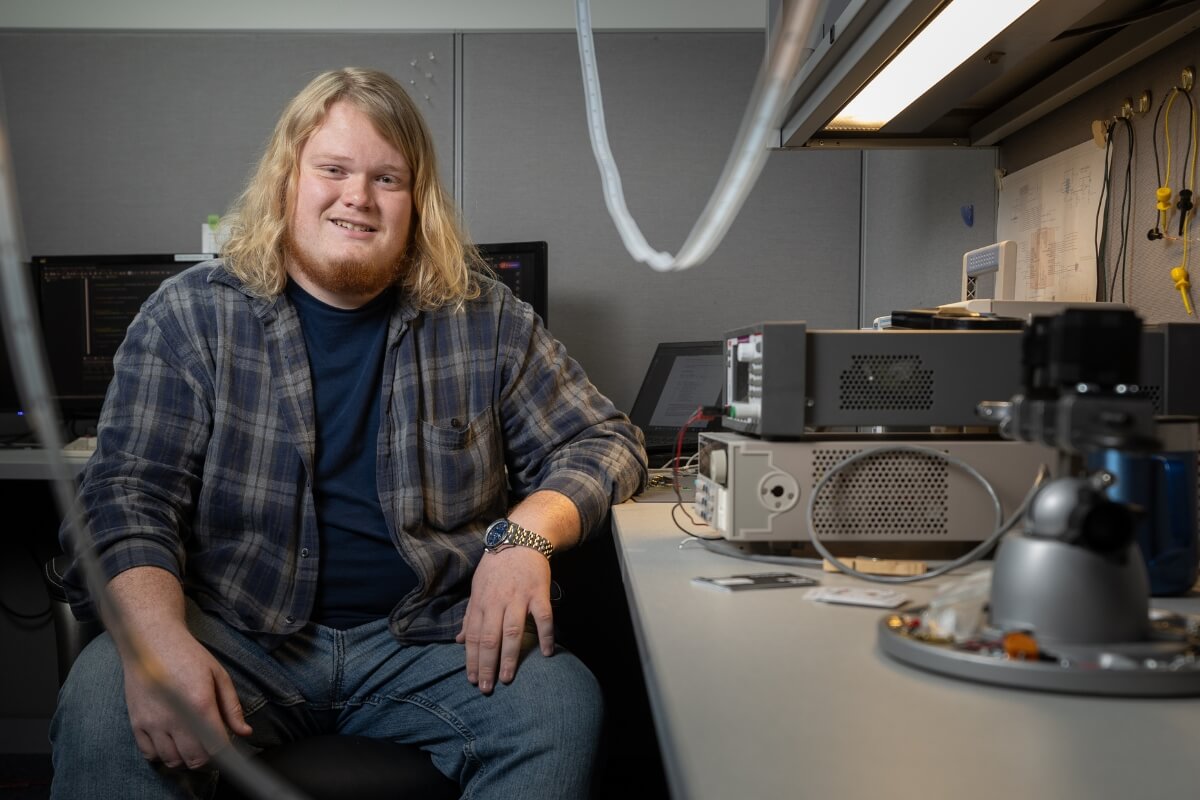
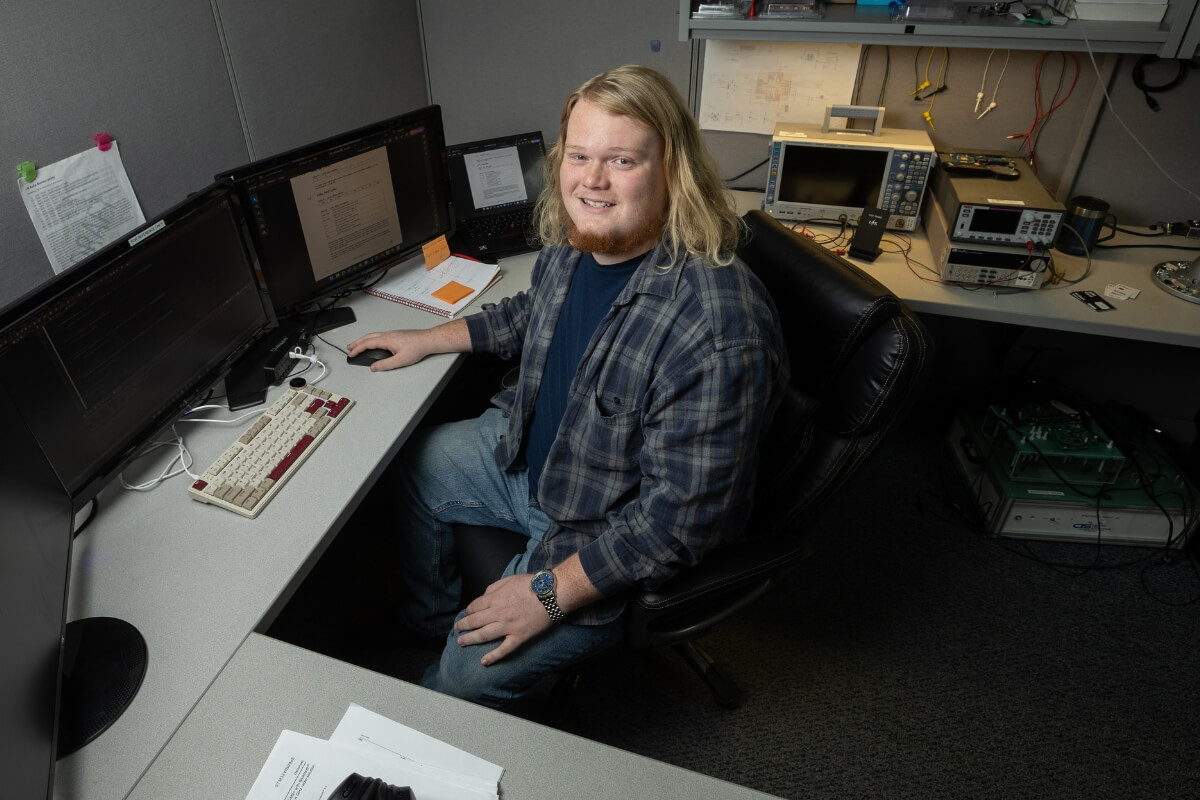
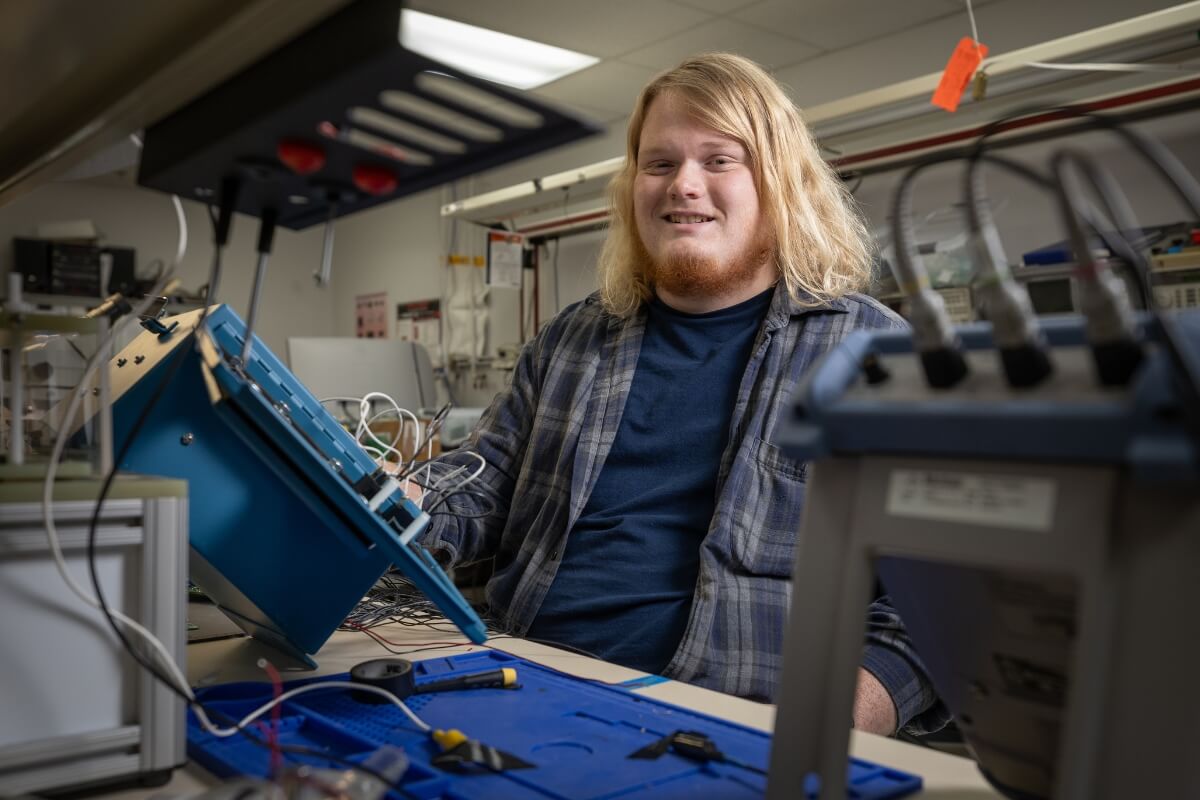
As an intern, Hurst was assigned with two initial tasks by Manager John Jacobs: to develop firmware, software that controls computer hardware, for an automatic printed circuit assembly (PCA) tester for VibraSwitch boards so that they could be tested for malfunctions, and to analyze the viability of a time-of-flight sensor for a tank measurement system.
“The latter took a couple of weeks,” he said. “I was able to pull the laser interface up and read measurements from it (and found it was extremely accurate), but not accurate in measuring liquids. I found that the laser refraction in the liquid was of course an integral issue in using it to measure tank levels. A time-of-flight laser sensor basically just sends a laser down to something and waits to see how long it took to come back.
“The idea was that it would be mounted on the top of the tank, shoot a laser to the surface of the liquid, and wait for it to return. This did not work, as the laser would refract or simply go through clear liquids and take longer to return, thus giving a further distance and a ‘lower tank level’ notification.”
His PCA testing assembly is ongoing, he added, because Schneider standards require significant fine-tuning to make it as accurate as possible. It’s a team project, he added, although his specific task was to develop firmware for running the PCA boards through a series of tests that analyze connections and electromechanical logic, among other things. His work takes place on a board designed by the company’s electrical design engineer, and the housing for the PCA testing apparatus was designed by the team’s mechanical engineer.
Such collaboration, he added, reflects similar team-oriented projects undertaken at Maryville College by Hurst and his peers.
“It is extremely valuable to have a personal connection not only with my professors like Dr. Barbara Johnson (an associate professor of computer science and Hurst’s advisor), but also my peers and basically the entire class. It is not uncommon for students to create entire GroupMe chats for the whole class, which I don’t think would be as effective in huge classes at larger schools. Those personal connections lead to high accomplishments.”
Hurst’s internship became something more after Jacobs and Hurst met with Nordic Semiconductor, a technology company based in Norway that had produced a new low-power chip designed for cellular solutions that emphasized low-power needs, he said. After the pitch, Jacobs came away with an idea for a new monitoring system that, if successful, would replace older, outdated monitors on tanks and gauges. Jacobs wanted to build an “extremely low-power minimalist cellular monitor” that he thought would be quite groundbreaking because of its simplicity and low production costs.
Working with some of Nordic’s development kits with the chip, Jacobs tasked Hurst with developing proof-of-concept for the project. The problem: his internship was coming to an end.
“He came up with a solution: terminating my internship and moving me to a contract-to-hire position, which is basically offering a temporary worker a contract at the end of which is full-time employment,” Hurst said. “I was over the moon when he told me this news. He asked if I would be interested in doing this so I could keep working on the project and see it to completion and stay on with the company afterwards. I of course agreed, and I’m now a contractor working at Schneider Electric.”
Representing MC STEM well
His title: associate firmware engineer, and according to Johnson, it’s just the latest step on a journey by one of her division’s many rising stars.
“Matt is an incredible student, both academically and personally. He is one of the top students in the Computer Science major here at Maryville College,” Johnson said. “ I know Matt is a very busy person with his major classes, his music scholarship (he plays trumpet in the school’s Tartanband), and his other activities and responsibilities, yet he still finds time to be an officer in our Computer Science Club and an active participant in the projects the club does on the students’ own time, including representing us at College events, developing a website for our club, and so much more. He is also just an extremely pleasant person who is a delight to work with.”
As for his new employers, Hurst’s addition to the team has been twofold: He’s become a valuable employee, and he’s made the company aware that Maryville College STEM students are a capable pool of possible interns and employees in the future.
“I have had a number of interns in the past and only hired one other,” Jacobs said. “Matthew is pursuing multiple projects and actually producing results. As for having a full-time position as a (college) junior, I would say it’s unusual, especially in an engineering/R&D (research and development) role. Schneider is very receptive to interns, but hiring someone full-time is a different matter, because we are very selective, and many of our employees stay here for their entire careers before retiring from the company.
“Matthew is a highly motivated and capable individual. He has been able to pick up many difficult concepts working largely on his own, and he brings some incredible skills to the table. I actually have very little experience with Maryville College and its students, because I never really considered it to be a technical setting but rather a liberal arts-focused environment. Matt is extremely curious and motivated to learn and figure things out on his own.
“He seems to have some great programming skills that I must believe come from some of his computer science coursework and other related projects,” Jacobs added. “As I look for interns and candidates to hire I will certainly be more receptive to MC students and grads.”