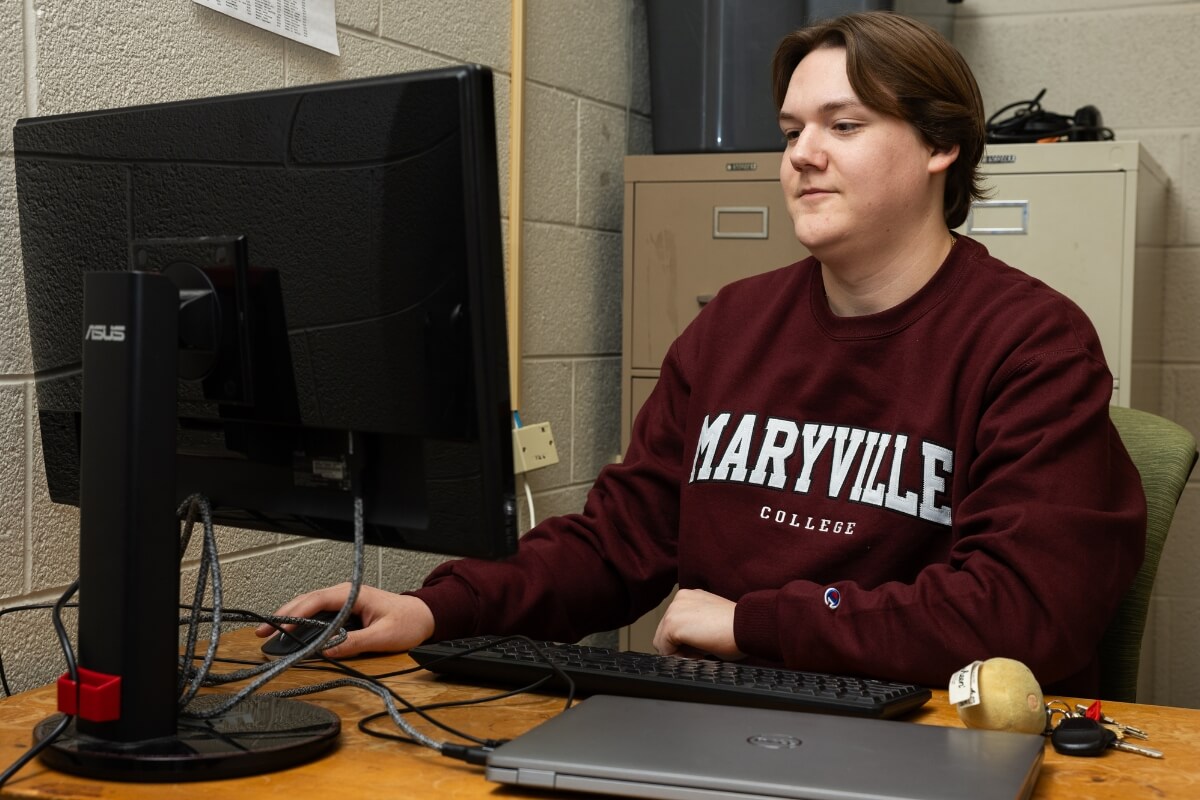
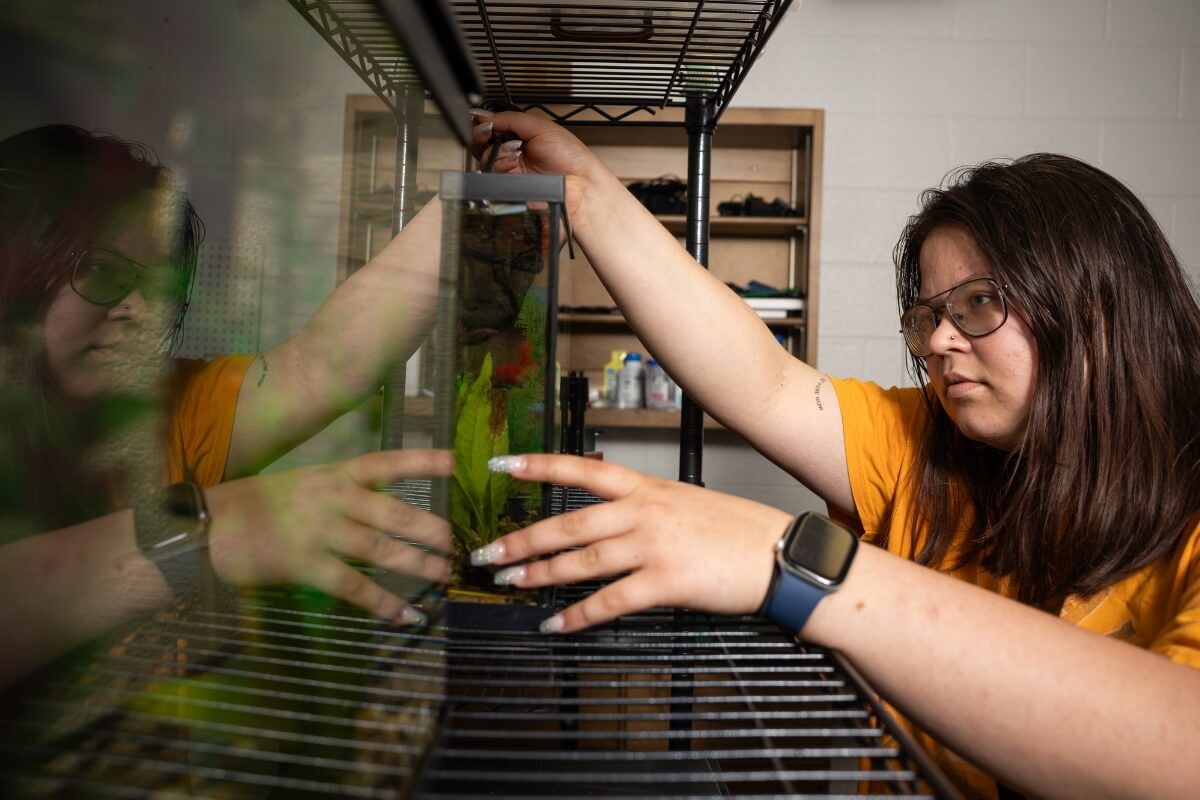
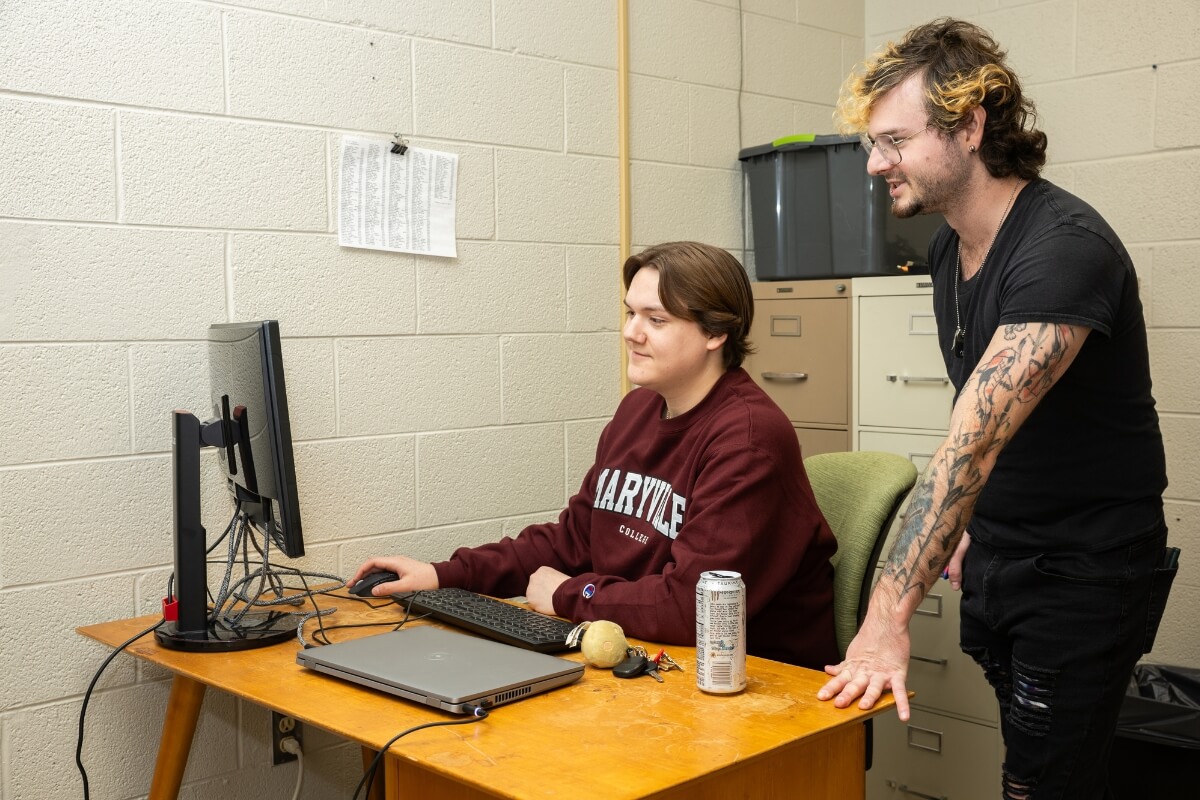
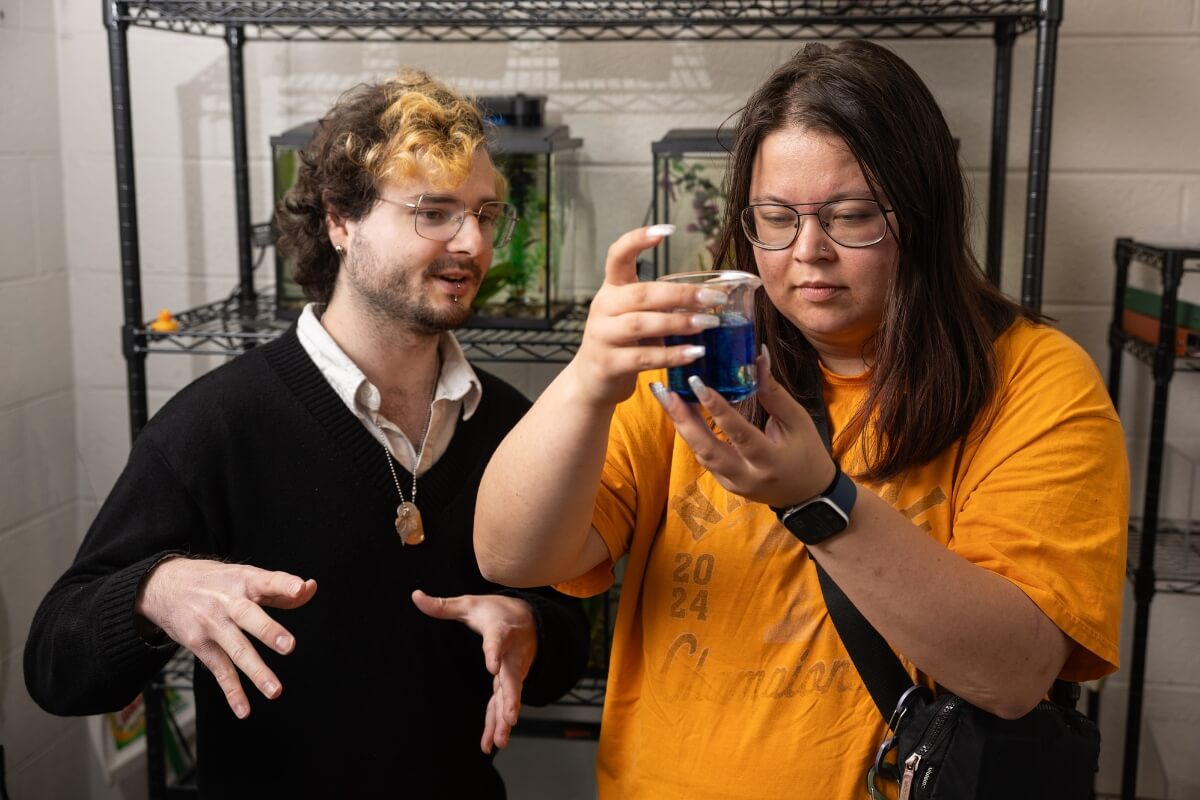
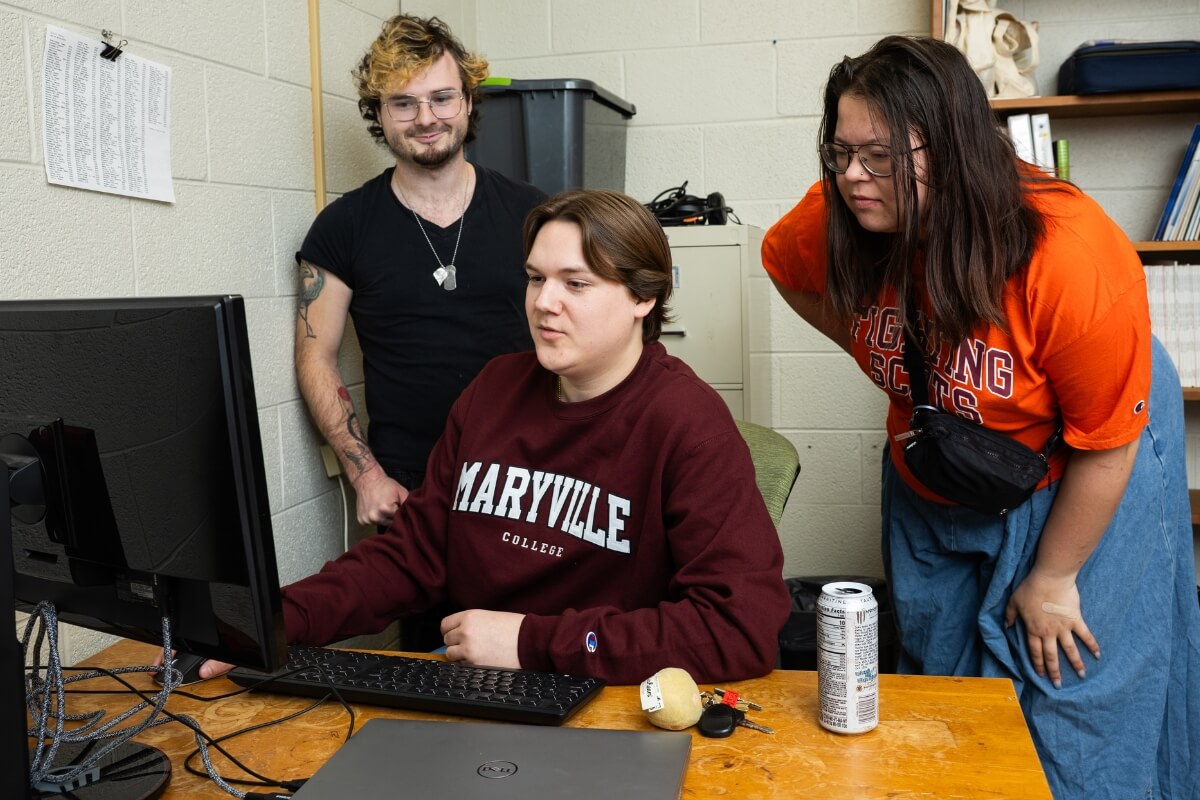
Two Maryville College Neuroscience majors working on research projects funded by the Ledford Scholars program
Oct. 31, 2025
Their Ledford Scholarships were awarded earlier this year, but for two Maryville College Neuroscience majors, the work funded by them is ongoing.
Sami Sasinouski ’26 and Clayton Tuggle ’26 were named as Ledford Scholars in April, when the presenting organization, the Appalachian College Association, announced the 2025 recipients from institutions across the Appalachian region. The Ledford Scholarship program, named for Colonel Lee B. Ledford, provides students at ACA-affiliated institutions with financial assistance for research projects.
The application process involves a written research proposal, as well as endorsements from a faculty mentor and the dean of the institution, followed by an extensive review of the proposal conducted by a committee of faculty and deans from various ACA schools. Dr. Jeff Kelly, assistant professor of neuroscience, and Dr. Chad Schrock, professor of psychology, served as the faculty mentors of both Sasinouski and Tuggle.
The research both Scots are able to do because of the Ledford Scholarship will make up the bulk of their respective Senior Studies, a centerpiece of the MC experience in which degree candidates work with a faculty supervisor to expound upon scholarship and ideas in their respective degree fields.
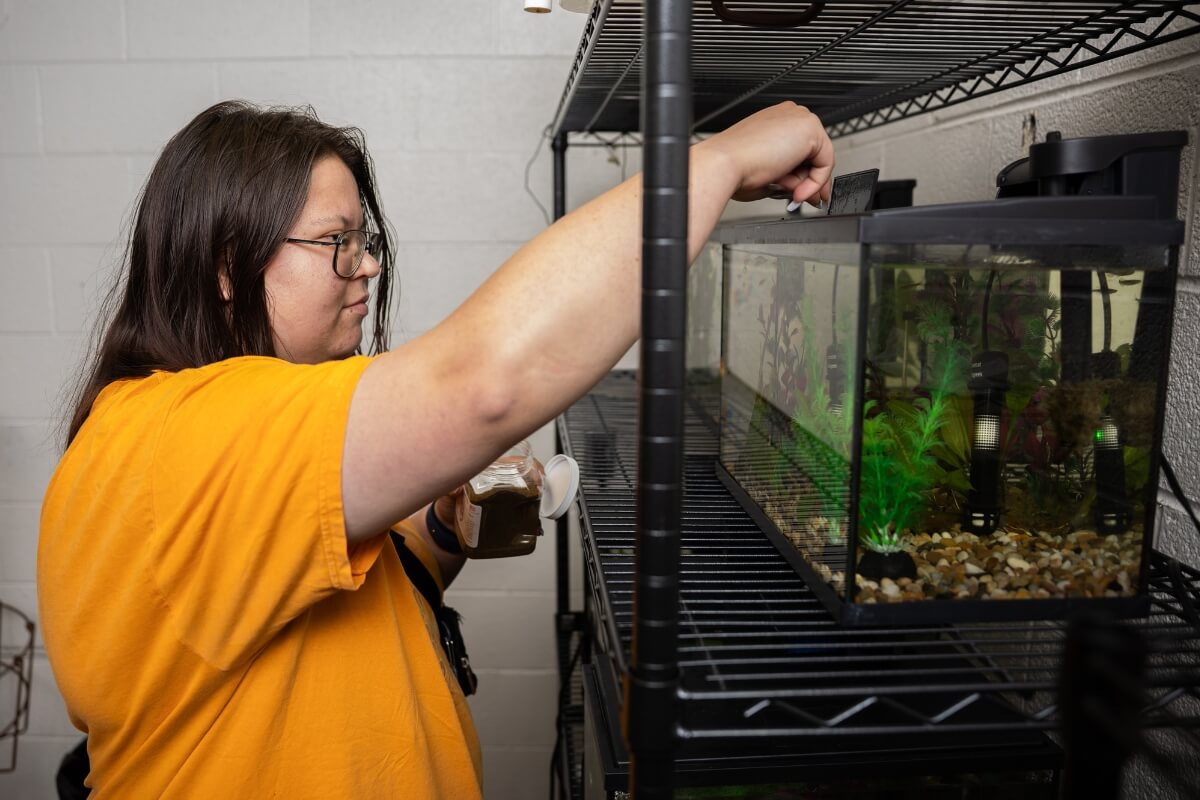
Sasinouski is studying zebrafish to compare the efficacy of common pharmaceutical treatments for bipolar disorder and measuring how each treatment affects the expression of brain-derived neurotrophic factor (BDNF), a protein involved in neural plasticity and neurogenesis. Tuggle is studying a set of public health data to determine correlations between traumatic brain injury and mental health outcomes in specific patient populations.
“Opportunities like the Ledford fellowship are incredibly helpful for students in so many ways,” Kelly said. “Not only does it provide the requisite financial resources to support the research and considerable time commitment, it also highlights the promise of these students as developing professionals. These are competitive fellowships, and I believe it speaks volumes to these students’ academic excellence that they have received this recognition and support.
“Such an award also certainly doesn’t hurt as a CV line when applying to graduate schools, med schools, jobs, etc. Importantly, though, I don’t believe that either of these Senior Study projects, as designed, would have been possible without the support of the Ledford Scholarship.”
Looking for answers using science
And he doesn’t mean just financially: Absolutely, Sasinouski said, the financial boost from the Ledford Scholarship is beneficial, but the award also “influenced my ability to conduct this research by giving me the opportunity to present my findings, and giving me the freedom to explore different routes that this experiment could go,” she said.
The variability of bipolar disorder attracted her to the research, she added, and zebrafish share a genetic similarity with humans that made them practical subjects for her work (in addition to the plentiful amount of research on zebrafish that already exists). As she got into her own research, she made several surprising discoveries, she said.
“It seems that lithium actually ended up making the zebrafish more anxious during some of the tests, which was actually the opposite of what we expected,” she said. “The most rewarding part has been completing the behavioral scoring that I had to do — it took me hours, but I felt so accomplished when I finished.”
“I’m super excited for Sami’s project because I think it fills a very clear gap in our current understanding of treatment for bipolar disorder,” Kelly added. “Currently, we don’t have a phenomenal understanding of how these medications work, nor how different individuals may respond to the pharmaceutical options available to them. Sami’s study tackles both of these research gaps in one swoop, which is an excellent contribution to the field.”
While Tuggle is pursuing a different avenue of research, his, too, is related to bipolar disorder — specifically, his father’s diagnosis. A U.S. Navy veteran, his dad was injured in an electrical accident during his service; after hospitalization and recovery, he was honorably discharged, but a year later, he was diagnosed with the brain disorder, Tuggle said.
“Originally, I wanted to research electrical injuries and a link between bipolar, but limited resources and sparse previous research has proven tricky,” he said. “However, I’ve been able to approach it from a wider angle, scoping out all traumatic brain injuries and their links to psychiatric conditions of any variety.”
The Ledford Scholarship, he added, provided him with funding to purchase datasets from the Healthcare Cost and Utilization Project, as well as the accompanying software to organize and sort the files. Without it, he said, “My entire study would be incomplete!”
And that, Kelly added, would have denied the world of research that may very well turn out to be vital.
“Clayton’s study is also exciting to me because in many ways it feels very exploratory,” Kelly said. “Because of the exploratory nature of the study, it’s got a level of suspense & excitement, because you never know what you’ll find! Not only that, but Clayton will also gain some excellent data science and coding skills, which are truly invaluable in our increasingly technological world.”
Invaluable experience, skill acquisition
For Schrock, the opportunity for skill development as Sasinouski and Tuggle work on their studies is critical, given the demands both projects must meet in order to be completed successfully. Applying for external funding and collaborating with other institutions to build technical expertise in their respective domains are just two examples, he said, and graduating from Maryville College with those skills under their belts will give them an advantage if they pursue post-graduate studies. And that both of this year’s Leford recipients are students in the Division of Behavioral Sciences is a bit of icing on the cake, he added.
“Opportunities like this are rare at the undergraduate level, and I’m confident this experience will serve them well as they continue their academic and professional journeys,” Schrock said. “The ACA’s Ledford Scholarship is an exceptional opportunity for highly motivated students to deepen their undergraduate experience. Both Clayton and Sami proposed ambitious projects that required specialized resources — and the Ledford program provided the support they needed to pursue those goals.
“Importantly, the application process is student-driven, which meant they had to refine their writing, articulate their research clearly, and present a compelling case for funding. That experience — learning how to compete for and secure external support — is invaluable and mirrors the kind of professional development they’ll need in graduate school and beyond.”
And, Sasinouski pointed out, it’s doubtful she and Tuggle could have taken on such ambitious projects anywhere else. The one-on-one collaboration between the pair and their faculty co-advisors served as both anchor and inspiration, and other schools, she said, are often so big that one-on-one mentorship is often impossible.
“I honestly don’t think I would’ve had the same access to this kind of research at a larger college,” she said. “Here, I have two thesis advisors who have both been instrumental in my research, and I don’t think I would’ve had that somewhere else. I also had the opportunity to apply for multiple sources of funding that wouldn’t have been offered in the same way at a larger college.”
“Being able to meet with my advisors nearly every day is a privilege,” Tuggle added. “At many large schools, one would be lucky to even schedule a meeting with their advisor during their entire time there. Without the personalized attention that Maryville College offers to its students, I can’t imagine I would be as optimistic as I am about researching anything. But, with the help of my department and advisors, I feel very motivated in my research.”
That distinction doesn’t go unnoticed by the faculty members themselves.
“This hands-on guidance not only strengthens the quality of the research but also increases opportunities for students to present at conferences or submit their work for publication,” Schrock said. “For motivated students, these experiences can be transformative. In fields like neuroscience, evidence of independent scholarship is increasingly essential for securing graduate-level opportunities, and our program is designed to foster that kind of growth.”