


Rethinking the Revolution: Maryville College Witherspoon Lecture Series kicks off with look at backcountry battles by Dr. Aaron Astor
Jan. 22, 2026
EDITOR’S NOTE: Given the forecast for inclement weather over the weekend, the first Witherspoon lecture has been postponed until Feb. 10. This story has been edited to reflect that change.

In the late summer of 1776, violence in what is now East Tennessee unfolded far from the colonial capitals and coastal cities that dominate most accounts of the American Revolution.
Along the Holston River, Cherokee warriors led by Dragging Canoe clashed with backcountry settlers at the Battle of Island Flats — one episode in a much broader struggle over land, power and the future of the continent. What was happening in this rugged borderland was not peripheral to the Revolution, but central to it, shaping the conflict’s course in ways that still resonate today.
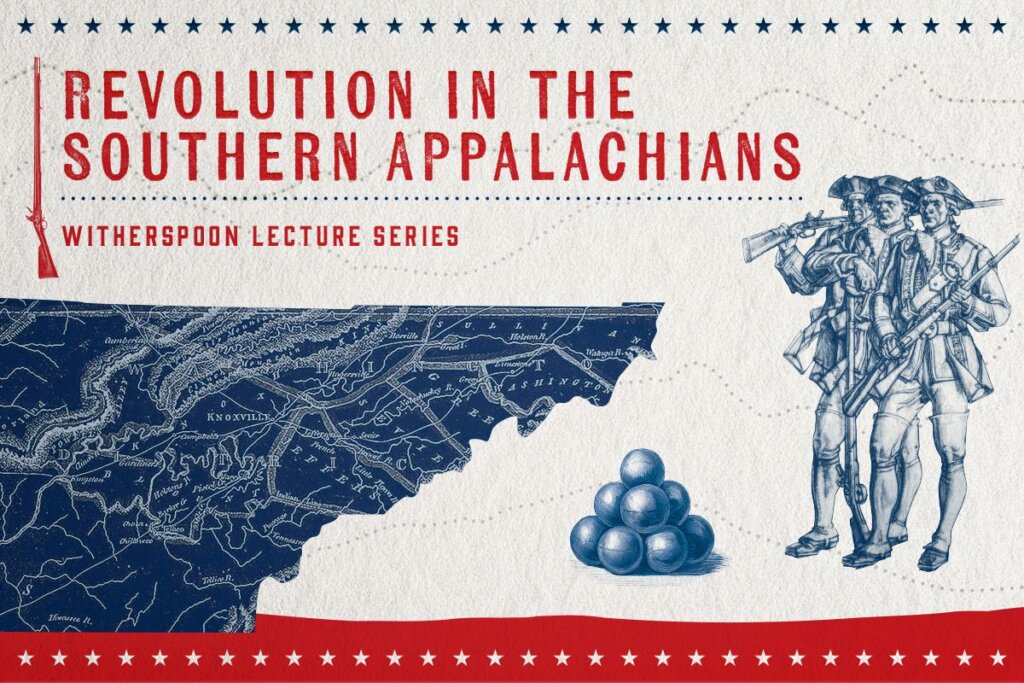
That overlooked history — and the interconnected wars that defined it — will take center stage when Dr. Aaron Astor, professor of history at Maryville College, delivers the opening lecture of the College’s 2026 Witherspoon Lecture Series. Astor’s lecture, “Backcountry Revolution: Two Wars in Southern Appalachia and the Creation of the American Republic,” will take place at 7 p.m. Tuesday, Feb. 10, in the Harold and Jean Lambert Recital Hall of the Clayton Center for the Arts. It’s free and open to the public and marks the kickoff of a three-part series examining Southern Appalachia’s pivotal role in the Revolutionary era.
“Like most people, I learned about the American Revolution in school with a focus almost entirely on New England, with a smattering of references to Yorktown, Pennsylvania, and New Jersey, and very little on the South and even less on the backcountry,” Astor said. “And yet, the Revolution really gets its energy from the backcountry as much as it does from the disputes over taxes and self-rule in New England. (The Battle of) Kings Mountain in 1780 really was a turning point for the Revolutionary War.
“Being at Maryville College with its own heritage in the area has driven home to me the importance of these backcountry settlers in the late 18th century, many — though not all of them — of Scots-Irish Presbyterian descent.”
Multiple opponents, constant danger
Astor’s lecture will examine the American Revolution not as a single, unified conflict, but as “two simultaneous and overlapping wars” unfolding in Southern Appalachia — one between colonists and the British Empire, and another between European settlers and Indigenous nations fighting to preserve their homelands.
“The real reason why the Backcountry matters so much is that it is the locus of ongoing Indian wars as European settlers push westward,” Astor said. “But the details matter a lot here, and it’s the internal split among specific Indian nations that matter as much as disputes between nations. The Cherokee are distantly related to the Iroquois and have some similar social patterns. Most importantly for the region, they had few natural allies, so they had to fend for themselves with the environment and take a very pragmatic approach to European settlement. That meant a constant internal struggle over the extent to which they should give in to European expansion or resist it.
“And after 1775, they split into two major factions. It was this split — the ‘Cherokee Chickamauga Wars’ — that engulfed the region at the same time as the Revolution. But it was connected to European settlers’ own desire to expand and an internal split over just how to govern this expanding empire — whether it would be managed from far-away London, entirely locally driven, or perhaps managed jointly between local elements and a newer central government representing the newly independent United States.”
At the time, territory controlled by the Cherokee encompassed much of what is now East Tennessee, although land ownership looked distinctly different when viewed through a native lens compared to a Western one, Astor pointed out.
“To the British, masculinity came with self-sufficiency — land ownership in particular,” he said. “So the ability to expand into the West was key for young men. For the Cherokee, masculinity came with hunting prowess, which required expansive lands on which to prove one’s mettle. Needless to say, the lands in dispute after 1775 in what is now East Tennessee were contested over these very reasons.”
Led by figures such as Dragging Canoe, the Cherokee faction resisted European expansion even as other Indigenous leaders sought accommodation. That resistance unfolded alongside — and was deeply entangled with — the settlers’ own divisions over governance, sovereignty and westward expansion.
“It was connected to European settlers’ own desire to expand and an internal split over just how to govern this expanding empire,” Astor said.
Connections to a wider war
These competing visions collided in the contested backcountry, turning Southern Appalachia into a decisive theater of the Revolutionary era — one whose outcome helped shape the future of the United States. Ultimately, Astor hopes attendees leave with a more integrated understanding of the era, and the ways in which these backcountry skirmishes played a pivotal role in containing Indigenous forces loyal to the crown, allowing the Continental Army to focus its efforts on the British forces that sailed in from the east.
“The main point,” he said, “is that the ‘Indian Wars’ and the ‘Revolutionary War’ are deeply connected. It was a struggle not just over independence from Great Britain, but over the very terms of settlement on the North American continent.
“We’re really excited to participate in the 250th Anniversary of the American Revolution by centering the story locally. It’s a really complex but fascinating time, and I hope people come out of it with a deeper understanding of it all.”
Maryville College, with its own deep regional history, has sharpened Astor’s focus on this overlooked dimension of the Revolution, and its liberal arts focus allows him to teach and conduct research at the same time. The author of two books — 2012’s “Rebels on the Border: Civil War, Emancipation and the Reconstruction of Kentucky and Missouri, 1860-1872,” and 2015’s “The Civil War Along Tennessee’s Cumberland Plateau,” as well as co-editing the 2021 publication “Slavery: Interpreting American History” — he’s halfway through the research and writing of his third, “Electing Civil War: Constitutional Democracy and the Long Election of 1860,” which will examine “the presidential election of 1860 as a grassroots phenomenon in four different places,” he said.
Astor’s lecture launches the 2026 Witherspoon Lecture Series, a three-part public program commemorating the 250th anniversary of the American Revolution by centering Southern Appalachia’s role in the nation’s founding. The series continues with “The Original Volunteers: Overmountain Men in the Southern Campaign” by Dr. Michael Lynch on Feb. 16, and “Wataugan Self-Governance: The Trans-Appalachian South and the Declaration of Independence, 1763–1776” by Dr. Christopher Magra on March 23. All lectures will be held at 7 p.m. in the Lambert Recital Hall of the Clayton Center for the Arts and are free and open to the public.