Maleah Wooten ’22 examines buying habits and more of her fellow Scots and herself
Jan. 24, 2023
Maryville College was the last place Maleah Wooten ’22 wanted to end up, but now she’s finding it hard to say goodbye.
Wooten, who graduated in December with a major in Outdoors Studies and Tourism, grew up in a small town on Michigan’s Lower Peninsula, but after one semester at Grand Valley State University in Allendale, Michigan, she wanted something different.
Why not, her father suggested, head south?
“I didn’t want to come here at all, but my dad really liked the school,” said Wooten, whose sister, Mikala Wooten ’20, is also an alum. “He was the one who actually got me in, and now I’m really glad I came. Growing up in a small town, I started out at a big school, and it didn’t work out. I think the smaller size is what I’ve liked the most about it.”
That, and discovering a passion she developed into a senior thesis and a series of guided talks at the Crawford House, home of Mountain Challenge, where Wooten worked as an undergraduate. It took a while to find that lane — she started out as a Design major before going back and forth between Health and Wellness Promotion and Outdoor Studies and Tourism, eventually relying on two faculty members of the Division and Health Sciences and Outdoor Studies for guidance: Division chair and Professor of Exercise Science Dr. Traci Haydu as her academic advisor, and Associate Professor of Exercise Science Dr. Jennifer Oody as her thesis advisor.
“I wanted to focus on consumerism, because every single person is a consumer,” Wooten said. “Dr. Oody helped me sort through a lot of ideas, and I figured out that I wanted to focus on why we consume the way we do, and I wanted to focus on clothing particularly. If I had just done consumerism, that would have been too broad, but everybody wears clothes.”
Taking stock of spending habits
One of the distinctive features of a Maryville education, the Senior Study requirement calls for students to complete a two-semester research and writing project that is guided by a faculty supervisor. According to the College’s catalog, the Senior Study program “facilitates the scholarship of discovery within the major field and integrates those methods with the educational goals fostered through the Maryville Curriculum.”
For Wooten’s thesis, she distributed a survey designed to examine participants’ views of sustainable clothing purchases and “fast fashion” — the inexpensive mass production of high-dollar, high-fashion designs delivered to retailers in time to capitalize on clothing trends. What made Wooten’s thesis different, Oody said, is that she wanted to incorporate the cerebral concepts of the classroom with experiential learning in the Mountain Challenge program.
“This was a topic she was super passionate about from the get-go, and she really wanted to do something with it that had an application to it for the college community,” Oody said. “She didn’t want to just write a thesis; she wanted to really take that and integrate it into Mountain Challenge, and make it something where she can really educate students about mindfulness.
“Because that’s the cool part about her thesis, is the mindfulness aspect of it. She talks about it in the context of impulse buying, of examining, ‘Do I really need this, or am I filling a void right now? And if I am, is there a more sustainable option for it? Could I thrift it or spend more money on a quality piece that’s going to last me forever?’”
There are, Wooten found, utilitarian purchases that take advantage of the short-term economic savings of fast fashion but overlook the poorer quality of the clothing. That, she added, is where sustainability can be applied. But there are also psychological issues at play when it comes to buying clothing. Jokingly referred to as “retail therapy,” it’s actually a common response to feelings of emptiness, she added.
“The way we consume stems from internal discontent and how we’re trying to fix it externally,” she said. “What I’m doing through my program is figuring out, how I can make it conversational? It’s not about changing your entire lifestyle; it’s about changing your perspective.”
Her survey asked questions about existing perspectives, and what she found was that in addition to purchasing clothes based on seasonal needs, respondents also looked at clothing as a form of self-expression and a way to communicate without words. Furthermore, she discovered that respondents were open to changing their approach to clothing consumption, provided the solutions were delivered gently.
“Most of them indicated that sure, they would participate in something if they didn’t have to do anything crazy or change anything about themselves,” she said. “That’s a response I knew I could do something with.”
Finding a connection through other means
As an outdoor facilitator with Mountain Challenge, she approached Jackie Eul ’18, program director of Mountain Challenge’s nonprofit arm Fit.Green.Happy® about organizing workshops, talks and guided programs around mindfulness — an emotional antidote to the instant gratification that drives consumerism. Mindfulness has long been a process to address mental health concerns, and in the beginning, Wooten only wanted to introduce that concept to willing participants.
“People don’t think about ‘Why am I purchasing this?’ when they’re in the middle of it,” she said. “Mindfulness is being aware of the space you’re in. It’s about connecting: To me, I practice faith pretty heavily, and my belief in God is something that’s drastically changed throughout my life. When you have that faith, it changes your perspective.
“Within that, what I’ve tried to do through Fit.Green.Happy.® is help people realize that we are created the same from the earth; that you can find ways to be connected to the trees, the rocks, the water; that mindfulness is being aware of the space you’re in and connecting with it.”
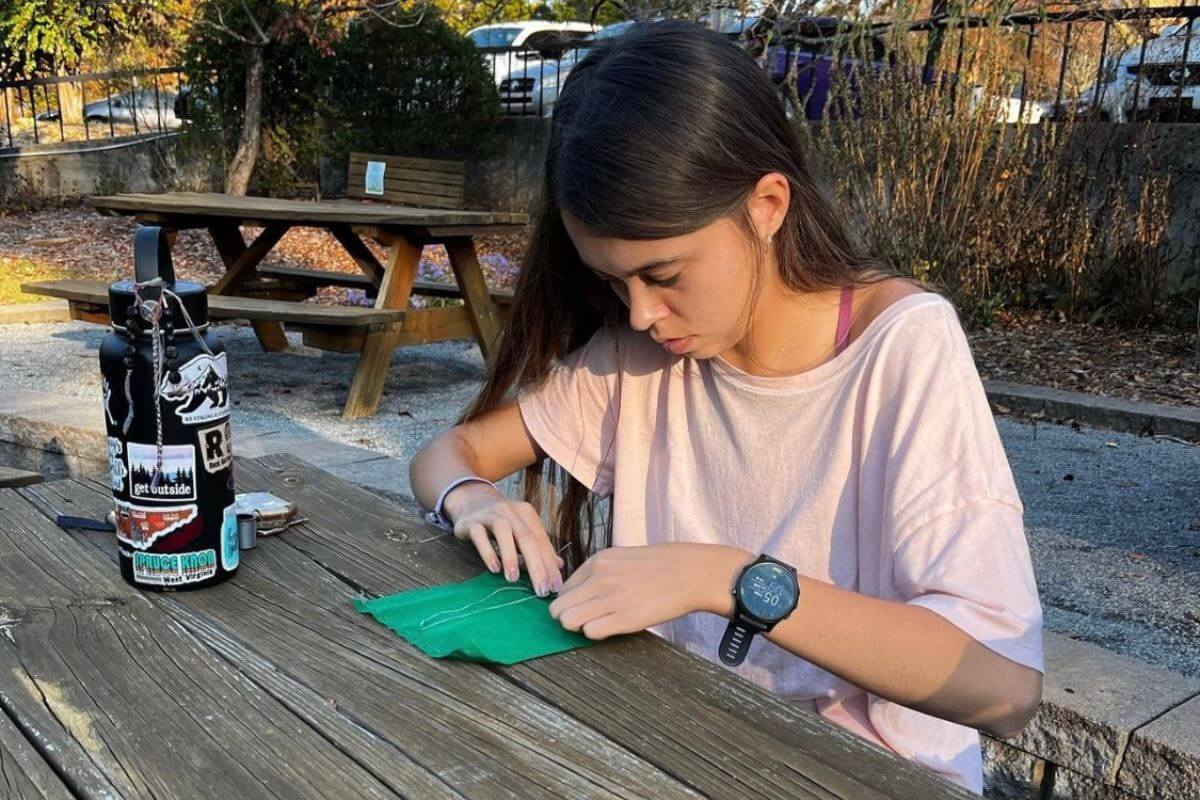
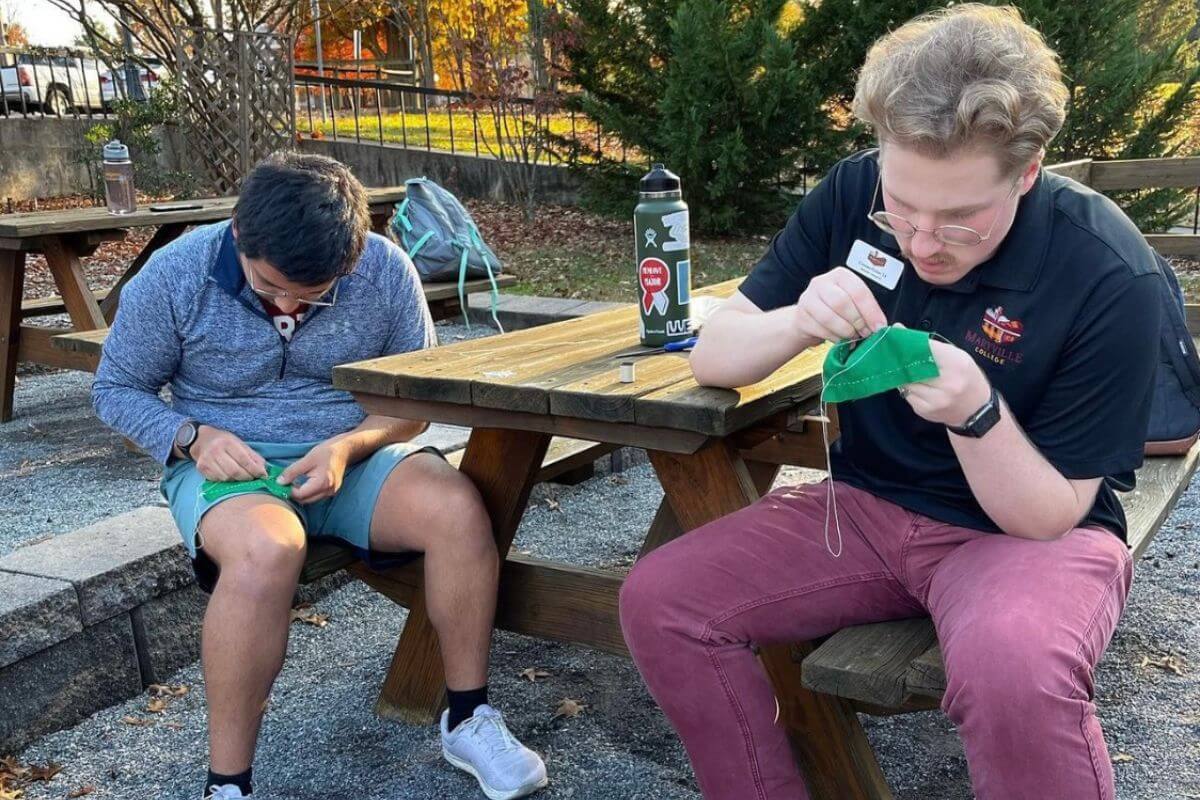
One of her Consumer Series at Crawford House involved clothing repair, during which Connor Goins ’24 taught participants how to sew patches and rips to prolong the lifespan of the items they wear. The most recent was a “forest bathing” session that focused on mindfulness connection as a way to promote sustainability and achieve harmony so often sought through consumption.
Wooten graduated last month, and her post-MC plans included getting married on Jan. 22, as well as relocating to Illinois with her fiancé. She’s unsure what the future holds, but she knows this: A liberal arts education at Maryville College has encouraged her to study everything, and so she feels prepared for anything.
“I know I want to work with people, but I’m not really too concerned with where that is,” she said.
That peace of mind – or mindfulness, as the case may be – is one of the trademarks of someone who took full advantage of a Maryville College education and plans to use it as a way to make a difference wherever she lands, Oody pointed out.
“The adults on campus are looking at this college student and thinking, ‘I didn’t figure this stuff out until my 40s, and she’s figured it out now!’” Oody said. “Sustainability … mending clothing … clothing swaps … learning how to sew and fix stuff … there are so many different ways you can take it, and so many different ways you can imagine that piece of consumerism.
“All of my students are great and do good work, and most of my thesis students are excited about their topics. For Maleah, this is a topic that aligns with her moral compass and her values as a person and who she is. I adore her relationship with this topic, because to me, that’s the coolest part of all.”