‘The ORNL Five’: Maryville College students take a deeper science dive with summer internships at national lab
Aug. 13, 2024
EDITOR’S NOTE: This is the third in an ongoing series spotlighting summer research projects and internships by Maryville College STEM students, made possible through a $645,000 Fund to Improve Post-Secondary Education (FIPSE) grant, administered through the U.S. Department of Education. The grant was earmarked for the expansion of MC’s Scots Science Scholars program and build on STEM initiatives provided by the College to “increase access to hands-on experiences and industry exposure, with a focus on addressing emerging technologies and scientific innovation in natural sciences, computational science and engineering.”
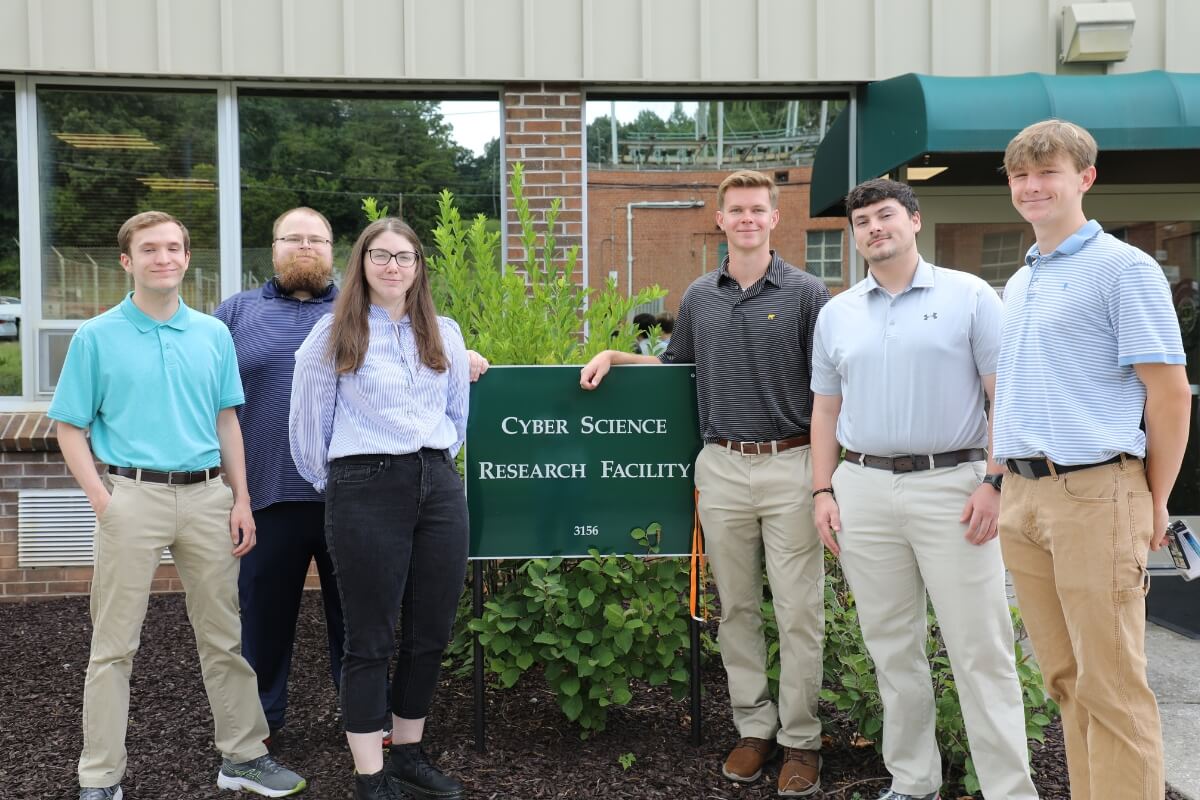
There’s a lot of orange and garnet over in the Emerging Cyber Systems Research Group at U.S. Department of Energy’s Oak Ridge National Laboratory: Five Maryville College undergraduates are working alongside an MC alumnus whose experiences at the East Tennessee research institution led him to create opportunities for those who followed in his footsteps.
Luke Koch ’20 was a Mathematics major interested in cybersecurity during his time at the College, he said, when Jeff Nichols — the group leader of Cyber Security Research and Koch’s own supervisor — came to MC as a guest lecturer. That led to his own ORNL internship, and an opportunity to open doors for numerous other Scots over the years — including five this summer: Kyla Pressnell ’25, Kylind Reagan ’26, Christian Goethert ’27, Tucker Smith ’27 and Thomas Rude ’25.
“I knew I wanted to do cybersecurity but had no idea how to start. Jeff pointed the way for me, and it changed the trajectory of my career,” Koch said. “I wanted to provide the same experience for current students. There are so many amazingly useful things you can do with Mathematics/Computer Science skills that, unfortunately, many students never hear about. When I went back to school to finish my degree after doing construction work, I looked up ‘jobs for math undergrads,’ and the top hit was a job in a bank.
“It didn’t interest me at all. When I applied to do cybersecurity research via a SULI (Summer Undergraduate Laboratory Internship) at ORNL, I was tasked with evading detection by AI. That work interested me so much, I decided to do a Ph.D. so I’d be better at it. With AI exploding across every industry right now, we are in dire need of capable mathematicians and programmers who can help us secure AI.”
Such cutting-edge research, he added, is just one example of numerous opportunities available to Scots in the Division of Mathematics and Computer Science … if they understand how to find them. Already, there’s a pipeline of talent between ORNL and Maryville College — Dr. Jesse Smith ’08, an assistant professor of mathematics, also works as part of a chemical risk assessment team at ORNL — and while MC students are usually dispersed into different groups based on the method through which they apply for an internship and the scope of their research interests, it’s unique for all five to wind up in the same research group, Koch pointed out.
“We do like to cluster interns in our group because they’re able to help each other and build a small community,” he said. “I’m still close with two of my intern friends when I went through SULI. I’m handling the admin side for these five, because I’m finishing my Ph.D. and can’t commit as many hours to the interns as I’d like.
“I helped the interns get settled, taught them some basic command line and machine learning skills, then handed them off to Sam Hollifield and Mingyan Li. Sam is our internationally recognized vehicle security expert and has mentored many students. Mingyan is a very experienced researcher who leads our federated learning work. Federated learning is used to secure internet-of-things devices that are vulnerable to intrusion but lack the processing power to run a full malware detection system. The interns are all working on securing either vehicle internal networks or IoT devices against intrusion. I still meet with the interns once a week to troubleshoot any tech issues and make sure they’re making progress.”
The Emerging Cyber Systems Research Group, Koch added, specializes in “creating realistic environments for stress-testing defensive tools.” In short: If a set of cybersecurity tools has been developed to defend against a particular threat, the group is tasked with helping partners determine if they’re effective enough to deal with said threat. Koch himself specializes in counter-AI research to stress test malware detection systems that rely on AI. The group’s interns have been assigned various other jobs that are putting their undergraduate educations through their own stress tests, of sorts.
“So far, I have done a lot of comparing and looking at various data types as well as using scripts to convert one type of data to another,” Goethert said. “I have also written a few scripts in both the BASH and Python programming language. On average, I work around 30 hours per week, and this opportunity so far has greatly aligned with my interests in STEM and does a great job at reinforcing my pursuit of software, math and electronics.”
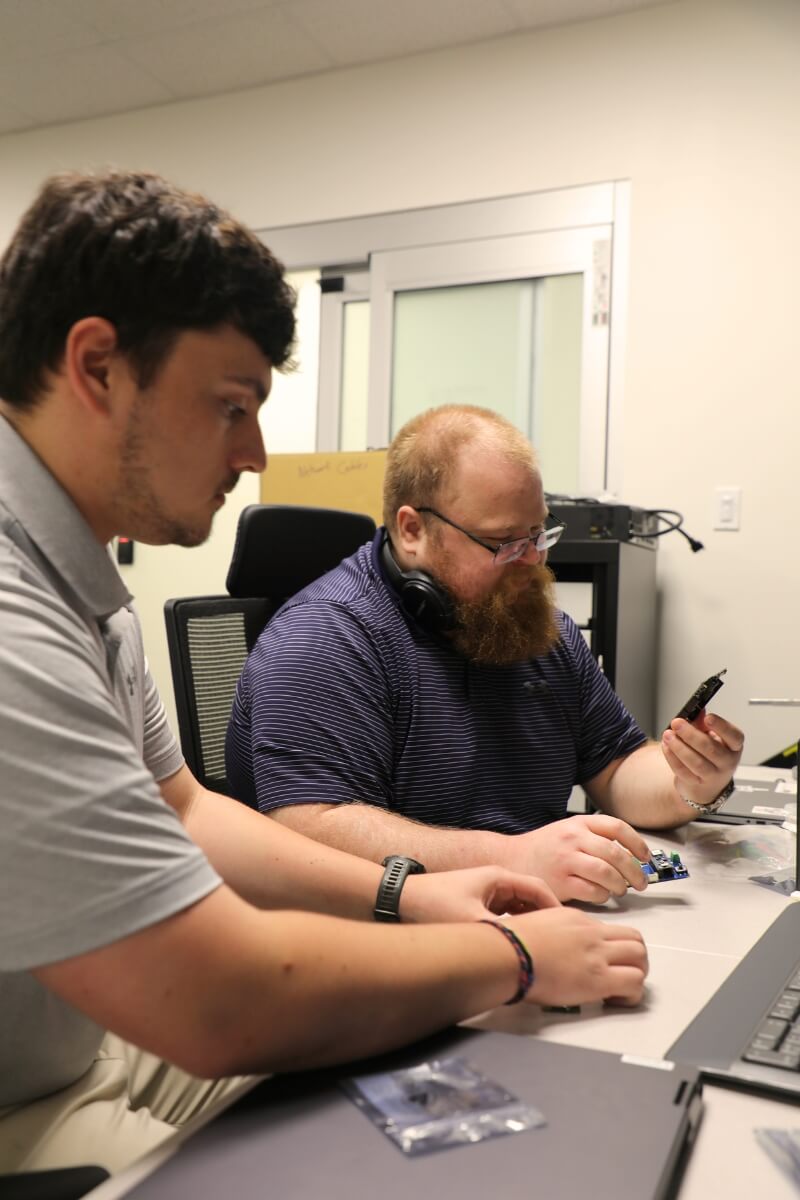
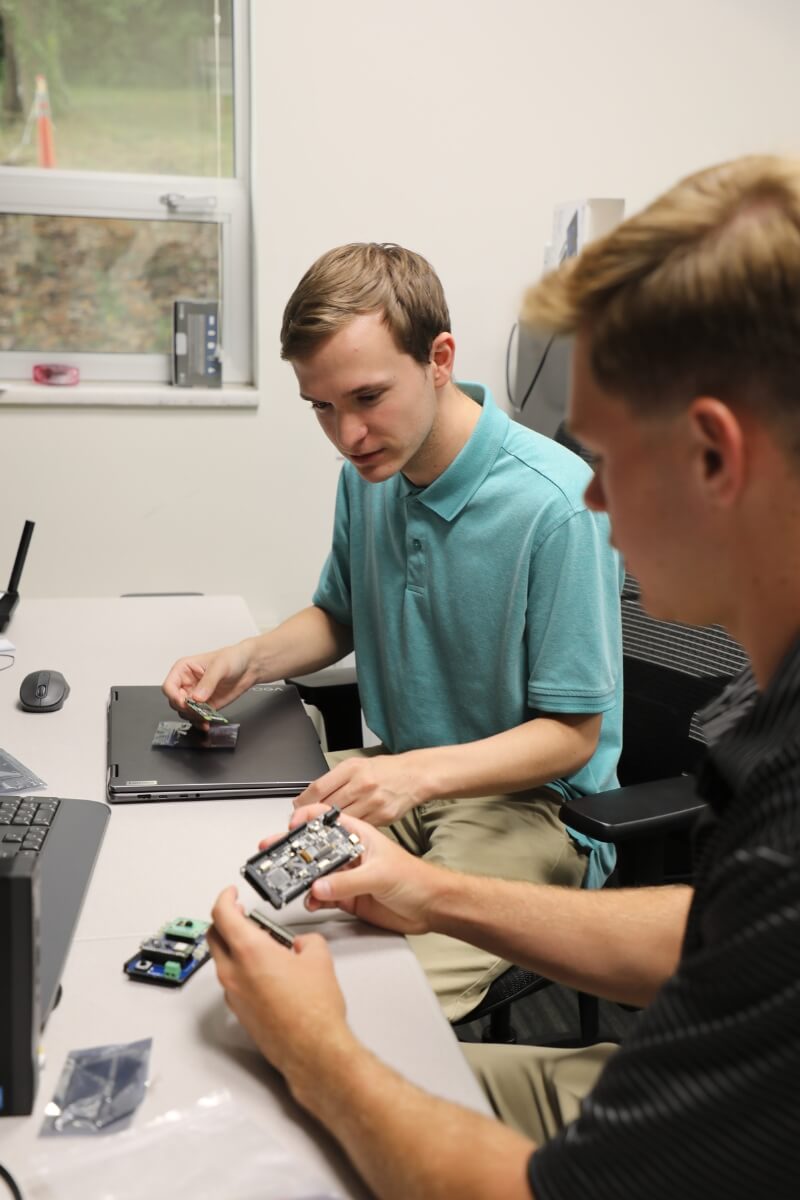
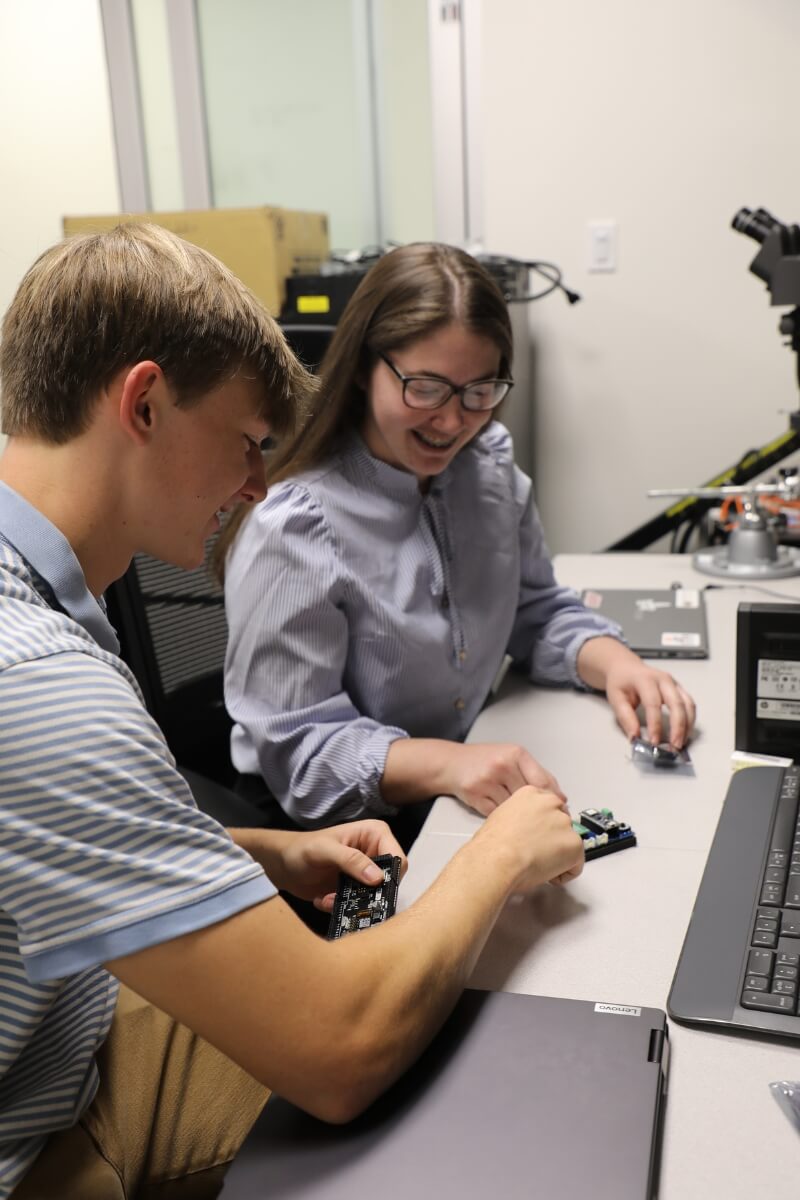
“I am working with Tiny Machine Learning,” Pressnell added. “So far, Tucker Smith and I have been working together and learning about this field, as we had little prior knowledge of the subject. We are now getting to work with microcontroller boards, specifically Arduinos. With these, we are learning how to train a model and use it to predict outcomes in the future.”
Pressnell’s work, she added, is vastly different than her academic interests in mathematics and statistics. While applicable, the diversity has been a unique experience, and it’s only strengthened her interest in math, she said.
“I find it fascinating that math can be used in nearly every other area of STEM,” she said. “The fact that lots of people seem to not like math even though almost everyone needs it in some way makes me truly enjoy it. Not only am I getting to gain knowledge of a topic that I have never learned about, but I am also taking with me the experiences with the people I met here.”
It’s been a summer of similar opportunities for all five Scots. Consider Rude’s work: He’s laboring to help create an RAG (Retrieval-Augmented Generation, an AI framework) to modify an LLM (Large Language Models, a type of deep learning model such as a neural network), designed to discover vulnerabilities in vehicles. In other words: If a smart car can be protected from cyber intrusion, he’s working to find out how, so that preventative defenses can be developed.
“Basically, it’s editing an AI program like CHATGTP to be able to tell you how to defend a vehicle against intrusion if you tell it the make and model and year,” Rude said. “This isn’t something that I had a lot of interest in, but learning about how to defend 18-wheelers from intrusion sounded like it would be fun, and I liked the idea of trying something new that I had never done before!”
Reagan is working on a similar project with the group’s vehicle security division, he added, specifically focusing on transportation and the development of a faster-than-real-time CAN (Controller Area Network) simulator that will be used to test the division’s defensive network.
“I have been interested in a career in cybersecurity for a while now, and this research opportunity has emboldened my choice,” he said. “The methods people use to try and make technology work in unintended ways and the responses to defend against these attacks has always been something that interests me, so getting to see firsthand how this process works and getting to read about all the methods to crack things in everyday vehicles in ways unimaginable to me has been very interesting and made my time at ORNL enjoyable.”
And that’s the crux of how a Maryville College Scot can play a valuable role in the work taking place at ORNL, Koch pointed out: Not only do programs of study in Mathematics and Computer Science teach students how to think and write like scientists, they also help students learn how to communicate effectively and think critically through Core Curriculum classes that augment a specific knowledge base with a broad foundation. And with the FIPSE grant funding their summer internships, the five are actually being paid by the Department of Education for work carried out on behalf of the Department of Energy.
“Your results will only have an impact if you’re able to communicate them effectively and rigorously, which is something Maryville prepares students to do,” Koch said. “Compared to students from tech-focused schools, MC students will lack some courses and research experience. I’ve pushed for this internship to happen because hands-on experience is very effective at overcoming this gap. Give me a student who is attentive and thinks clearly, and I can teach them the tech skills they might be missing.
“To current students, I’d say your career will only be as awesome as you make it. You can pick a normal career and be bored all day, or you can figure out what it takes to do cool things. Nathan Keough ’23, my first MC intern, and I both wanted to do meaningful work and stepped outside of the usual undergrad path to find that more interesting work. I went from shoveling rocks as a construction worker to copyrighting counter-AI technology that was licensed to a startup. It has been a tough road trying to finish a Ph.D., but knowing I’m a part of securing the nation keeps me going.”
More importantly, Rude and Goethert said, they’ve taken this summer to get involved in work they had no idea whether they would enjoy or not, but the experience, they knew through the mentorship of Koch and the advocacy of Dr. Maria Siopsis (professor of mathematics and one of the co-leaders of the S3 program), would be invaluable.
“Currently, the most exciting takeaway from this internship has to be learning some of the basics of the BASH programming language,” Goethert said. “It is something that I definitely will be pursuing once the internship is over. I would urge students to look into summer internships that involve learning and research. They truly are amazing for gaining new skillsets and trying new, possibly different and unique interests that may initially have never crossed one’s mind.”
Tucker Smith is one of those individuals: He’s working with the DRIFT group at ORNL, assisting in the optimization of code that classifies internet-based attacks. While his interests are more tailored toward nuclear and mechanical engineering, he said, his summer work has given him insight he didn’t possess beforehand into computer science and the various ways it’s implemented into everyday life.
“I am very pleased and excited that I have gotten to learn how wide of a topic cyber security and computer science is and how it can be applied to different areas and practices such as mechanical engineering and nuclear engineering,” he said.
Up next: Rolling on the river with Kaitlin Koster ’25 and Reese Bailey ’25!