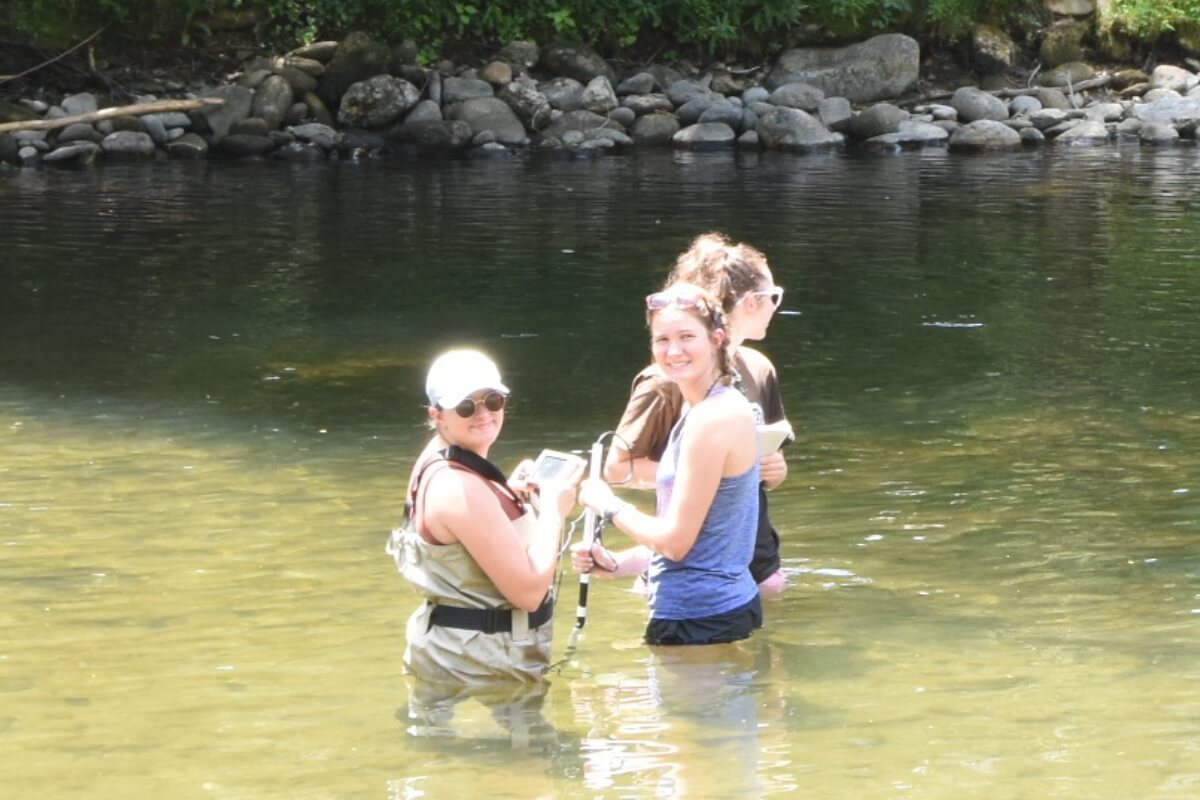
Kaitlin Koster ’25, Reese Bailey ’25 and Izzy Wright ’25 expand MC’s research of Blount County’s most important waterway
Aug. 13, 2024
EDITOR’S NOTE: This is the fourth in an ongoing series spotlighting summer research projects and internships by Maryville College STEM students, made possible through a $645,000 Fund to Improve Post-Secondary Education (FIPSE) grant, administered through the U.S. Department of Education. The grant was earmarked for the expansion of MC’s Scots Science Scholars program and build on STEM initiatives provided by the College to “increase access to hands-on experiences and industry exposure, with a focus on addressing emerging technologies and scientific innovation in natural sciences, computational science and engineering.”
During the summer, the Little River beckons county residents with promises of cool respite as it flows through the mountain hamlet of Townsend, on its way through the heart of the same county that Maryville College calls home.
Three rising seniors, however — Isabella “Izzy” Wright ’25, Kaitlin Koster ’25 and Reese Bailey ’25 — are frequent visitors to the waterway for different reasons. In the fall of 2023, a four-year water quality assessment study was approved by the Townsend City Council to determine the impact development and population growth has on the Little River, which provides drinking water to most of Blount County.
Thanks to the Arconic Foundation and the Little River Watershed Association, Chemistry Professor Dr. Nathan Duncan and Wright began work last summer to collect and test water samples, and this summer, the pair are joined on the Little River by Maryville College students Koster and Bailey, who are carrying out their own research projects in conjunction with the study.
“So (Wright) collected the background chemistry data last summer — IC (ion chromatography) data, pH, dissolved oxygen and temperature, and this summer, all three of them are sharing that load, along with E.coli testing and total suspended solids,” Duncan said. “They each have their own research question that they are trying to answer this summer as well. Kaitlin is focused on the macroinvertebrates and identifying the sorted samples to the family level, which she will eventually use a biotic index to give an overall health assessment of the Little River based on the species density, diversity and presence of pollution-tolerant species.
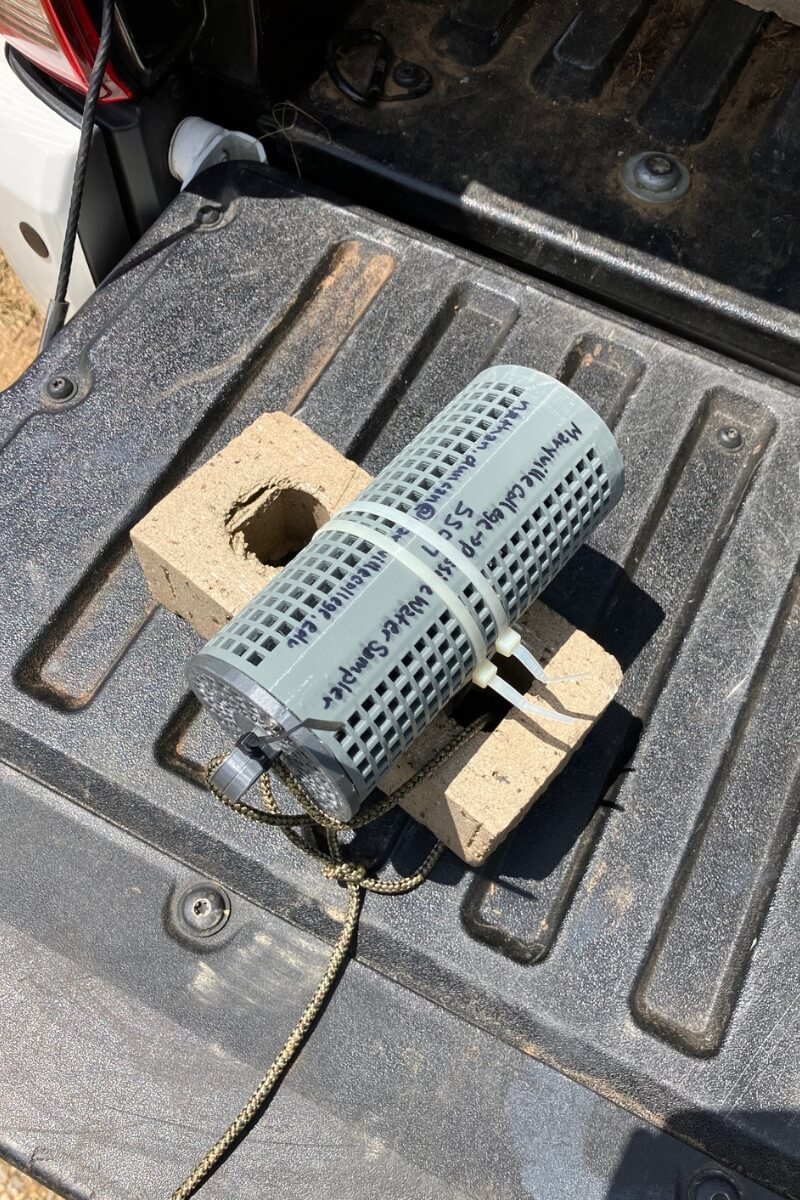
“Izzy is working on a method for analyzing for the presence of microplastics in the river. And Reese is evaluating the 3D-printed passive samplers to see if they will work well as a method for determining long-term presence of organic compounds such as pesticides, herbicides, pharmaceuticals, and personal care products (like sunscreen) which may have long-term effects on living organisms in the river. Passive organic samplers are known as a way to do this kind of testing, but a lot of environmental research like this often depends on harvesting large numbers of living organisms and doing extractions on their tissue to look for the presence of pollutants.
“These types of samplers are an alternative that hopefully can be used anywhere,” Duncan added. “We did tests earlier this summer to see if they behave well in a simulated environment (in an aquarium spiked with known amounts of certain pesticides). Now we have deployed 10 of them in the Little River in Townsend and hopefully will be able to analyze the samplers for pesticides and other compounds using HPLC and HPLC-Mass Spectrometry.”
It’s an actual scientific experiment that may not work, Duncan said — but if it does, it could potentially be used in other types of environmental aquatic analyses. The hope, Bailey added, is to create a methodology to evaluate the presence of pesticides in the Little River through a sampling system that doesn’t involve harvesting organisms that live in the river and dissecting them to determine those results.
“This spring I worked with Dr. (Jennifer) Brigati (professor of biology and chair of the Maryville College Division of Natural Sciences) to help set up a new lab for her genetics class involving the RT-PCR,” Bailey said. “The RT-PCR amplifies a selected gene in DNA provided based on primers added to the sample as well as fluorescing dyes.This project evaluates the presence of GMOs in common grocery store foods through amplification curves on the RT-PCR.
“I worked to create the best method for doing this by running the experiment and ensuring the GMO food samples selected would work for this project. This project was different in that it had a focus into a different branch of the natural sciences than my current one. This was more focused into the areas of genetics and biochemistry, which was amazing to be able to experience all the avenues that my current major can take me into!”
The opportunity not only allowed Bailey to refine her lab station skills through work with various instrumentation and development of methodology that could be used by future students, it gave her a chance to work closely with Maryville College faculty members outside of the classroom. Through Brigati’s assistance in the lab and Duncan’s in the field, it’s been a true scientific immersion similar to the work carried out by professionals in the fields she hopes to pursue after graduation.
“One of the unique and amazing parts of working on the Little River project has been working beside two people in very similar situations to me,” Bailey said of Koster and Wright. “We all help each other with our parts of the project, so I’ve gotten to learn how to identify macroinvertebrates by order, how to quantify total suspended solids, and how one can test for E. coli in river systems. Not being native to East Tennessee, this project has also broadened my view into the beautiful surrounding area and what I can learn from it and experience in it. Both of these projects have given me invaluable learning experiences in life skills and lab skills.”
As she wades into the Little River with a kick net — a rectangular mesh net with pole handles on each side used to scoop organisms from the water — Koster often finds herself marveling on the uniqueness of the opportunities afforded to her and her peers. A native of Hendersonville, Tennessee, she’s able to afford to stay at Maryville College to conduct research this summer thanks to funding from the FIPSE grant, which provides all three students with a stipend that gives them monetary compensation in addition to practical experience.
“We collect samples via kick net from specific sites along the Little River in Townsend, then take them back to the lab to sort the debris from the organisms,” said Koster, who also works with Dr. David Unger, associate professor of biology at MC, and Dr. John Enz of Jacksonville University to collect and analyze the macro invertebrates. “Then, I switch to a microscope to count and sort the bugs to order and then to family. These counts will be used in concurrence with an index specifying the pollution tolerance of different families. I will conduct a statistical analysis of these results and be able to show how the organisms and levels of pollution in the river vary from site to site.”
It’s a project that will double as Koster’s Senior Study (a key component of the Maryville College experience in which degree candidates complete research projects in their programs of study with the guidance of faculty members) but even without the academic credit, the opportunity to take part in fieldwork that will benefit an entire town and all of the tourists who flock there annually is an experience the trio likely wouldn’t have been a part of at other larger institutions. And that they’re working together, Bailey said, makes their collective results all the more germane to the entire project.
“The work that each of us puts into our own aspects of the project, as well as what we pour into each other’s projects, makes this overall project flow so smoothly and allows the collection of important data to be effortless,” she said.
Up next: Fish and birds, river and fields with Gabe New ’25 and Madison Taylor ’25!