


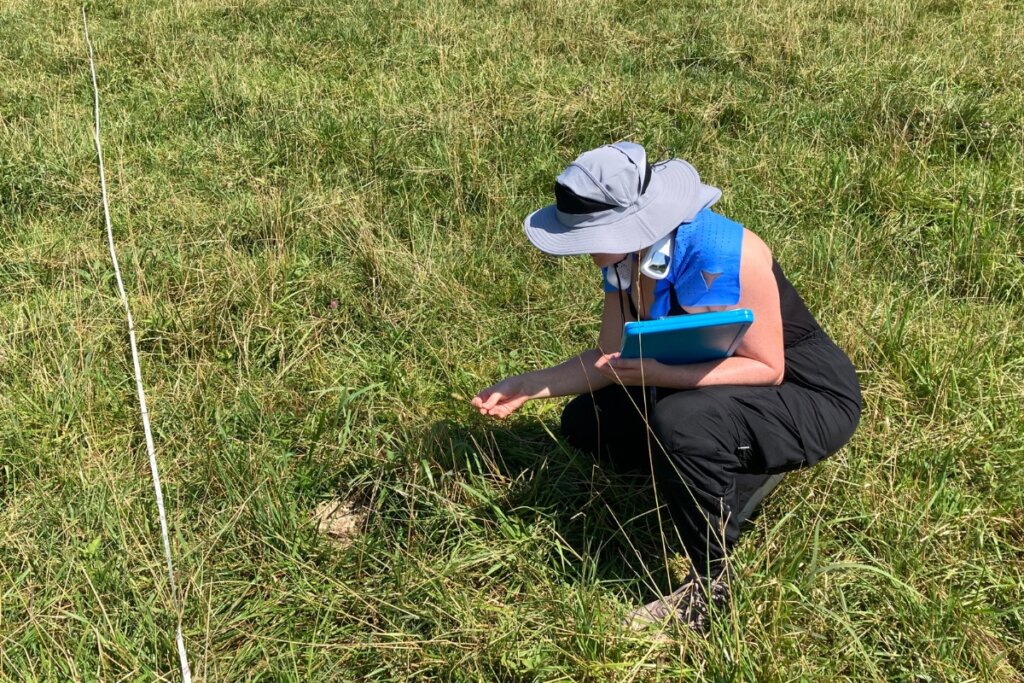
MC’s Gabe New ’25 and Madison Taylor ’25 look to the skies and beneath the current to document threats to wildlife
Aug. 13, 2024
EDITOR’S NOTE: This is the fourth in an ongoing series spotlighting Maryville College student research projects and internships over the summer by MC STEM students, made possible through a $645,000 Fund to Improve Post-Secondary Education (FIPSE) grant, administered through the U.S. Department of Education. The grant was earmarked for the expansion of MC’s Scots Science Scholars program and build on STEM initiatives provided by the College to “increase access to hands-on experiences and industry exposure, with a focus on addressing emerging technologies and scientific innovation in natural sciences, computational science and engineering.”
Reese Bailey ’25, Izzy Wright ’25 and Kaitlin Koster ’25 aren’t the only Scots working by the water this summer: The FIPSE grant is also funding Maryville College student research by Madison Taylor ’25 and Gabe New ’25.
New, in particular, is working along the Little River, specifically at the Peery’s Mill dam, located in Walland, Tennessee, a few miles up East Lamar Alexander Parkway from the College. First built in 1842, it was operated as a working mill by 1905 and, in the 1980s, a tourist attraction until fire destroyed everything but the dam itself. It’s a familiar spot for Dr. Julie Konkel, visiting lecturer in environmental science, and when New suggested examining how the dam affects native fish populations, the MC faculty member — who also serves as watershed scientist and coordinator with the Blount County Soil and Water Conservation District — didn’t hesitate.
”We are working together to correlate the quality of the habitat with his fish surveys,” Konkel said. “This study site is also valuable, as Gabe’s thesis work will serve as a baseline data set that we can refer back to when we look at the same locations after the removal of the dam. In terms of presenting the findings, there are many people in the Walland and Townsend communities who have vested interests in the Peery’s Mill Dam location due to its potential for removal of the dam in the next decade.
“We would like to make the data we collect available so the public can be informed about the quality of habitat along that section of Little River and, in the future, see how the (proposed) removal of the dam could benefit the environment and sensitive species that live there. We will also share our data with government or other entities, such as TVA, TDEC or the Army Corps of Engineers, who all have some level of engagement with the Peery’s Mill Dam project.”
New is conducting fish surveys, stream elevation surveys, streambed habitat assessment and water quality analyses in three locations near the dam, Konkel added, all of which are popular swimming spots for local residents. High-intensity recreational use can cause significant impacts as well, but New and Konkel are working specifically to document changes in habitat along the river caused by the presence of the dam.
“For instance, one of the three sites is located directly upstream of the dam in the ‘reservoir zone,’ which has deep water, little flow, less oxygen, different temperature gradients and a streambed habitat that is mostly soft sediment,” Konkel said. “This site is important to capture since the data will serve as a baseline for a before-and-after dam removal study in the future. The other sites, however, represent more typical river conditions with flowing water, a streambed that has rocks and woody debris and has moderate recreational use.”
While New will be peering into the water, however, Taylor will be looking to the sky — more specifically, to the vegetation in four different sites that could serve as hosts for the Eastern meadowlark, an avian of the blackbird family with a distinctive yellow underbelly. A grassland species, the Eastern meadowlark was once abundant in the Eastern United States. However, as development stripped this part of the country of its meadows for agricultural purposes, the species has been in steep decline in recent years, Konkel said.
“But efforts to sustain their habitat in this region may prevent the species from being listed as threatened,” Konkel said. “Despite loss of native meadow habitat, studies have shown that sustainably managed pasturelands can support meadowlark species. (Taylor) will conduct bird counts and plant community assessments at four sites that represent different management approaches ranging from meadow conservation to regenerative farming to overgrazed pastures.
“(Taylor) will analyze these data to determine how plant community richness under different management strategies supports viable Eastern meadowlark habitat. These data will (foster) discussions that will better integrate conservation and agriculture to assist the transition from conventional agriculture to regenerative agriculture that develops ‘agroecosystems.’”
Both projects will also provide data for the Habitat Assessment Project for Sensitive Species (HAPSS) effort that aims to enhance and advance conversations with land managers and property owners whose stewardship can significantly influence the viability of native species in Tennessee.
“I’m working on the Easter meadlowlark study … doing bird surveys twice a month and vegetation surveys once a month at four locations under different management styles,” Taylor said. “I will identify what vegetation is present, and if there is an Eastern meadowlark population established. I am hoping to make correlations between the vegetation and populations to suggest land management strategies that cater toward the Eastern Meadowlark’s habitat, since their natural habitat, grasslands, has been heavily depleted.
“The FIPSE grant has helped me pay for my materials for fieldwork. It also provides me with money for my travel expenses. I do a lot of driving back and forth each month, so it is incredibly helpful. I am also very grateful for the portion of this grant that allows me to earn money while completing my research. Gaining the experience of habitat surveying is something I would not have without my project, but having it treated as a part-time job makes it even more rewarding.”
“When discussing her project, Madison expressed interest in building skills that would prepare her for a career in conservation land management, and she was particularly interested in the Eastern meadowlark after taking Ornithology with (MC Biology Professor) Dr. Drew Crain,” Konkel added. “The project we developed thus compares the presence and abundance of Eastern meadowlark on properties with different statuses of land management.”
For her part in this summer’s Maryville College student research, Taylor is collecting data from a conventionally managed pasture; a farm that has employed regenerative grazing practices for more than a decade; a farm transitioning from cropland to regenerative grazing; and on a meadow specifically managed as bird habitat. The idea, she said, is to determine which of these land management practices best supports the Eastern meadowlark, and whether regenerative grazing practices might increase the species’ habitat if introduced to regional farms as part of widespread restoration efforts.
“So far, the data is showing an established population at one farm that has been managed under regenerative methods, like rotational grazing of cattle,” Taylor said. “No other sites have had consistent or abundant sightings of Eastern meadowlark. This was interesting to me, because it seems like there could be real potential for greater habitat in this area after management shifts. The vegetation varies throughout the sites. To determine true differences, the data must be analyzed, but I have not reached that point in my project yet.”
What may be revealed by the continuing studies of both Taylor and New, Konkel said, may play a big role in future Maryville College student research projects, especially as she continues to build lab and field supplies necessary for environmental monitoring methods used in the two studies. The FIPSE grant, Konkel added, has supported the acquirement of equipment and informational resources critical to their work … which has been incomparable for the students themselves.
“As a rising senior at Maryville College, my professors and classes have prepared me to design and implement this senior study,” New said. “Post graduation, and thanks to this study, I will be able to transfer these skills into my future research. And because Maryville College is so close to the Smokies and the biodiversity there, this opportunity truly gives me access to a very unique experience that couldn’t be replicated anywhere else.”
Up next: William Leeper ’27 takes a look at a bug problem!