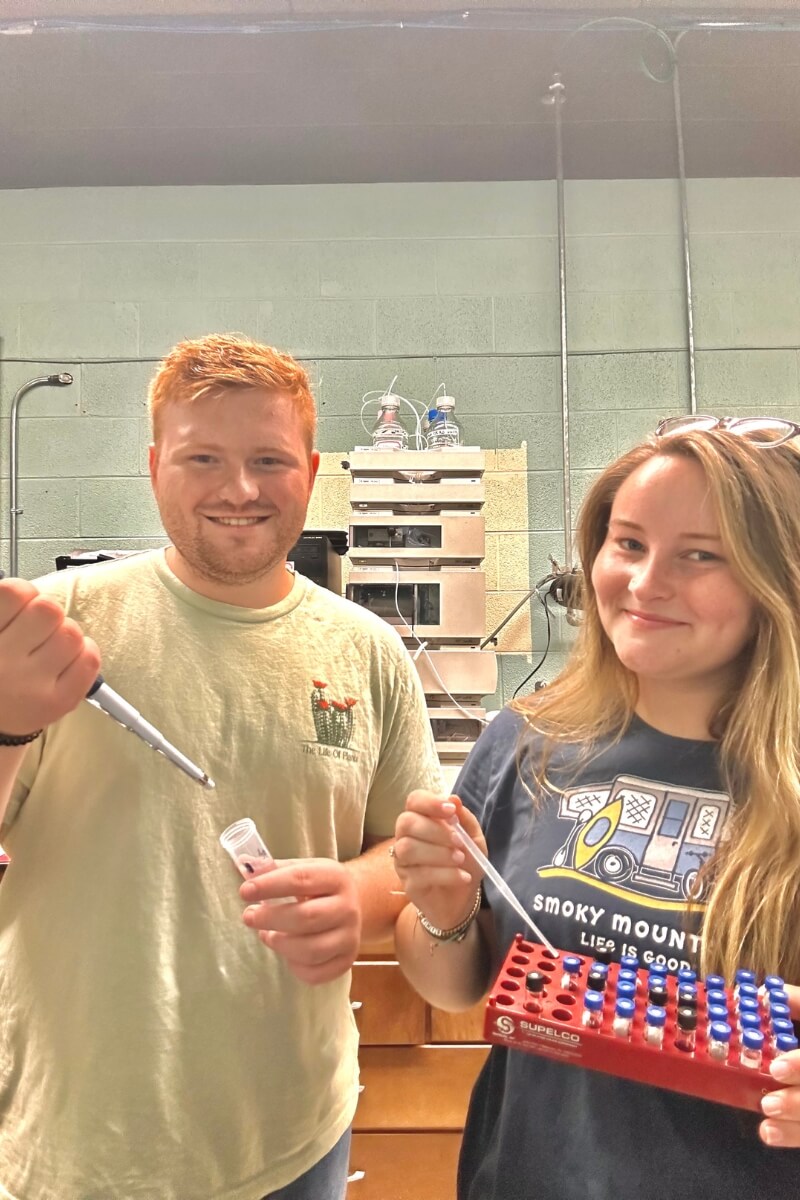
Colby Huffman ’25 and Ellie Jaynes ’26 work to trace anabolic agents from the farm to the kitchen
Aug. 13, 2024
EDITOR’S NOTE: This is the sixth in an ongoing series spotlighting summer research projects and internships by Maryville College STEM students, made possible through a $645,000 Fund to Improve Post-Secondary Education (FIPSE) grant, administered through the U.S. Department of Education. The grant was earmarked for the expansion of MC’s Scots Science Scholars program and build on STEM initiatives provided by the College to “increase access to hands-on experiences and industry exposure, with a focus on addressing emerging technologies and scientific innovation in natural sciences, computational science and engineering.”
The use of anabolic agents in agriculture, specifically by farmers who raise beef cattle, has been a topic of much debate for years, to the point that some European countries banned them decades ago.
It was in BIO-412, MC Biology Professor Dr. Drew Crain’s Animal Physiology class, that Colby Huffman ’25 first became aware of them, and he found the subject so fascinating that he asked to work with Crain over the summer to research the amount of those agents — steroid hormones, in most cases — can be found in beef.
“This is important, because most producers use beef enhancement that makes their cows develop more muscle quicker, which is great for the farmer because it’s economical, but maybe not so much for the people eating the meat,” Huffman said. “That question is still up in the air, though, so hopefully this project will shed some light on the situation. I’m asking the question, ‘How much of these enhancers are staying in the meat?’ This is the first step to determining if there are potential impacts on the consumer.”
“When discussing the endocrine system, I mentioned in passing about how we do not know much about the impact of hormone supplements for cattle,” Crain added. “For instance, do any of the hormones end up in the meat, and does cooking the meat impact this? Colby’s family owns a beef cattle farm, and Colby approached me inquiring if he could pursue this question with me. When we heard that Ellie Jaynes (’26), who has a very quantitative and mathematical mind, could help us, this project was born.
“I act as a faculty mentor to Colby and Ellie. As I explained to them, I am treating this like a graduate school research project. I meet with them regularly giving advice and direction, and then they do the research.”
The first experiment with anabolic agents to support livestock growth took place in 1948, according to the National Institute of Health, and over the next several decades, they’ve been explored for use in both agriculture and pharmaceuticals. The misuse of growth stimulants in livestock, however, led to a ban in the Netherlands in 1961. Other European countries followed suit, and that decision spurred Huffman’s interests in determining whether the presence of such steroid hormones might have an effect on people. Like their peers in the labs and fields this summer, Huffman and Jaynes can afford to spend their summer doing research thanks to compensation via the FIPSE grant.
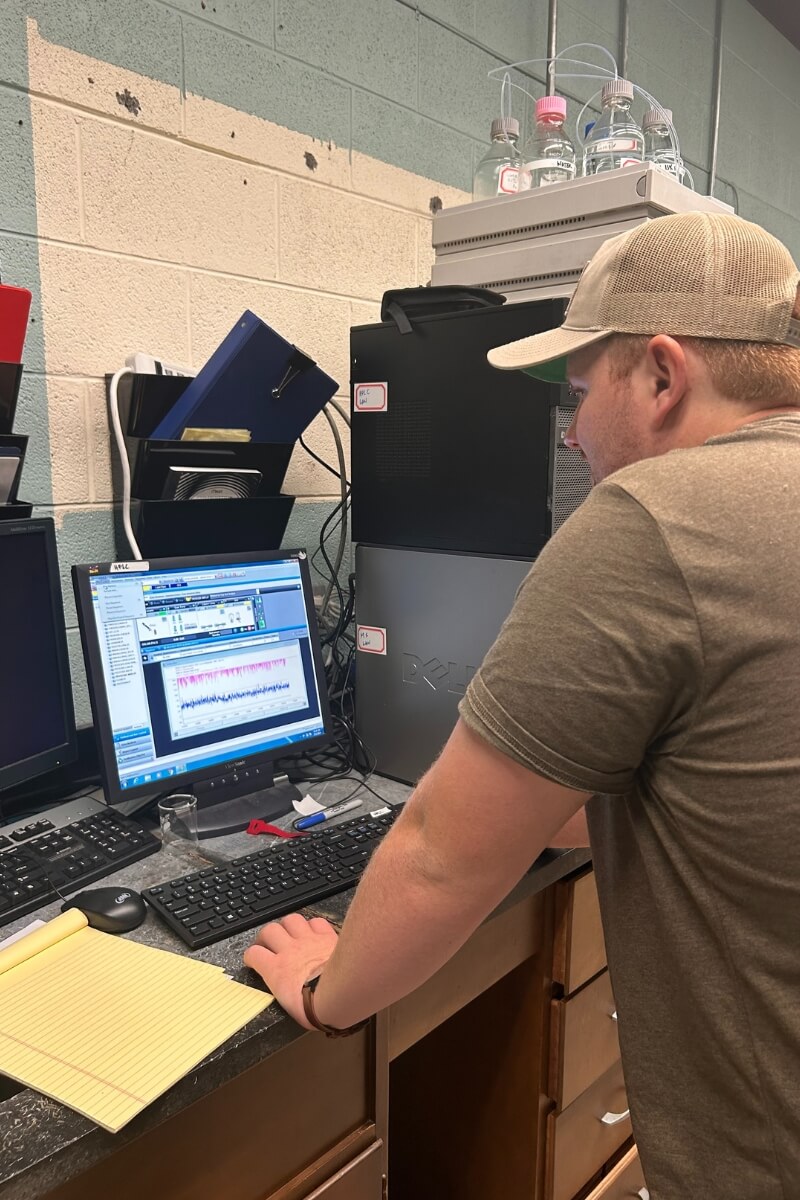
“The process for doing so is to get a sample of beef for the grocery store, extract the steroids from the meat, and then measure them using a very sophisticated instrument called High-Performance Liquid Chromatography-tandem Mass Spectrometry (HPLC-MS/MS or LC-MS/MS),” he said.
Jaynes, a rising junior Mathematics major, then analyzes the resulting data to determine the specificity and the amount of the anabolic agents discovered in those grocery store samples. Collecting that data is the first step, Huffman said, and determining the effects of those agents on people rather than livestock is a much more complex scientific feat.
“Another exciting portion is that this is a pretty big project, but it has so much potential to keep evolving and taking on more and more to study,” Huffman said. “An example would be analyzing waterways because the cows also urinate some of these substances out, and most water treatment plants, to my knowledge, do not filter these substances, which could be another way they are consumed by people.
“Needless to say, I am extremely interested in this project and often get lost in planning the crossroads and different avenues. However, I would like to keep working on this through my senior thesis and explore some more avenues that this project and protocol can offer at Maryville.”
Up next: Jonathan Yost ’26 mines marigolds for repellent!