Inspired by Job Childs Lawrence, couple funds a Maryville College liberal arts fellowship in his name
April 14, 2026
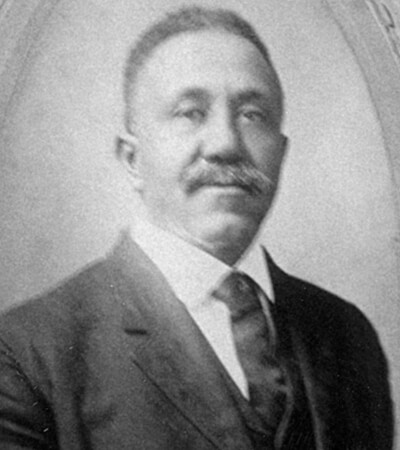
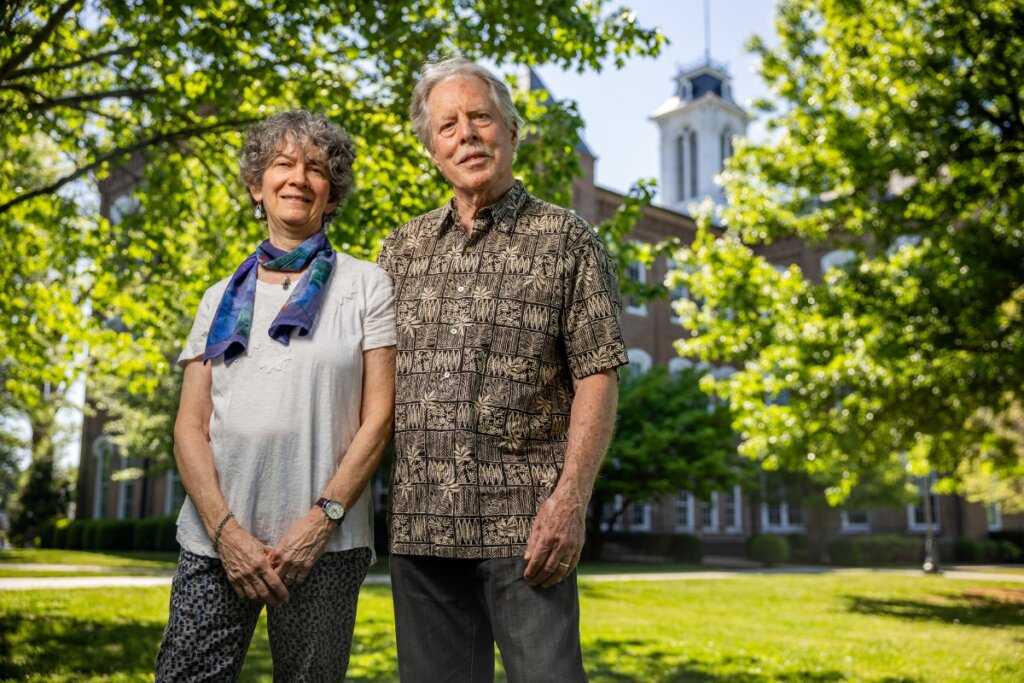
Throughout his life, Job Childs Lawrence benefited from education as a counterweight to injustice, and in funding a fellowship that bears his name, alumnus Doug Gamble ’68 and former adjunct instructor Nina Gregg aim to support and encourage education about the causes of injustice and ways to address them.
Born into slavery in 1852, Lawrence enrolled in Maryville College after the Civil War, studying English there until 1877 at one of the few institutions in the South at the time that offered an education to Black and White students equally. Lawrence joined the Athenian Literary Society as a student, served as the organization’s librarian from 1875-76, and engaged in statewide activism: In 1874, he and fellow Blount County resident William Bennett Scott Sr. took out ads in the Nashville Union and American newspaper calling for a “state convention of colored citizens” to “ask the first rights due to us as citizens of a common country — ‘Civil Rights’ — without which, freedom such as we have will prove a farce.”
Gamble and Gregg learned of Lawrence’s association with Maryville College from Fran Ansley, a long-time friend, fellow activist and professor emerita of the University of Tennessee College of Law. Recognizing the contemporary relevance of his challenges, they wanted to foster a way to “affirm the interdependence of education and advocacy for equal rights and justice,” because “advocacy made Job Childs Lawrence’s education possible, and his education informed his advocacy,” the couple said.
“His story is one example of the history of denial of education to people in this country, and people finding a way to learn,” the couple said. “His life story from being enslaved to freedom to education to advocacy and the legacy of his life and work — and how his descendants continued that legacy — are inspiring and motivating.”
A lifelong champion of education
After his time at Maryville College, Lawrence enrolled in Howard University to prepare for the ministry. He served as chaplain of the Freedmen’s Hospital on the Howard campus and after graduation in 1879, he was ordained by the Presbytery of Kingston, Tennessee. Throughout his early ministry, he established churches along the foothills and valleys of the Great Smoky Mountains. He returned to MC to serve on the Board of Directors from 1883 to 1890, during which time he served as pastor of Shiloh Presbyterian Church in Knoxville.
In 1887, he led a push for minority representation on public boards, and the following year was selected as the first Black member of the Knoxville City Board of Education by the town’s board of aldermen. Public opposition was fierce, however, and after Knoxville newspapers led a campaign against his service, his selection was retracted. The state Supreme Court would later reject his lawsuit to serve on the board, but Lawrence and his wife, Missouri Ann, continued to advocate for education as a beacon of hope: They worked tirelessly to provide opportunities for their nine children, and their son, Charles, would go on to graduate from the Tuskegee Institute in 1917, where he struck up a close friendship with Booker T. Washington.
As lifelong activists and organizers — Gamble served as president of the Maryville College student body during the tumultuous years of the late 1960s — the couple was inspired by Lawrence’s story to fund the Job Childs Lawrence Liberal Arts Fellowship as a way to inspire and support faculty members new to Maryville College. The decision grew out of conversations with Dr. Dan Klingensmith, a history professor who at the time served as vice president and dean of the College, about how to attract and retain faculty members, and while the pair isn’t ready to endow the gift permanently until results demonstrate that it is indeed fulfilling a need at Maryville College, they’ve been pleased so far with the ways in which the fellowship has been used.
“We thought we could help new and junior faculty have time to continue learning and exploring,” they said. “We want to help develop opportunities for faculty to explore, learn and teach on topics and in areas that challenge them and challenge/support students to think about political, social, economic and cultural power — how power is exercised in ways overt and covert, what is possible and not possible when constraints are imposed on part of the population, and how groups have always sought ways, sometimes at great personal risk, to organize to overcome oppression and exercise self-determination.”
The fellowship calls for recipients to “develop new Humanities and Social Science courses about systemic inequities and policy, strategies, organizing, activism and solutions to redress inequities,” and it provides support for attendance at conferences and seminars that will strengthen recipient knowledge, as well as the purchase of relevant materials. Recipients are expected to teach the new course within three semesters, as well as deliver a lunch lecture open to the entire campus.
Faculty Fellows develop new courses
The inaugural Fellow of the Job Childs Lawrence Liberal Arts Fellowship was Dr. Rachel Ponder, assistant professor of criminal justice, who used the funding to prepare a new course “in which students compared the American justice system to international case examples of post-conflict reconciliation and transitional justice attempts,” Ponder said.
“Through the course, I collected data on student assignments and assessments, combined with additional research, and wrote a paper which I will be presenting at a Law and Society Association conference in San Francisco (in May),” she said. “The award helped fund that trip. This has been part of a larger project that will take students to Rwanda for a May term course in 2027 to continue to study their justice attempts post-genocide.”
For the 2025-26 academic year, it was given to Savanna Gregory, a visiting lecturer of Health and Wellness Promotion, who is in the process of completing a new class — PHR-336: Community Health — that will be offered in the fall of 2026 and designed to “introduce students to the assessment and identification of community health needs with emphasis on the influence of the Social Determinants of Health,” Gregory said.
SDOH, she added, are the social, economic and environmental conditions in which people live that are generally considered to be driving factors of many health outcomes and health disparities, including factors such as healthcare access, food security, income and employment.
“Through this project — ‘The Reimagination of Community Health through a Community Engaged Lens’ — this course would be offered as a community-engaged, student experience-based course,” she added. “As part of the new format, students will spend 15 to 20 hours throughout the semester working within a community organization to translate course material into application at the community level. Through the community-engaged component of the course, students will be given the opportunity to apply their knowledge, bridging theory to application, by working with local organizations to analyze existing efforts and contribute to real-world, community-identified solutions that address systemic poverty and advance health equity.
“Taken together, this course will advance Maryville College’s commitment to the liberal arts and further Rev. Job Childs Lawrence’s legacy of the interconnectedness and critical importance of education and advocacy as we work to solve our region’s most pressing issues.”
Most recently, it was awarded to incoming sociology faculty member Dr. Annie McGhee, who will join the Maryville College Division of Social Sciences beginning with the 2026-27 academic year.
Passing on the thirst for knowledge
For Gamble and Gregg, the breadth of diversity among those recipients is exactly what the fellowship was designed to strengthen, and in using it, they hope those faculty members and future Fellows grow their own knowledge and perspectives to help students “foster critical thinking through exposure to and consideration of social movements and activism and their relevance to students’ lives and their communities.”
That trickle-down effect — developing faculty recipients to expand the scope of what they offer to students in their classrooms — will ideally inspire other faculty members to develop a curriculum that includes educating students “about the rich history of people organizing to change the conditions of their lives and the lives of others.”
And that, they added, will hopefully inspire and motivate those students to do the same … just another example of the Maryville College call to “do good on the largest possible scale.”
“We have both been early-career and newly hired college and university faculty and understand the difficulty of fulfilling all duties and not having time or space to continue learning and exploring,” the couple said. “Fields of study change, and faculty need time and resources to stay current and to continue learning. When faculty share with students how and what they are learning and exploring, this adds a valuable dimension to student learning and exploring and encourages students to ask new questions and go beyond the familiar.”