In the Maryville College Woods, it’s ‘Turtles All the Way Down,’ according to Dr. Dave Unger
Sept. 19, 2024
What do country singer Sturgill Simpson and the Maryville College Woods have in common?
Turtles. Turtles all the way down, it seems.
While Simpson’s April 2014 release of the single “Turtles All the Way Down” had nothing directly to do with Maryville College, a few months later, Dr. Dave Unger — associate professor of biology at MC — began seeing them all over campus. It started, Unger recalls, when a student found an Eastern box turtle — Terrapene carolina carolina — outside of Beeson Village, one of the College’s residence halls, and brought it to Unger’s lab in the Sutton Science Center.
“Not really knowing what else to do, I took some basic body measurements, recorded its mass, drew a picture of its shell, and released it into the Maryville College Woods,” Unger says. “Throughout 2014 and early into 2015, more turtles were found at various places around campus and in the College Woods. A non-majors class conducted by (chemistry professor) Dr. Nathan Duncan, in which he had the students conduct the first active search for turtles, turned up 8 turtles in a single day.”
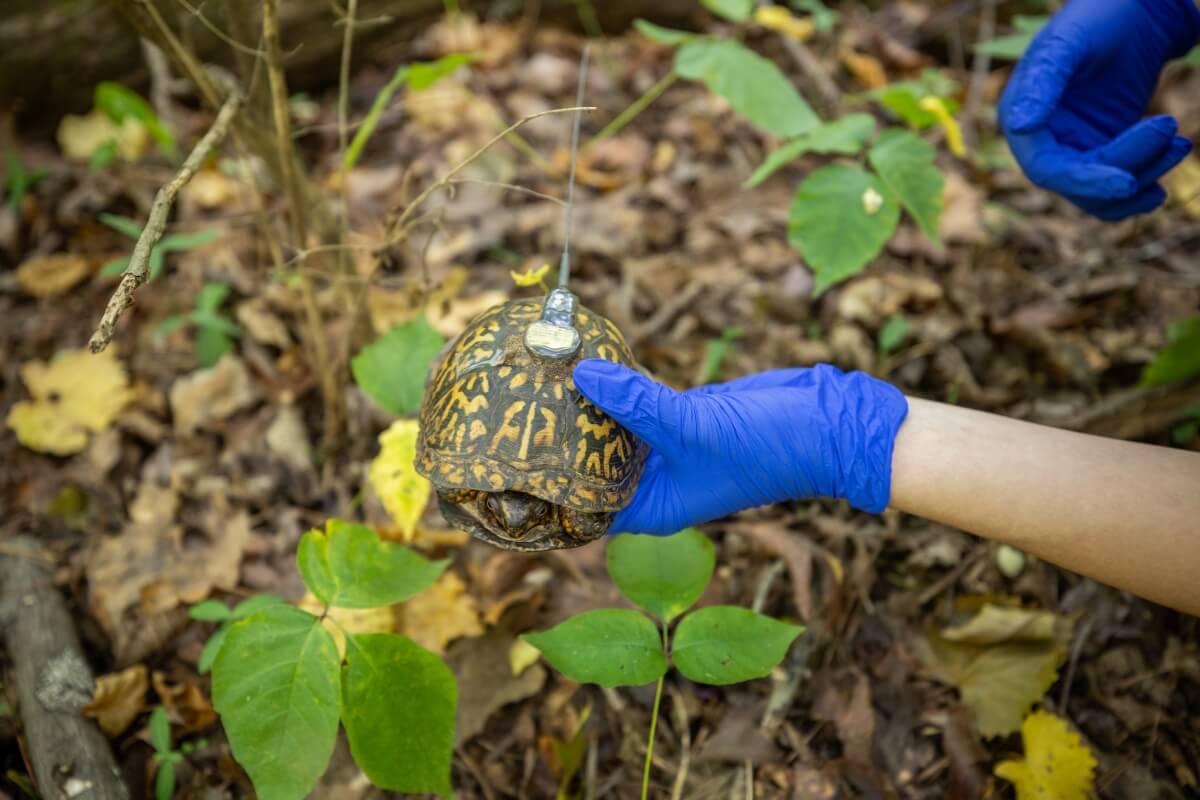
A subspecies of the common box turtle, the Eastern box turtle is a mostly terrestrial reptile, despite belonging to the pond turtle family. While it’s a known “indicator species,” Unger says, of the overall health of its environment, in 2011 the International Union for Conservation of Nature (IUCN) downgraded the species’ conservation status from near threatened to vulnerable, citing a “widespread persistent and ongoing gradual decline of Terrapene carolina that probably exceeds 32% over three generations.”
On the MC campus, however, the species seemed to be thriving, Unger points out.
“As it became apparent there was an abundance of them in our small woodlot, we decided to begin conducting organized research,” he says. “I put in for a Tennessee state permit to capture, mark and study box turtles. Dr. (Drew) Crain (professor of biology) and I also came up with a method for permanently marking turtles by ‘notching’ the scutes that surround the top (carapace) of the shell.”
And so began Unger’s ongoing box turtle project, which officially got off the ground in 2015. For the first two years, he says, he and his peers and students focused on finding, measuring and marking as many turtles as possible. By 2017, they had logged 64 individual turtles in the Maryville College Woods. That same year, the first Senior Study — a cornerstone of the MC experience during which students work with faculty members to complete a major project within their degree field — was conducted on turtles.
Valerie Whitehead ’18, after being awarded a $6,100 prestigious Ledford Scholarship, put together a Senior Study that called for the use of “sniffer dogs” — Boiken Spaniels — that helped the two randomly and rapidly capture 42 turtles in less than 48 hours.
“We used what’s called a ‘Lincoln/Peterson Mark-Recapture’ analysis that utilizes the ratio of marked versus unmarked turtles that the dogs found and the total number of turtles we had captured to come up with an estimated population of turtles in the College Woods of 588 individuals,” he adds.
Turtles all the way down, indeed.
Student involvement grows
It’s little wonder, then, that additional Senior Study projects would explore the box turtle population in the MC Woods, including:
- “Methodology Development for Genetic Analysis of Box Turtles found in the Maryville College Woods,’ by Molly Hamant ’17;
- “Baseline Health Assessment via Blood Analysis of Box Turtles from the Maryville College Woods,” Sarah Gordon ’19;
- “Morphometric Data of Eastern Box Turtles in the Maryville College Woods,” Reid Ballard ’21;
- “The Identification of Ranavirus Within Eastern Box Turtles (Terrapene carolina) of the Maryville College Woods,” Daniel Sikes ’22; and
- “Management Recommendations for Eastern Box Turtles in the Maryville College Woods,” Haley Harmon ’22.
Over the past nine years, Unger and his students have captured and permanently marked 182 individual turtles in the College Woods, and using the Lincoln-Peterson Mark/Recapture model, the most recent data collected means there are an estimated 455 turtles in the College Woods.
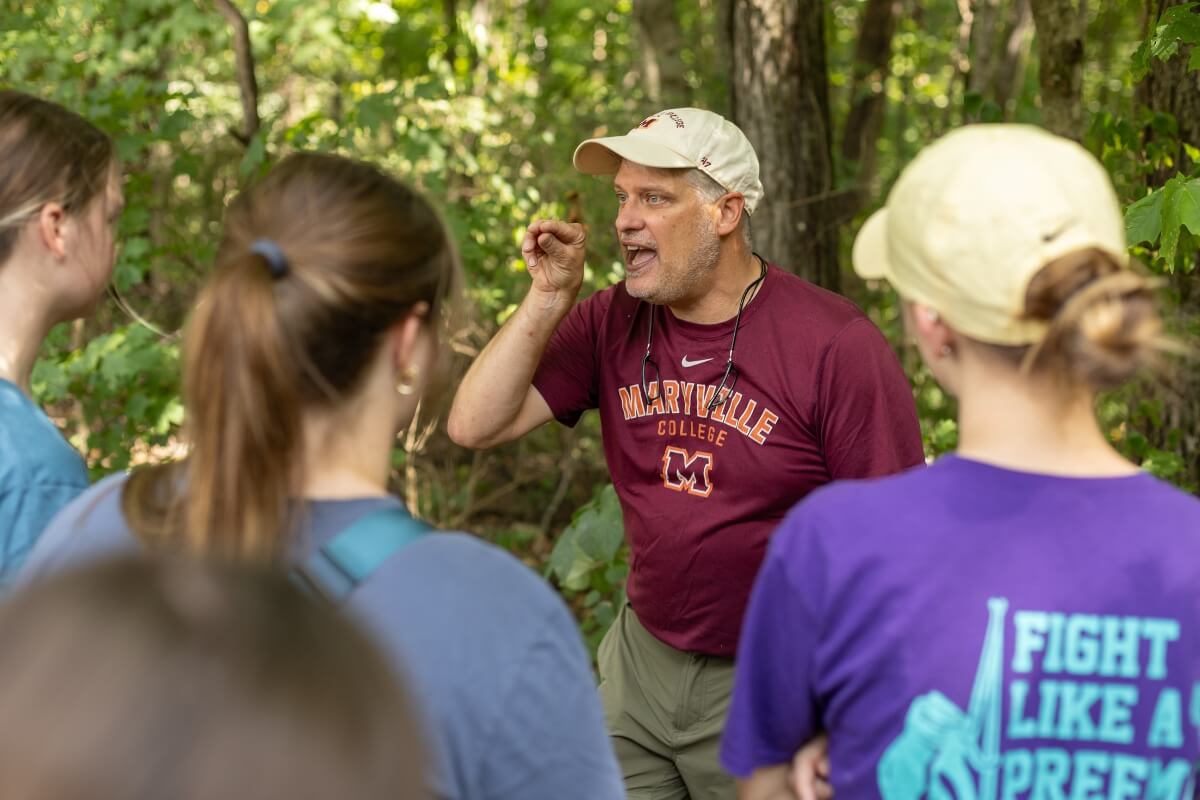
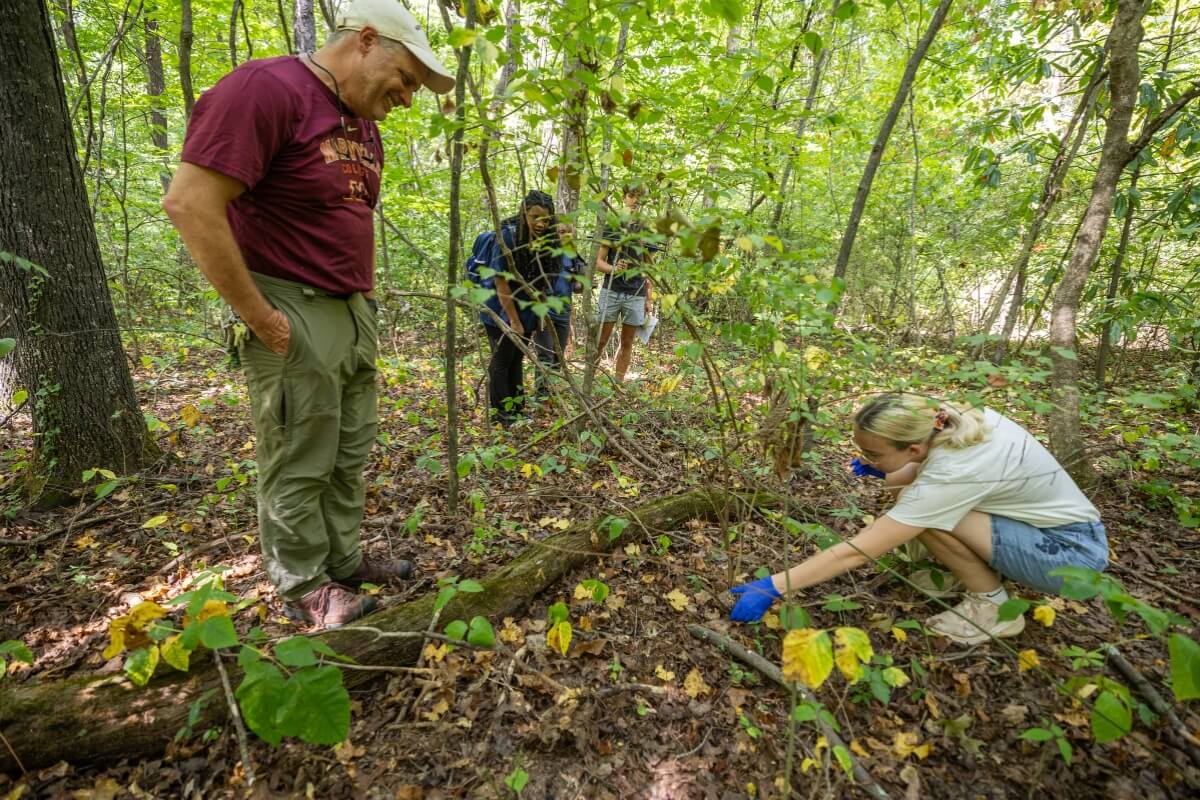
Every autumn in his BIO-222 (Ecology and Evolution) course, Unger begins by teaching students in the initial lab session how to perform “transect sampling” in the Woods by walking a straight line, looking for turtles.
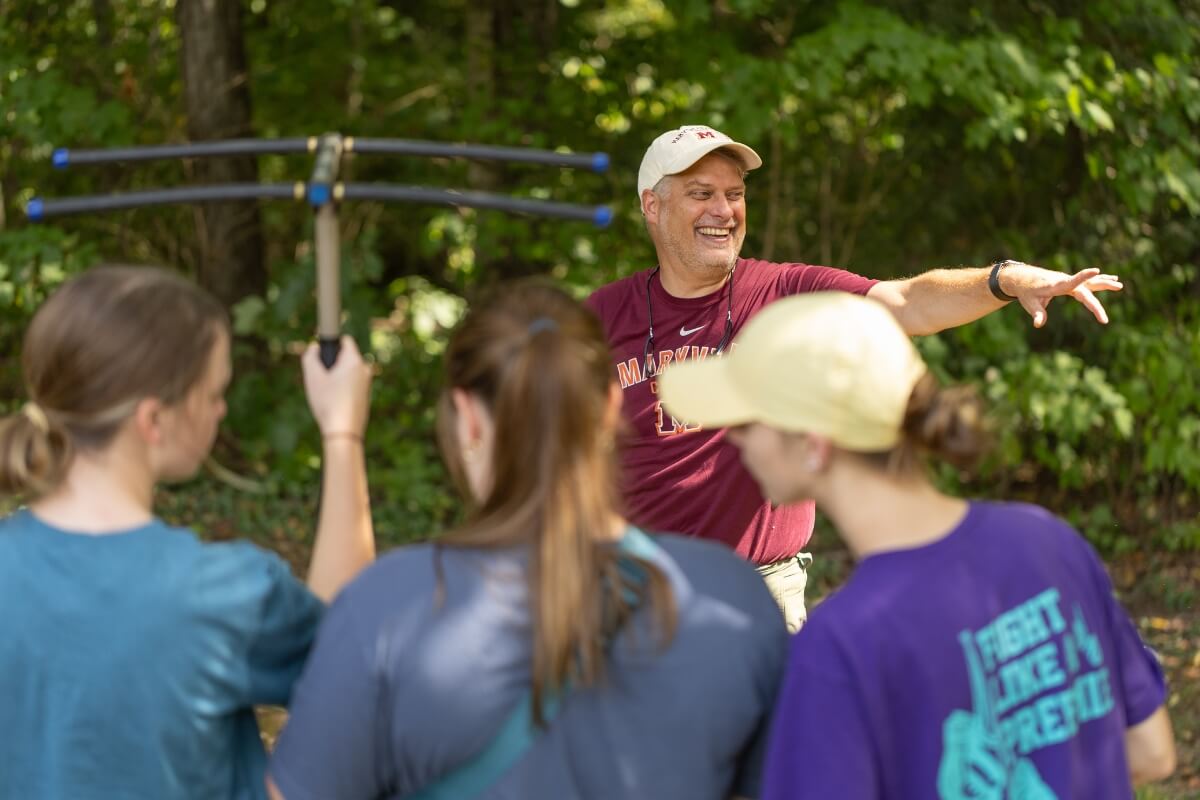
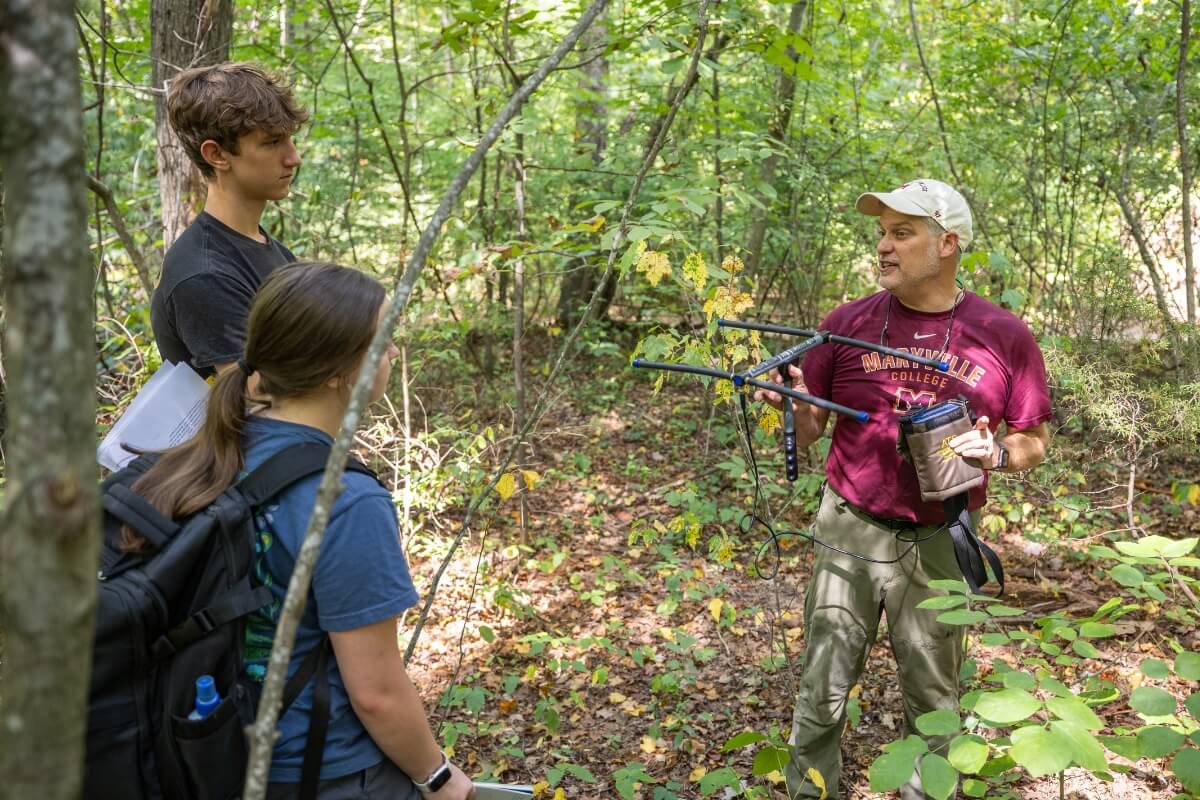
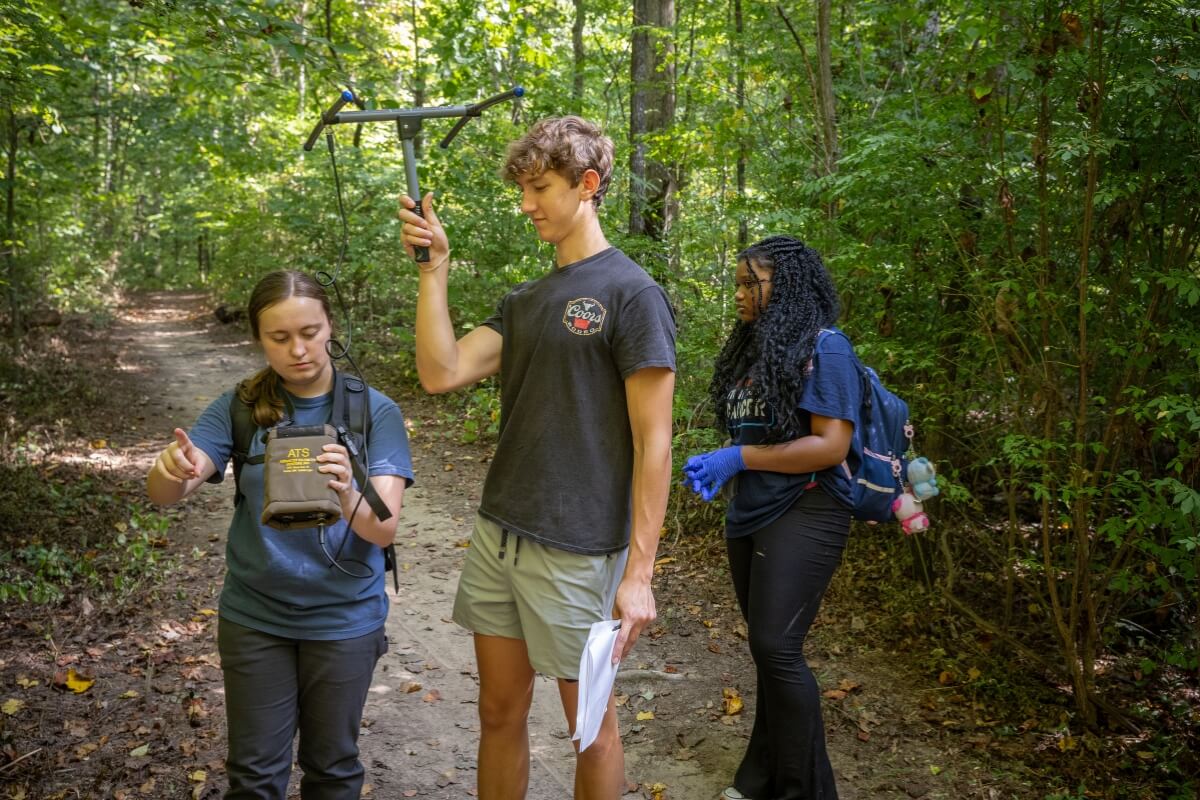
“Once at least six turtles have been found, we check to see if they are marked or not, measure them, weigh them, and attach a radio transmitter to their shell using epoxy, and release them where they were found,” Unger says. “The radio transmitter allows us to follow the turtles using a receiver set to the frequency of the transmitter.
“It’s the same as someone tuning into their favorite radio station, except here, students are tuning in to their favorite turtle. The students are then broken up into groups of three or four and assigned a turtle, which they then have to track weekly for the entire semester.”
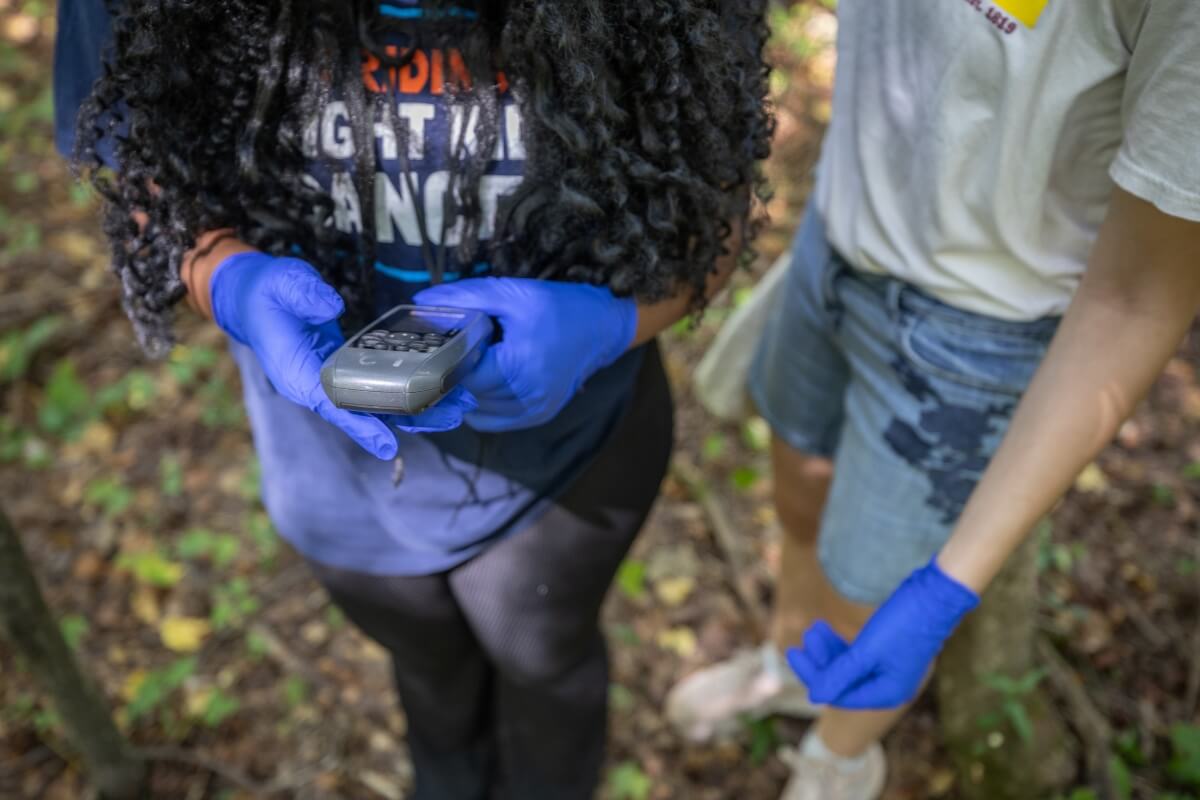
The more rigorous turtle monitoring is a direct result of Harmon’s Senior Study, and it calls for the student groups to record the date, time, physical location via GPS coordinates, activity (whether the turtle is resting, moving, mating, etc.), what kind of vegetation the turtle is in (and specifically if it’s in an invasive species such as English ivy, and if there are additional turtles in the vicinity.
In addition to more in-depth monitoring, Harmon’s Senior Study looked at the College’s own box turtle data and combined it with information from 75-plus peer reviewed journal articles to come up with a number of management strategies for the MC turtles. Many of those strategies have been taken into consideration by the College Woods Committee, which oversees the usage and health of the forest. For example, Harmon’s recommendation is to continue with prescribed burns in small areas, being careful not to burn grassland areas; to minimize the application of herbicides; to keep some English ivy; and to continue the restoration of streambanks in the Woods.
“This data allows us to then calculate the animal’s territory or ‘home range,’ as well as how they spend their time, the habitat they are using most, whether they are fraternizing with other turtles, and whether or not they are avoiding or choosing to be in/around English ivy,” he said. “The last piece of data assists with management in the College Woods of English ivy. There is some evidence to suggest the ivy acts as a nursery for juvenile turtles, and this research is ongoing. If found to be true, then we will want to leave some patches of ivy alone for the turtles to use.”
So much more than turtle studies
At the end of the semester, the data collected by his students is then compiled, analyzed and formally presented to their classmates. Their work not only helps maintain the Eastern box turtle population at Maryville College; it also gives those Scots involved in the work some opportunities that may not be so readily available at other institutions.
“The work they do not only helps better our understanding of the turtles, but it gives the students a skill rarely done at the undergraduate level (radio telemetry) that requires perseverance, discipline and patience; teaches them valuable skills in data collection, compiling and statistical analyses; and enhances their presentation abilities,” Unger says. “Despite being a project on turtles, all aspects of the project will hopefully benefit them regardless of what field or career path they choose.”
In addition, several ongoing Woods projects led by Crain will continue to benefit the Eastern box turtles that call Maryville College home. The removal of invasive species and the streamside restoration of Duncan Branch are two examples, along with a restored flower meadow and other riparian habitats in the College Woods that will enhance breeding, basking, feeding and nesting habitats, Unger says.
And, he adds, it offers an opportunity for the general public to follow suit: If they want to create their own box turtle habitats, they should allow their lawns to grow 6 inches or taller. That provides habitat for box turtles and prevents lawn mower strikes, a common means of turtle fatality in suburban areas. And for members of the public who use the MC Woods and happen to run across a turtle? The transmitters include his name and number, so he’s gotten a number of calls over the years from Woods walkers and hikers unaware of the research project and concerned that something is wrong with the turtle.
“Members of the public who use the College Woods occasionally find one of our turtles and call us, wondering what to do with them, and the answer is simple: Nothing! The best advice from me is to let it alone to live its life,” Unger adds. “If you want to help us out, take a picture of the carapace (the back of the turtle), preferably with your location on as part of the picture’s data; and send that to us with a detailed description of where you saw it, along with some notes of what you observe the turtle doing (resting, feeding, mating, walking, or interacting with another turtle). If it’s wearing a transmitter, including the frequency would be helpful as well.
“Folks can send all of that to me at dave.unger@maryvillecollege.edu, and that will help tremendously in two ways: It keeps the turtles from being disturbed unnecessarily, and it potentially provides us with usable data for research purposes!”