


Text: Dr. Michael Lamb’s Commencement address to the Maryville College Class of 2025
May 6, 2025
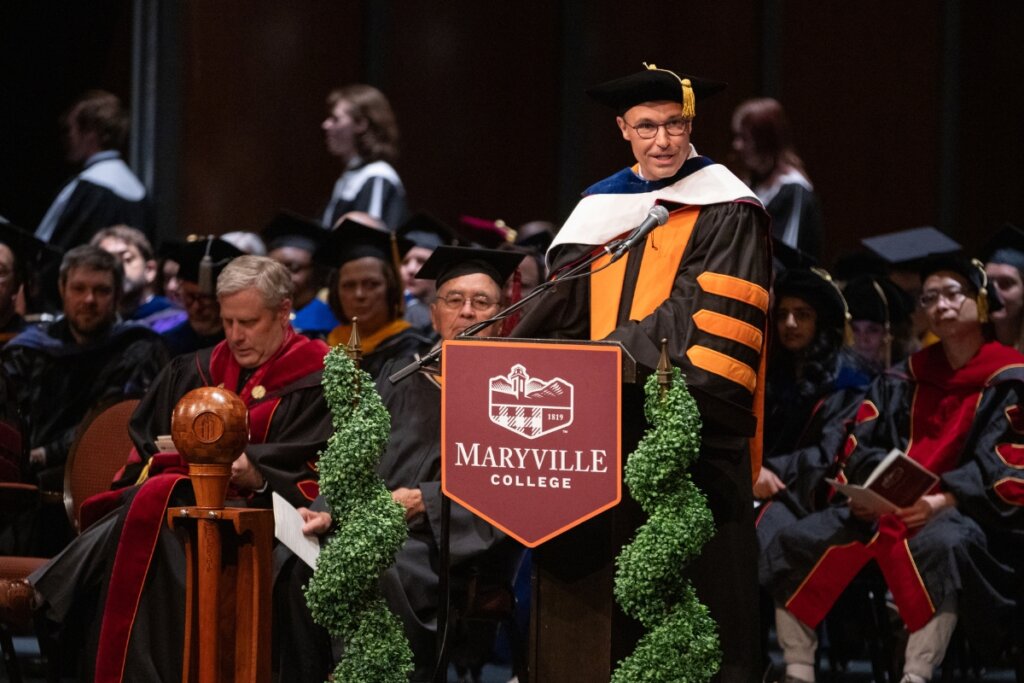
Dr. Michael Lamb, F.M. Kirby Foundation Chair of Leadership and Character, as well as the executive director of the Program for Leadership and Character and associate professor of Interdisciplinary Humanities at Wake Forest University, delivered the Maryville College Commencement address to the Class of 2025 on May 3, 2025, in the Ronald and Lynda Nutt Theatre of the Clayton Center for the Arts on the Maryville College campus. Here is the full text of his address.
Thank you, President Coker.
Faculty, staff, trustees, alumni, families, and friends, thank you for your generous invitation to join today’s celebration. And what a tremendous honor to receive an honorary degree from Maryville College. Thank you so much. I am so grateful to be here with you.
I especially want to thank those who give us reason today to celebrate today: the graduates. Congratulations, Class of 2025!
As a native Tennessean of Scottish descent who attended another Presbyterian college across the state, I’ve long admired Maryville College, not least because my brother Patrick wrestled and ran cross country here. He gave our entire family a reason to root for the Scots.
This is my first commencement address, but before you start scrolling on your phones and posting graduation selfies on Instagram, let me assure you: I’m not entirely unqualified. For six years, I’ve taught a course called “Commencing Character,” which pairs the study of character with commencement speeches focused on various virtues. I’ve read hundreds of graduation speeches with students, and one of my favorites is by the award-winning writer and professor, George Saunders.
In a 2013 address at Syracuse University, Saunders opens by reflecting on what he regrets in life. It was not “working terrible jobs” or embarrassing himself in front of a girl he liked. No, it was a much more ordinary story about a new girl who moved to his town in seventh grade and was teased and ignored by others in his class. Saunders was “actually pretty nice to her,” he confesses. He “even (mildly) defended her.” But years later, he still thinks about that girl and wonders if he could have done more.
“What I regret most in my life,” he concludes, “are failures of kindness. Those moments when another human being was there, in front of me, suffering, and I responded … sensibly. Reservedly. Mildly.” Saunders counsels us, in the end, to “err in the direction of kindness.”[i] That’s pretty good advice for our divided age.
Today, I want to elevate a related virtue fitting for graduation: gratitude. And inspired by Saunders, I must begin with a confession.
When I was a senior in college, just weeks from graduation, I was asked to give a speech to my college’s Board of Trustees. I was so glad to have a chance to thank the college for my education (and the scholarship that made it possible), and the faculty and staff who’d transformed my life during those four years. But I was also nervous, and when I’m nervous, I talk faster than you might think possible for a farm boy from Tennessee.
So I asked my theatre professor, Professor Jilg, to help me with my public speaking. Through several sessions, he gave me clarity and confidence, and the speech went off without a hitch. But this was before TikTok or even YouTube, so the College didn’t think to record it. They asked me to give the speech again a few days later to a camera.
I still remember the lonely auditorium with a couple hundred seats filled by only four people. One was Professor Jilg.
In the speech, I’d thanked almost a dozen faculty and staff by name for their influence over four years. I’d considered mentioning Professor Jilg, but the speech was already too long and we’d only started working together independently a couple of weeks earlier. Now he was there in front of me. Should I add a line to thank him or be faithful to the text I’d given?
I decided not to improvise — and regretted it. Afterward, I thanked him profusely and wrote a thank you note. But to this day, I still regret that failure of gratitude.
As we learn in college, mistakes often teach us the most, and this one taught me an important lesson: when in doubt, err on the side of gratitude.
In this life, amidst our distractions and self-focus, it’s easy to overlook the people who have shaped and sustained us, and we often have few opportunities to thank them — publicly — for their efforts. When we have that opportunity, we should take it — or create it.
We should err on the side of gratitude.
This is especially important at commencement. Graduates, with hard work and determination, skill and sweat, you have accomplished so much these last four years. Throughout, you’ve been Keepers of the Covenant, pursuing the ideals of “scholarship, respect, and integrity” engraved on the Covenant Stone.[ii] Today, we celebrate you. You have so much to be proud of — and grateful for.
And not just a college diploma or “earning potential,” but a liberal arts education that has both informed you and formed you, challenging you to become critical thinkers, compassionate leaders, and committed citizens. In ancient Rome, the liberal arts named those disciplines that help us to become “free.”[iii] They are, in other words, “liberating arts” that liberate us and enable us to liberate others.[iv] Maryville College has given you an education in liberation.
It has also given you friendships, mentors, and memories that will animate a lifetime. You’ve had opportunities to take courses you’ve found intoxicating (and not just those of you minoring in beer brewing). You’ve been able to root for Coach Fox and the Scots on the football field, to be greeted by Ms. Daisy in Pearsons, to meet President Coker and his Basset Hound, Dolly, on walks across campus, and to explore the beauty and serenity of the College Woods.
As you remember these people and places (and many others), err on the side of gratitude.
And not just for the good things but for the hard ones, those moments that tested your strength, stretched your character, and deepened your resilience: the mistakes you made, the exams you bombed, the games you lost, the heartbreaks you grieved, the hurtful words you said, the grateful words you left unsaid.[v] These experiences can help us become better, if we have the humility to recognize them and the gratitude to honor their wisdom.
Err on the side of gratitude.
And not just on graduation day but every day. Gratitude is more than just a positive attitude for special occasions. It is a virtue, a habit of heart and mind that disposes us to acknowledge good things in our lives and express appropriate appreciation for them. Developing and sustaining this virtue is not easy. It requires intentional effort and repeated practice.[vi] But if we can build this moral muscle, we will be better equipped to carry the weight of the world.
Indeed, research shows that “gratitude is good for us.”[vii] Spending a few minutes each day giving thanks, studies have found, can increase our happiness, reduce our anxiety, deepen our friendships, and even improve our sleep.[viii]
And it’s good not only for our physical and mental health but also for our moral health. This is perhaps why the Roman philosopher Cicero says that gratitude is “not only the greatest [virtue], but is also the parent of all other virtues.”[ix]
Gratitude, for instance, can birth humility. If we gratefully acknowledge those who’ve helped us along the way, we implicitly recognize that we didn’t do it all by ourselves. This humility can, in turn, bolster our gratitude, making us quicker to see others’ gifts.[x]
Gratitude can also foster hope.[xi] When we recognize the good things in our lives and those who’ve assisted us, we can see grounds for hope and become less likely to despair. I’ve seen this firsthand. One of my students, Sofia, entered college as a self-proclaimed “pessimist.” But as part of a class assignment, she began keeping a gratitude journal, and it changed her outlook completely. Five years later, Sofia still keeps a gratitude journal and is one of the most hopeful people I know.
Be like Sofia. Err on the side of gratitude.
Yet, even as we celebrate the benefits of giving thanks, we must also beware of what journalist Barbara Ehrenreich calls “the selfish side of gratitude.”[xii] If we see gratitude only as a hack for our own self-improvement, we can easily become too self-satisfied, feeling grateful for all we have without doing anything about it.
This is why gratitude – not as an attitude but as a virtue – must find expression in action. It is not enough merely to feel appreciation; we must find ways to enact and express it.
Maryville has taught you this. It has encouraged you to “work for justice and dedicate a life of creativity and service to the peoples of the world.”[xiii] Gratitude can advance these urgent aims.[xiv] By acknowledging the role that others play in our lives, including those who might typically be unseen or unacknowledged, we become better able to offer the respect and recognition they are due. And if we are better able to see others, we are better able – and motivated – to serve them.
Maryville has given you a gift: you are part of a noble tradition that calls you to use your education not only for yourselves but for society. To take all that you’ve learned here to, as Maryville founder Isaac Anderson encouraged, “do good on the largest scale possible.”[xv] And to do good not merely out of solemn duty but out of grateful delight, knowing that we are part of a story larger than ourselves and have a sacred obligation and opportunity to be stewards of the goods we share.[xvi]
Err on the side of gratitude so you can err on the side of service and stewardship.
Understood this way, gratitude is not an expression of shallow self-satisfaction but a form of resistance against an isolating and individualizing culture.[xvii] It entails a just and generous acknowledgement of a fundamental truth: we are, to quote Zadie Smith, the work of “many hands.”[xviii]
No one knew this better than Mister Rogers, who taught many of us how to be a neighbor. In his Dartmouth College commencement address, Mister Rogers does something remarkable in an age of incessant talk: he pauses and gives his audience the “gift of a silent minute” to reflect on the people who have shaped them.[xix] In that same spirit of gratitude, I want to invite us to close our eyes for a moment to remember those family and friends, faculty and staff, teachers and mentors, who have brought us to this day.
Who did you remember? I recalled professors, teachers, mentors, friends, and family, especially my parents, who are here today. They taught me how to be grateful – and gave me reasons to be.
As we bring these people to mind and to heart, may we not only feel gratitude but be moved to express it.
Graduates, with your program, you have received a blank card. We invite you to use it — to write a note of thanks to someone who has made your Maryville experience meaningful. May your gratitude itself be a gift.
Now, as you commence this new chapter of your life, know that you are surrounded by a grateful (and proud) cloud of witnesses who are here not only to celebrate you but to support you. Whenever you encounter uncertainty, disappointment, or despair, as you no doubt will, know that you are not alone. Remember those who’ve helped you along the way. With you and within you, you carry the gifts of Maryville College and all those you have known here. May you use those gifts wisely and well to make the world a little kinder and more courageous, a little humbler and more hopeful, a little more just and generous, and a little more grateful.
Thank you for what you have done—– and what you will do. We cannot wait to see the work of your many hands.
Congratulations, Class of 2025.
Notes
While notes are not common in commencement addresses, acknowledging sources of insight and inspiration seems especially important in a speech on gratitude. In addition to those cited below, I am grateful to Anna Broadwell-Gulde, Bradley Burroughs, Bryan Coker, Nathan Hatch, Ann Phelps, Reid Morgan, Elaine Tooley, and the senior Leadership and Character Scholars at Wake Forest University for helpful input and feedback.
[i] George Saunders, Convocation Address, Syracuse University, 2013.The full text is included in Joel Lowell, “George Saunders’s Advice to Graduates,” The 6th Floor, New York Times (July 31, 2013), https://6thfloor.blogs.nytimes.com/2013/07/31/george-saunderss-advice-to-graduates/
[ii] Maryville College, “Maryville College Covenant,” https://www.maryvillecollege.edu/about/mission-vision/covenant/.
[iii] See Bruce A. Kimball, Orators and Philosophers: A History of the Idea of Liberal Education, expanded ed. (College Entrance Examination Board, 1995), esp. 13–16.
[iv] Jeffrey Bilbro, Jessica Hooten Wilson, and David Henreckson, eds., The Liberating Arts: Why We Need Liberal Arts Education (Plough, 2023).
[v] On the importance of gratitude amidst adversity, see Robert A. Emmons, Thanks! How Practicing Gratitude Can Make You Happier (Houghton Mifflin, 2007), 156–184, and Diana Butler Bass, Grateful: The Transformative Power of Giving Thanks (HarperOne, 2018), 38–42.
[vi] On gratitude as a virtue that involves both acknowledgement and recognition and requires regular practice, see Emmons, Thanks!, 4–17, 185–209, and Bass, Grateful, 52–70, 85–90.
[vii] Bass, Grateful, 181.
[viii] For summaries of studies highlighting the benefits of gratitude, see Emmons, Thanks!, 9–13, 25–89, and Amy Morin, “7 Scientifically Proven Benefits of Gratitude,” Psychology Today (April 3, 2015), https://www.psychologytoday.com/us/blog/what-mentally-strong-people-dont-do/201504/7-scientifically-proven-benefits-of-gratitude.
[ix] Marcus Tullius Cicero, For Plancius, in The Orations of Marcus Tullius Cicero, trans. C. D. Yonge (George Bell & Sons, 1891), 33.80.
[x] See Elliot Kruse, Joseph Chancellor, Peter M. Ruberton, and Sonya Lyubomirsky, “An Upward Spiral between Gratitude and Humility,” Social Psychological and Personality Science 5, no. 7 (2014): 805–814.
[xi] Charlotte vanOyen Witvliet, Fallon J. Richie, Lindsey M. Root Luna, L. M., Daryl R. Van Tongeren, “Gratitude Predicts Hope and Happiness: A Two-Study Assessment of Traits and States,” The Journal of Positive Psychology 14, no. 3 (2018): 271–282.
[xii] Barbara Ehrenreich, “The Selfish Side of Gratitude,” New York Times (December 31, 2015), https://www.nytimes.com/2016/01/03/opinion/sunday/the-selfish-side-of-gratitude.html
[xiii] Maryville College, “Mission Statement,” https://www.maryvillecollege.edu/about/mission-vision/mission/.
[xiv] Thomas Aquinas considers the virtue of gratitude as “part” of the virtue of justice. See The Summa Theologiae of St. Thomas Aquinas, trans. Fathers of the English Dominican Province, 2nd and revised edition (Burns Oates and Washbourne, 1920), II-II.106.
[xv] Maryville College, “Why Choose Maryville?”, https://www.maryvillecollege.edu/admissions/why/.
[xvi] On the dangers of gratitude “based in duty or demand,” see Bass, Grateful, xxi–xxv.
[xvii] See Bass, Grateful, esp. 19–22, 139–140, 161–169, 185–186; Emmons, Thanks!, 53–54.
[xviii] Zadie Smith, “Many Hands,” Commencement Address, The New School (May 23, 2014), https://www.youtube.com/watch?v=pjdmo6EKn8I.
[xix] Fred Rogers, Commencement Address, Dartmouth College (2002), https://home.dartmouth.edu/news/2018/03/revisiting-fred-rogers-2002-commencement-address.