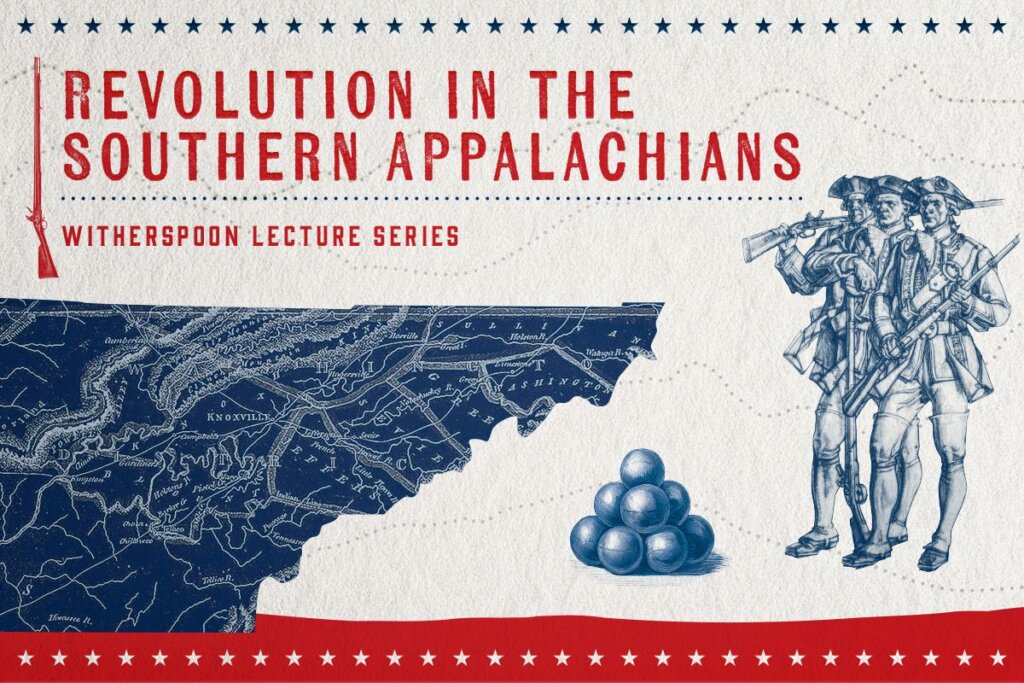
Feb. 16 Witherspoon Lecture explores Southern Appalachia’s Overmountain Men and their contributions to the Revolution
Feb. 12, 2026
In many ways, they were defined by place, forged by the rugged terrain of Southern Appalachia and far more at home in its forested hills than on formal parade grounds.
Known as the Overmountain Men, they didn’t look like soldiers, and they didn’t want to be treated like them. With fringed hunting shirts instead of uniforms, long rifles, tomahawks, and shot pouches slung across their torsos, they had a reputation for being “difficult to discipline” and unwilling to stay on campaign for long.
But as historian Dr. Michael Lynch notes, their appearance alone carried power.
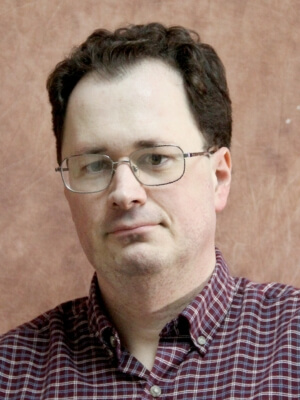
“Americans believed British soldiers were terrified of any troops in hunting shirts, because they associated them with marksmanship,” said Lynch, who will deliver the second of three talks in the Witherspoon Lecture Series at 7 p.m. Monday, Feb. 16, in the Harold and Jean Lambert Recital Hall of the Clayton Center for the Arts.
Titled “The Original Volunteers: Overmountain Men in the Southern Campaign,” Lynch’s lecture will detail how settlers from what is now East Tennessee and southwestern Virginia crossed the Appalachians in 1780, bringing with them frontier skills honed by survival, and using them to surround and destroy a Loyalist force at the Battle of King’s Mountain, a turning point in the Revolutionary War’s Southern Campaign.
The director of the Abraham Lincoln Library and Museum at Lincoln Memorial University and a historical researcher of the Revolutionary-era Southern backcountry, Lynch will draw from firsthand accounts to tell audience members how the Overmountain Men looked nothing like the soldiers most Americans picture when they think of the 18th-century battlefield.
“They didn’t wear standard uniforms of the type we associate with 18th and 19th-century soldiers,” Lynch said. “One veteran who was still a teenager during the war claimed that hunting shirts were the most common type of clothing he and his fellow militiamen wore. These were long shirts with fringes and a short cape across the shoulders.”
And they were armed with the same weapons used in frontier clashes with Native American tribes, skirmishes that gave them the experience necessary to win a decisive victory at the Battle of King’s Mountain on Oct. 7, 1780, where Overmountain fighters surrounded and defeated Loyalist forces commanded by Maj. Patrick Ferguson — a victory Lynch describes as their most significant contribution to the war effort.
At the same time, Lynch cautions against romanticized myths that place frontier fighters at the center of the overall war effort.
“There’s a popular, longstanding myth that America won the Revolutionary War because the American army was full of backwoods riflemen like the Overmountain Men,” he said. “That doesn’t hold up when you look at the war as a whole. The real backbone of the American war effort was the regular army, the longer-term soldiers who waged the same type of conventional war as the British.
“King’s Mountain was an exception, because it was an important victory won solely by backwoods irregulars. And it’s important to note that British soldiers could and did adapt to fighting in the American woods; they were doing so before the Revolutionary War started.”
The entreaties by British forces to Native American tribes, for example, gave those settlers on the frontier a reason to take up arms. While their lives looked much different than those of colonists living in more civilized parts of the country at the time, the war had profound implications on settlers, Lynch said, because British-Native partnerships made living on the frontier even more precarious.
It galvanized frontier leadership, he added, to seek their own alliances with authorities to the east.
“When you dig into what frontier elites were actually saying as the Revolution started to unfold, what they really wanted was to be incorporated into the Patriot movement, and into the new temporary governments the Americans back east were creating,” he said. “They knew they were in a very vulnerable position, with their land claims in question and Indian nations nearby who were determined to take that land back, and they needed allies who could provide both military assistance and legitimacy.”
And while the reputation of Tennessee as the “Volunteer State” wouldn’t be cemented into its legacy until the War of 1812 and, later, the Mexican-American War, the ideas of citizenship, identity and military service took root in the formation of the Overmountain Men as a military force.
“As Appalachian settlers and western frontiersmen were trying to find their place in the new nation, veterans of the Revolution emphasized their participation in the Southern Campaign to prove they’d been making patriotic sacrifices from the very beginning,” he said. “ And their descendants kept harkening back to that again and again whenever Tennesseans were called on to mobilize. There’s a recurring notion in American culture that mountaineers are uniquely suited to warfare, and that idea draws heavily on the precedents set by volunteer riflemen in the Revolution.”
Those critical moments in America’s history, he added, unfolded throughout East Tennessee. Letters from 250 years ago describe places and landmarks within a short drive — as is his own library and museum, located in Harrogate, Tennessee. Home of one of the largest private Lincoln collections in the world, the Lincoln Library and Museum is roughly 75 miles from Maryville, and while the Revolution in the backcountry is still Lynch’s primary area of interest and research, using the library’s materials for both public and institutional learning through its affiliation with Lincoln Memorial University is just as rewarding.
“There was widespread opposition to the Confederacy in this part of Tennessee, and early in the war, Lincoln was eager to make the most of the Unionist sentiment here,” Lynch said. “ That’s something the founders of LMU emphasized when promoting the college, and they drew comparisons between Lincoln, who worked his way from humble circumstances up to the presidency, and the early students who came here from around the region, many of whom paid for their educations by manual labor.
“It’s a privilege to bring people into an encounter with Lincoln using original objects and manuscripts. I don’t think there’s any personality in American history who resonates with so many people.”
The Witherspoon Lecture Series brings nationally recognized scholars to Maryville College to examine the intersections of history, culture and civic life, with the 2026 series marking the approach of the nation’s 250th anniversary. Maryville College History Professor Dr. Aaron Astor kicked off the series on Tuesday, Feb. 10, and Dr. Christopher Magra — a professor of early American history at the University of Tennessee-Knoxville and director of the Center for the Study of Tennesseans and War — will deliver the final lecture in the series at 7 p.m. Monday, March 23, in the Lambert Recital Hall.
All Witherspoon lectures are free and open to the public.