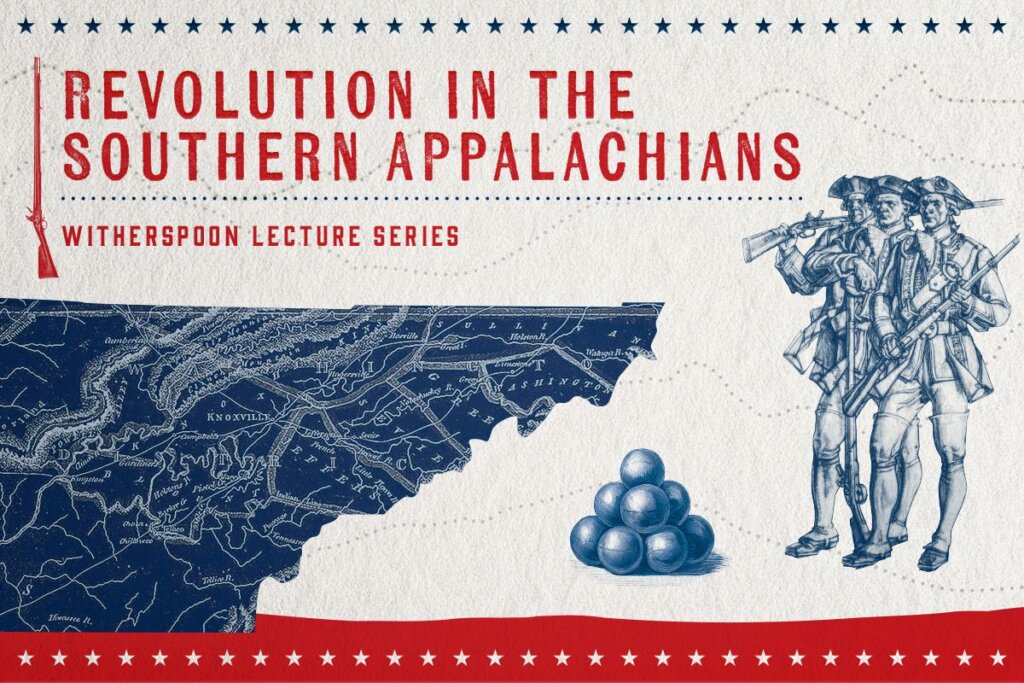
Final Maryville College Witherspoon Lecture to explore Watauga Association, precursor to American independence
Feb. 19, 2026
They crossed the mountains under the mistaken assumption that the Cherokee had ceded land in East Tennessee river valleys to the state of Virginia.
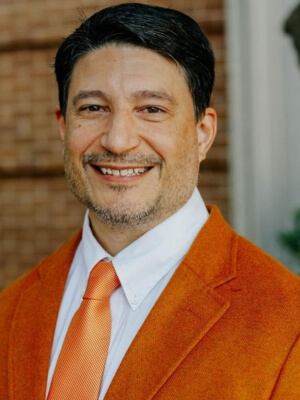
When they found out otherwise and were ordered to leave, they instead negotiated a 10-year lease with the tribe, setting up a settlement near present-day Elizabethton, Tennessee, independent of any existing American colony. The Watauga Association, as it came to be known, will be the subject of the third and final talk in the ongoing Witherspoon Lecture Series, delivered by Dr. Christopher Magra, a professor of early American history at the University of Tennessee-Knoxville and director of the Center for the Study of Tennesseans and War.
“The 1772 Watauga Association represents the first constitutional government formed by American-born settlers independent of British authority,” said Magra, who will deliver his lecture — titled “Wataugan Self-Governance: The Trans-Appalachian South and the Declaration of Independence, 1763-1776” — on Monday, March 23, in the Clayton Center for the Arts.
“As we approach the 250th anniversary of the American Revolution, Watauga matters because it demonstrates that the spirit of independence did not flow outward from the Continental Congress in Philadelphia,” Magra added. “The Spirit of 1776 was everywhere, even in the foothills of the Appalachian Mountains.”
A ‘rehearsal’ for the Revolution
Magra’s discussion will posit that Watauga, he said, was a rehearsal for the American Revolution. The semi-autonomous Wataugan government was created in 1772, after White settlers pushed into the Watauga, Nolichucky and Holston river valleys of East Tennessee, claiming to have done so because they believed those lands had been given to Virginia by the Cherokee. Those settlers, in fact, had violated the Royal Proclamation of 1763, issued by King George III, which forbade any new settlements west of a line along the spine of the Appalachians.
After they were ordered to leave those valleys, settlers instead worked out a lease and eventual purchase in 1775 from the Cherokee, establishing the Watauga Association to provide basic governmental oversight.
“I was drawn to this subject by the sheer audacity of the Wataugans,” Magra said. “These were individuals who crossed the Proclamation Line of 1763 — illegally, in the eyes of the Crown — and had to establish a political system from scratch to avoid total anarchy.
“Watauga reflected the broader colonial frustration with distant, unresponsive government. However, they shaped the Revolution by forcing Founding Fathers to deal with westward expansion and government protection for settlers.”
The quasi-independence of the Watauga Association didn’t last long; in April 1775, the Revolution began, and Wataugan settlers shifted allegiance to the colonies under a new name, the Washington District. In the summer of 1776, they petitioned for annexation from the North Carolina Assembly, and in November 1777, the Washington District was admitted as Washington County, North Carolina.
That Wataugan self-determination, however, was a catalyst for Revolutionary success, Magra said.
“While New England had the ‘shot heard around the world,’ Southern Appalachia provided the Overmountain Men,” Magra said, referring to those frontier settlers who volunteered their services to the war effort — a topic discussed by Dr. Michael Lynch during the Feb. 16 Witherspoon Lecture.
“Appalachian settlers contributed a specific brand of militant frontier rage to the Revolution,” he added. “Without the Watauga settlers’ participation in the Battle of Kings Mountain in 1780, Great Britain’s Southern Campaign might have succeeded.
“Traditional stories of the American Revolution often overlook the Southern frontier. The Battle of Kings Mountain isn’t studied as much as a turning point in the war as the Battle of Saratoga. Yet, British strategy broke at Kings Mountain.”
Complicated relationships with tribes
As Lynch pointed out, frontier living made the Overmountain Men notoriously undisciplined, and for good reason, Magra added: While they shared Eastern ideals of land ownership and economic independence, they could not rely on British military protection for their homes and farms on the frontier, relying on their instincts to defend themselves and their families.
“This led to a more direct, often brutal, interaction with Indigenous nations,” Magra said. “Settlers didn’t just debate political theories about the nature of good government. They lived the reality of disputed sovereignty every day … (and) the relationship between settlers and Native Americans was a volatile mix of diplomacy and conflict.
“The Wataugans leased land from the Cherokee (specifically Attakullakulla), a move that (Cherokee) traditionalists like Dragging Canoe saw as a betrayal of their heritage. Today, we must understand this as a foundational moment of displacement that shaped the next century of American-Indigenous relations.”
Not that the Wataugans were in a constant state of warfare with the Cherokee; while skirmishes with Native Americans made for exciting frontier stories, everyday life was much more complicated, Magra said.
“The biggest misconception is that Appalachia was a primitive society of isolated anti-socials,” he said. “In reality, the trans-Appalachian South was a cosmopolitan hub of land speculators, displaced farmers, runaway slaves, new immigrants, and diverse linguistic groups, all engaged in complex relations with Native Americans. Watauga tells us that frontier identity was defined by negotiated autonomy.
“They didn’t want to be outside the bounds of law. Contrary to Frederick Jackson Turner, frontier living did not produce antipathy to control. Settlers wanted the law to be local, and they wanted government to provide security.”
Which is what the Watauga Association sought to do — a model that represented frontier independence before the colonies set out to establish their own.
“At a time when many feel disconnected from governance, Watauga reminds East Tennesseans that our ancestors were among the first to demand a seat at the table,” he said. “It provides a sense of place in the larger American story that is often overlooked in national textbooks. Scholarship shouldn’t live in a silo. By bringing the Watauga story to a public forum, we bridge the gap between archival research and local pride.
“I want people to leave (the lecture) understanding that frontier is not just a place on a map, but a state of mind. You don’t need a Ph.D. to appreciate that the roots of American democracy are buried in the soil of the Watauga River valley.”
“Wataugan Self-Governance: The Trans-Appalachian South and the Declaration of Independence, 1763-1776” will be delivered at 7 p.m. Monday, March 23, in the Harold and Jean Lambert Recital Hall in the Clayton Center for the Arts. It is the third and final lecture in the Newell and Mary Lee Witherspoon Lecture Series, endowed in 2022 by Newell Witherspoon ’52 and Mary Lee Witherspoon ’56 and established to strengthen relationships between members of the campus community, as well as between the campus and the greater East Tennessee region through the creation of opportunities to learn about and discuss topics that are important, timely and of broad interest.