From Sutton to success: MC students get scientific paper published in academic journal
Feb. 24, 2026
In the fall of 2024, Maryville College students Colby Huffman ’25 and Ellie Jaynes ’26 found inspiration in the most likely of places: a supportive and engaging classroom.
“It was in my BIO-412 Animal Physiology class that I first mentioned anabolic agents to Colby,” Dr. Drew Crain, professor of biology, said. “Colby was very interested in this topic and approached me about doing a research project to examine anabolic agents in the meat sold for consumption.”
Anabolic agents broadly describe hormones and related compounds that exhibit steroid-like behavior and can promote muscle growth within animals, according to Huffman.
The anabolics are often small pellets implanted under the skin and behind the ear of cattle and emit hormones or synthetic agents used to increase the animal’s growth rate and efficiency by which they convert the feed they eat into meat, according to the FDA.
Humans who consume meat grown with anabolic agents can experience side effects in all organs, according to the National Institute of Health (NIH), as well as harmful effects on the human brain, such as brain atrophy and altered cognitive function. However, the reproductive system is the most impacted, as anabolic agents can cause irreversible infertility.
In many countries around the world, including the United States, Canada, China, Argentina, Australia and other large meat producers, the use of steroids is permitted, but in all countries of the European Union, there is a strict ban on the use of anabolic steroids to fatten animals, according to the FDA.
Those compounds have been studied extensively in Europe and are subject to regulatory restrictions, which prompted the key motivating question for the pair’s work: If these compounds are considered concerning enough to warrant regulation, at what levels are they present in consumer meat products, and at what levels should consumers be concerned about potential health risks?
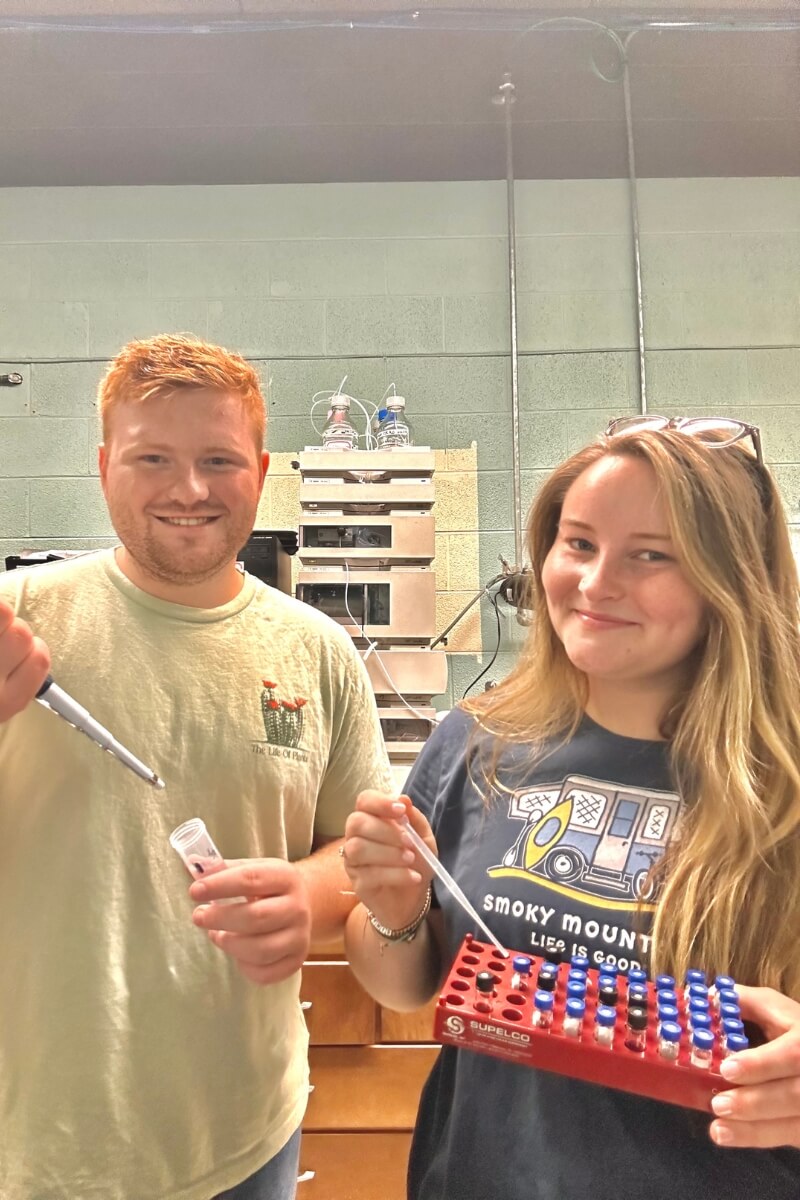
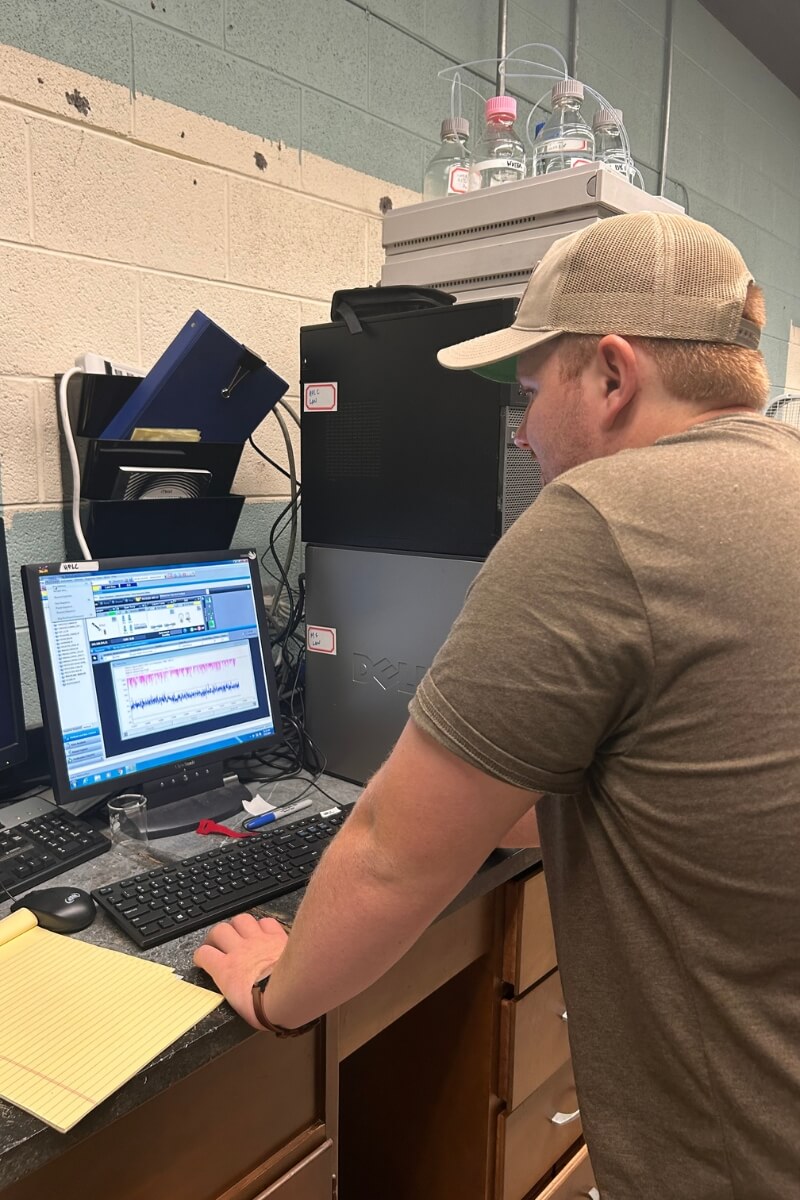
“Colby, being a Biochemistry student, took the lead on measuring the agents in the meat,” Crain said. “Ellie, being an Engineering major, managed the data and took the lead on the statistical analyses.”
The study aimed to develop a simple and cost-effective method for measuring and comparing hormones in meat from cattle.
For their study, Huffman and Jaynes obtained two types of meat: ribeye and ground beef. The meat was purchased from East Tennessee farms; some cuts included no growth enhancements, while others did. They purchased an additional ribeye and a pack of ground beef from a global grocery outlet in Blount County.
After extracting and measuring hormones in the beef samples, their research detected large amounts of steroids and hormone growth enhancers in the ribeye and ground beef from the farms where anabolic agents were used, and little to no growth enhancers in the meat from the farms that didn’t.
Their samples concluded that, in general, meat from farms not using growth enhancement had much lower concentrations of compounds than ones using growth enhancement.
Although he served primarily in a research advisory capacity, Crain saw the impressive work Huffman and Jaynes were undertaking and encouraged them to take the next step in their scientific journeys.
“In the natural sciences, publication in a scientific journal is the pinnacle of scholarly work,” Crain said. “As scientists, we need to share the work that we do with the wider scientific community so that solutions can be sought for complex problems.
“When I saw the quality of the work that Colby and Ellie conducted, I suggested that we submit this for publication. I worked with Colby on writing up a manuscript, and he and I submitted it to the Review of Undergraduate Research in Agricultural and Life Sciences journal.”
Associate Professor of Chemistry Dr. Nathan Duncan co-wrote the paper and provided knowledge on the instruments used to measure the chemicals. RURALS published the study last fall. In addition to the students’ and faculty members’ findings for growth enhancers in beef from different sources, the study produced a protocol for measuring hormones in beef that is “simple, standard and cost-effective.”
Even after all the hard work and dedication Huffman and Jaynes put into their research, it is extremely rare for undergraduate students to have their research published in a scientific journal, Crain said, which makes this a tremendous accomplishment for both students.
“It’s still incredible to me that the research we started is now published,” Jaynes said. “I really hope it serves to inform people about what’s in the beef they are buying, and I hope it inspires other scientists to dig deeper into this topic.”
Huffman agreed, attributing much of their success to Maryville College and its faculty and staff.
“Maryville College played a critical role in my academic development and success,” Huffman said. “The rigor of the coursework provided a strong foundation in content knowledge and my lab work provided problem-solving skills. The Scots Science Scholars program was particularly impactful, as it facilitated a smooth transition from high school to college and provided early access to meaningful research experiences.
“I began laboratory work with Professor of Chemistry Dr. Angelia Gibson as early as the spring semester of my freshman year, an experience that shaped my trajectory in science. I am deeply grateful to Dr. Gibson, as well as Professor of Mathematics Dr. Maria Siopsis and STEM Success Center Manager Brett Longwith, for their mentorship and support during my time at Maryville College.”
Huffman is currently enrolled in a Ph.D. program at the University of Tennessee-Knoxville and works at Oak Ridge National Laboratory, and he hopes to collaborate with Maryville College on future research endeavors, he added, including one he’s developing with MC Chemistry Professor Dr. Angelia Gibson.
The published manuscript can be read here at https://digitalcommons.unl.edu/rurals/vol17/iss1/7/
— Written by McKenna Marr ’28