After successful first two years, MC’s TRIO support program looks to expand offerings and awareness
July 21, 2022
It’s a sweltering June morning on the third floor of Anderson Hall, and the students who wander the hallway are lost music camp students, guitars across their backs, who have mistakenly wandered into the suite of Maryville College’s TRIO Student Support Services.
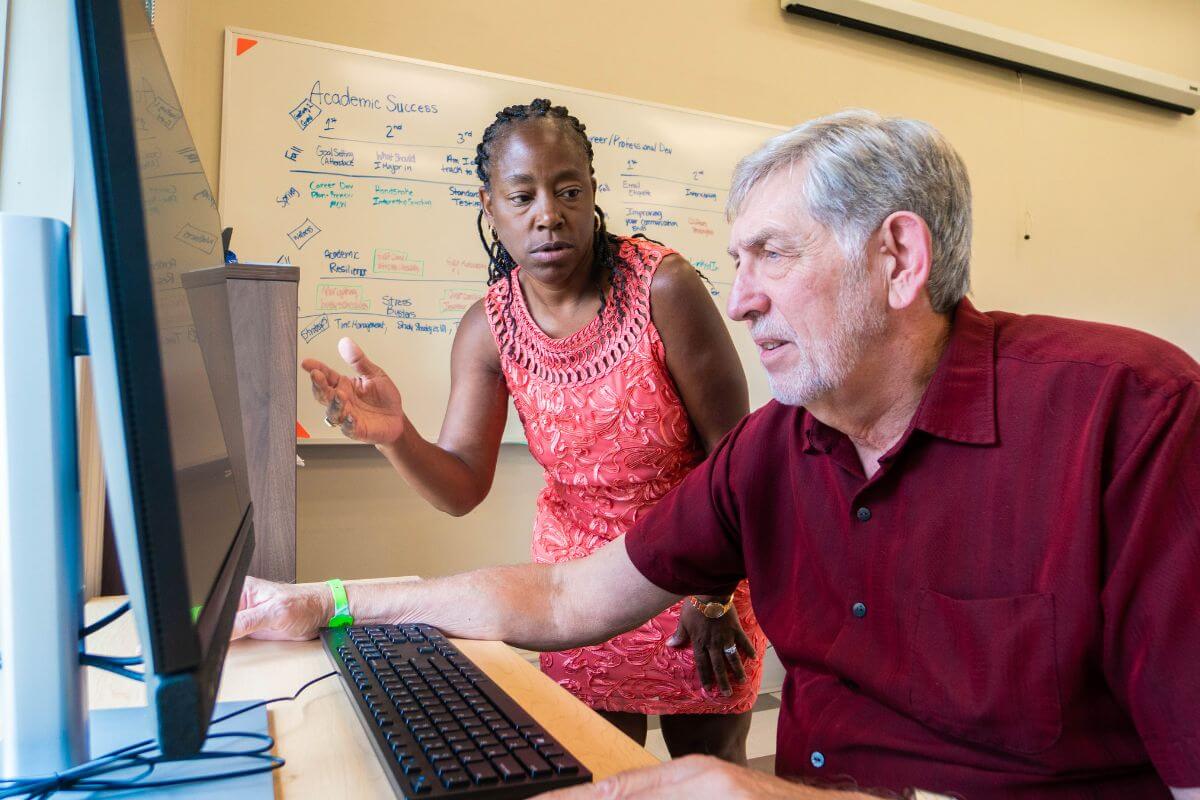
Dr. Sylvia Turner, the program’s director, and Dr. Walter Grubb, one of TRIO’s academic coaches, greet them with smiles, ready and willing to give directions and offer assistance, should they be asked. After friendly nods, the visitors make their way back toward the elevator, and Turner and Grubb get back to work.
There’s a lot to do before the new academic year begins, and students who come looking for TRIO will find them soon enough.
“As an organization, our purpose is to help students stay at Maryville College and to graduate from Maryville College,” Turner said. “We know there are obstacles, and that college life can be a little challenging. The idea behind TRIO is to help them get to that finish line and make progress on the goals they set for themselves.”
TRiO: A federal umbrella program
TRIO, Grubb notes, isn’t an acronym: It’s an umbrella designation for eight federal programs “targeted to serve and assist low-income individuals, first-generation college students and individuals with disabilities to progress through the academic pipeline.” It’s rooted in the War on Poverty launched by President Lyndon Johnson in the 1960s, and the TRIO name was coined at a time when those programs numbered only three: Upward Bound, Talent Search and Student Support Services.
Maryville College received a five-year, $1.3 million U.S. Department of Education grant to support retention and graduation efforts in August 2020, and when Turner was brought in as director, she quickly began recruiting MC students who qualified.
“When a student applies to be in TRIO, we’ll screen their applications to make sure they meet the eligibility criteria,” she said. “They have to be a first-generation college student, have high financial need — the federal government gives us income guidelines to use — or they have to have a documented disability and be receiving services through our Office of Disability Services. Once we confirm they’re eligible, we’ll assign them a coach who does an intake interview, during which we get as much information as we can, so we know how to actually serve them.”
The idea, she added, is to identify areas of their college experience where the greatest assistance is needed — both from the TRIO staff or from other Maryville College student-facing organizations like the MC Counseling Center or Academic Support Services.
The biggest challenge, Turner pointed out, is that many Maryville College students don’t know that TRIO exists, or how it works, but the staff works diligently to expand its outreach.
“We’ll set up in the residence halls and at Pearsons (Hall), and we’ll work with the faculty to go into some of the first-year classes,” Grubb said. “We’re working with the athletic department to get the word out to our student-athletes as well.”
Smashing stereotypes and exceeding expectation
And, Turner added, although not every TRIO participant will receive financial support from TRIO, the program offers stipends to students who are Pell-eligible and have financial aid gaps. TRIO stipends — hugely beneficial and one of the program’s most attractive components, Turner said — are reserved for Pell Grant recipients, and to receive it, they must complete the program’s Flight School Leadership program, which includes academic coaching and peer mentoring sessions, workshops and participation in cultural events.
“For some students, it’s a lot, and we understand that students are busy,” Turner said. “We work with students and campus partners to try to streamline our program requirements. There are some students who do need a lot of support, and a lot of times, when people think of the population we serve, they tend to think that those students are struggling academically. Certainly, we do help students who are academically at risk, but we also have students who are doing remarkably well in their classes and even serve as supplemental instruction leaders and academic tutors.
“We have students like Angela Anderton ’22, who is now at NYU; Tiara Kemp ’22, who was accepted into Emory University’s School of Public Health; and Nick Clifton ’22, who will be starting a master’s program in educational technology in the fall. It’s not always about the struggling students.”
Clifton, for example, received the Carl ’63 and Jean McDonald Outstanding Senior Award during April’s Academic Achievement Awards ceremony, and his list of MC accomplishments highlight Turner’s point that TRIO isn’t a one-size-fits-all program: In addition to serving as a Newman Civic Fellow, president of the Kappa Delta Pi Education Honor Society, a Resident Assistant, a member of the Tennessee Educators of Color Alliance, NEA Aspiring Educator, team captain for the MC Scots men’s basketball program and 1,800 plus hours of Bonner Scholar service, he also made time for TRIO.
“I joined TRIO as soon as the program started at Maryville College,” Clifton said. “I met with Dr. Turner, my TRIO coach, who made sure I had what I needed for my classes and that I was on track to graduate. Since I was doing my student teaching, it was hard for me to meet during the day, so most of our meetings were in the evenings.
“When I started looking at grad schools, she helped me understand the application process, look for housing and went on a grad school visit with another TRIO student and me. She even came to watch me play basketball. The whole staff, not only Dr. Turner, will do whatever it takes to make sure we feel supported and have what we need.”
“Nicholas Clifton is a multi-talented young man with an authentic servant heart,” Turner added. “He epitomizes all that our program stands for. I can only imagine how his future students will love him as their teacher. We have certainly enjoyed him as a TRIO role model.”
Widening the safety net
Although by MC standards, TRIO is a relatively young program, it’s already carved out a community among both administrators and students. Grubb and Turner have an easy camaraderie that complements their passion for service, and a desire to see TRIO become an even more entrenched part of the Maryville College community.
“I see TRIO as a community within the larger Maryville College community,” Grubb said. “There’s a family atmosphere up here (in the TRIO suite), and the vision and energy are pretty contagious. There’s a ‘whatever it takes’ attitude, and we try to communicate that to students: ‘What do you need, and how are we going to make that happen?’
“I have been quite impressed by the quality of students who have walked in the door. These are really remarkable young people, and a few nontraditional students as well, and I see such unbelievable potential, every day.”
For many students, their potential, along with their desire to succeed and the willingness to do whatever it takes to do so, reinforces the TRIO team’s commitment to each student’s success. And like most individual MC offices, it’s often accomplished with the assistance of others dedicated to student improvement as well.
“We’ve been able to pull in a lot of our campus partners,” Turner said. “We work frequently with Noah Bowman (director of the Academic Success Center at MC) and his team of student tutors and mentors; we’ve worked with the Counseling Center to ensure students know what mental health resources are available to them; and we work with the Career Center, which helps us deliver a lot of our professional development and career content, as well as puts us in touch with community partners.”
Currently, the Maryville College TRIO program is funded to serve 140 students, and applications are currently being accepted. With the arrival of a new academic year in August, Turner hopes that more students will take advantage of all that TRIO offers.
“We’re funded to serve 140 students, and that’s a pretty common grant number — but I’ve never known Dr. Turner to turn someone away,” Grubb said. “Just last week, we got a phone call from someone who does not qualify, but she went above and beyond the call of duty to help them find other resources on campus. And that attitude permeates TRIO.”
And, Turner added, the program has flourished, especially as COVID-19 limitations have been lifted. Some virtual programming remains in place to accommodate students who find it difficult to meet on campus, but most services are in person. In addition, the TRIO Hangar on Anderson’s third floor serves student needs with new computers and a student printer.
“We were able to go on an in-person graduate school tour and to an outdoor theme park,” Turner said. “We also hosted an etiquette dinner to prepare those getting ready to hit that professional circuit. We’re continuing to design programming that will help students transition into the next stage of their academic or professional career.
“We’re proud of the work we’ve done so far, but we’re excited about the ways in which we’ll continue to grow as an integral part of the Maryville College experience.”
For more information or to apply, students can visit the TRIO website or stop by the TRIO office in Anderson Hall.