


MC receives grant for College Woods restoration project; volunteers needed for work days
Jan. 4, 2022
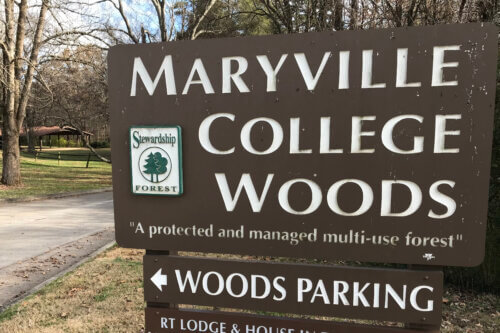
Maryville College has received a grant from the Tennessee River Basin Network to complete a restoration project in the Maryville College Woods in early 2022.
The grant, titled “Restoration of the Duncan Branch Riparian Zone in the Maryville College Woods, Blount County, Tennessee,” will allow for the removal of Chinese privet from a stretch along Duncan Branch creek, as well as the addition of native plant species to restore the area. After the restoration, water analyses along Duncan Branch creek will be completed to check for pesticides.
The 128-acre Maryville College Woods, located at the Southeastern part of the Maryville College campus, includes a private, protected and managed multi-use forest designated in 2000 by the Forestry Division of the Tennessee Department of Agriculture as a Stewardship Forest. The certification was based on an early 1990s plan developed by the College that named education as the primary objective in managing the Maryville College Woods. The College Woods was recertified as a Stewardship Forest in 2013, after the College worked with state foresters to assess the condition of the woods and develop a stewardship plan that included objectives for ownership and management.
Bisected by Brown Creek and Duncan Branch, the mature forest harbors a diversity of habitats, including temporary wetlands and seepage areas. Purchased by the College in 1881, the Maryville College Woods is not only a critical educational resource – it’s also a very popular recreational area of the campus for members of the College community, as well as residents of the surrounding community. The Maryville College Woods Group oversees usage and health of the College Woods, and in 2013, the group developed a 100-Year Woods Plan – an outline of management of the area for the next 100 years, addressing future land and resource use, as well as woods security.
Dr. Drew Crain, professor of biology at Maryville College and member of the Maryville College Woods Group, worked with the Tennessee River Basin Network to secure the grant for the restoration project.
In the grant proposal, Crain noted that the presence of exotic invasive species was found to be the biggest threat to the College Woods overall – and in the area targeted by the proposal, the greatest threat to forest health is Chinese privet.
“Removal of these species along the banks of Duncan Branch and replacing with native plant species has tremendous potential to restore a significant riparian zone,” Crain wrote. “In accordance with the recommendations made in our Forest Stewardship Plan, we propose to continue to remove Chinese privet from a 750 linear foot section along Duncan branch. This area has nice canopy trees, but the removal of privet will leave few understory shrubs, as the privet has outcompeted the natives. Thus, we will replant with native understory trees and shrubs.”
After the restoration, water analyses for pesticides as Duncan Branch creek enters and exits the College Woods will be completed. A 2018 Senior Study examined water quality in Duncan Branch and found preliminary evidence for the presence of common household pesticides; however, the sampling methodology available during the study was not sensitive enough to determine concentrations of pesticides, Crain wrote. The new analyses will determine the extent and identity of possible pesticide contaminants.
Volunteers needed for upcoming work days
To assist with the removal and planting in early 2022, Crain is looking for volunteers to join “Friends of the College Woods” for two, four-hour weekend work days, scheduled for Sat., Jan. 22 (weather date Jan. 29) and Sat., Feb. 19 (weather date Feb. 26). Volunteers are asked to meet at McArthur Pavilion at 9 a.m. During the “Woods Work Days,” volunteers will remove Chinese Privet and Bush Honeysuckle and plant native Rhododendrons, River Oats and Beautyberry. All volunteers will receive a “Friends of the College Woods” t-shirt.
“Healthy forests require management, and the College has periodic work days to remove invasive non-native plants, maintain trails and plant native trees,” Crain said. “Because many alumni and community members routinely use the College Woods for exercise, recreation and respite, we invite such individuals to help us during our ‘Woods Work Days.’”
For more information about the College Woods, upcoming work days, or the Friends of the College Woods, please visit maryvillecollege.edu/woods.