Camden Johnson ’25: Working to document deeper knowledge of the Maryville College Woods
Aug. 13, 2024
EDITOR’S NOTE: This is the second in an ongoing series spotlighting summer research projects and internships by Maryville College STEM students, made possible through a $645,000 Fund to Improve Post-Secondary Education (FIPSE) grant, administered through the U.S. Department of Education. The grant was earmarked for the expansion of MC’s Scots Science Scholars program and build on STEM initiatives provided by the College to “increase access to hands-on experiences and industry exposure, with a focus on addressing emerging technologies and scientific innovation in natural sciences, computational science and engineering.”
It’s a 140-acre tract of wilderness in the middle of a small city, and the uniqueness of the Maryville College Woods has initiated numerous scientific studies and research projects over the years. Add to that list one involving wildflowers, currently being carried out by Camden Johnson ’25.
“I remember helping with a woods clean-up, which happens periodically throughout the semesters to improve the health of the MC Woods, during my sophomore year,” Johnson said. “Some faculty were talking about different projects in the MC Woods, and I heard them suggest some sort of floral survey among other projects that could be useful moving forward in terms of research and management. During my education at MC, I have found that I enjoy and am really interested in doing fieldwork, especially when it involves something else I enjoy like plants.
“Then Carmela Lewis ’24, who recently graduated, completed an ecological survey of wildflowers near the Great Smoky Mountains National Park for her senior thesis during my junior year. This really gave me good groundwork that I could build upon and adapt for my wildflower survey of the MC Woods.”
Unlike his Scots peers and predecessors — such as Ben Taylor ’06, now a professor at Harvard University — Johnson had never stepped into the MC Woods before attending Maryville College. Upon his arrival, he said, he discovered what a unique biosystem it is, and what respite it offered along the myriad trails and open areas.
“This, combined with many of my professors utilizing the Woods for classes and learning opportunities, gave them a greater sense of importance in my mind,” Johnson said. “A lot of the research and management in the MC Woods, however, has been focused on invasive species and native animals. This means that current research about the plant communities in the MC Woods, specifically the wildflowers, is lacking. It seems that now, more than ever, active management is taking place to retain the health of the MC Woods, and the data from this project can go to better inform those management decisions.”
The first week of March, Johnson officially launched his survey, beginning with a defined path that began and ended at the McArthur Pavilion. That specific trek, he added, was mapped out to encompass as much of the Woods as possible and to include a range of different habitats. Along the walk, he surveys visible wildflowers on and within 15 meters of the path, noting their GPS location and using the PictureThis app for plant identification.
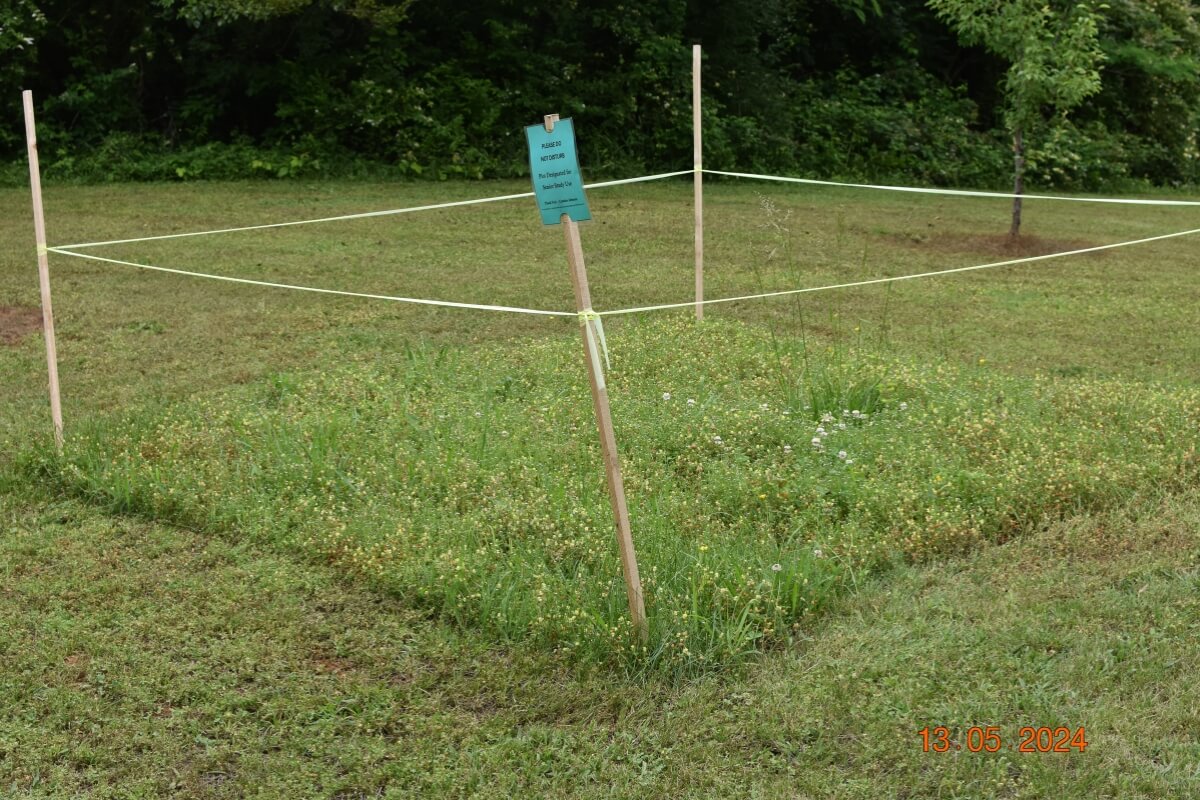
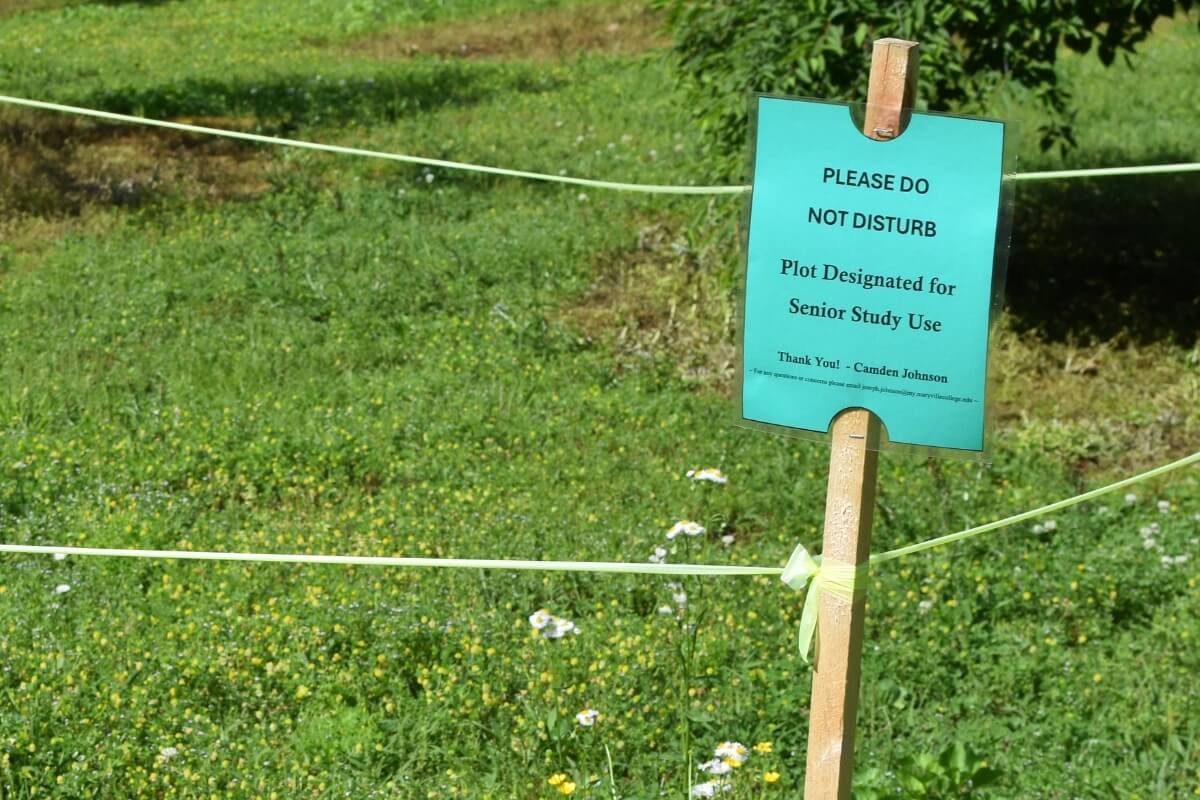
“Three 3×3 meter sample plots, made of wooden stakes connected by flagging tape, were also constructed across the length of each orchard on April 14,” he said. “The wildflower survey is scheduled to formally end at the end of summer on Sept. 22. At that point, I will be able to produce species distribution maps, complete statistical analyses, and make comparisons among the findings from the orchard plots and different portions of the path through the MC Woods.”
Building off of the work Lewis did last summer, Johnson put together a more expansive and systematic survey of the MC Woods, following a designated path and examining the orchard plots on a weekly basis and over a longer period of time.
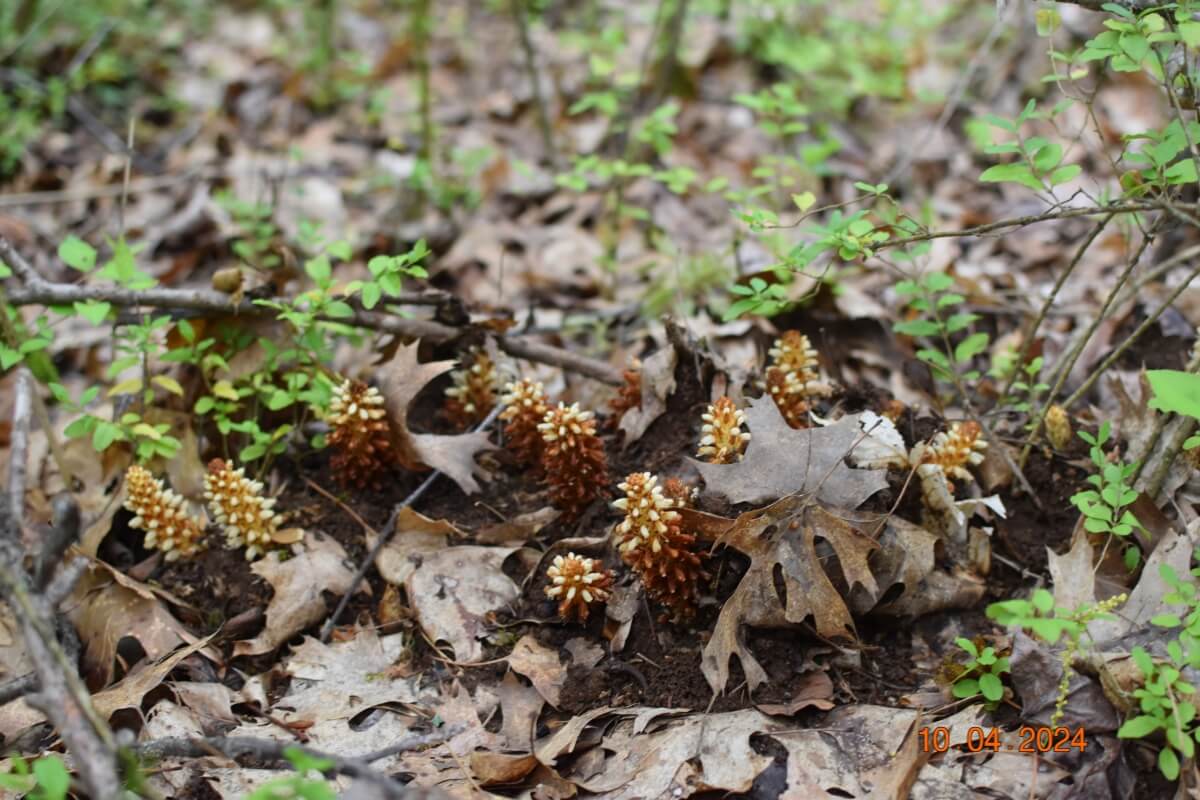
While it’s still too early to draw any data-based conclusions, his observations are illuminating. Case in point: Early on in the survey, he said, he found a wildflower called American Cancer-Root, which is known to parasitize the root systems of certain oak species and does not photosynthesize, like other plants do. And in areas of the forest where the Friends of the Maryville College Woods committee has worked to remove invasive species of plants, wildflowers are more plentiful.
“Other areas of the MC Woods that have yet to experience any disturbance and contain much more dense vegetation lack a lot of wildflowers, and don’t exhibit as much plant diversity,” he said. “Now that I have surveyed through the spring and now into summer, there is also a shocking decline in the amount of wildflowers I am finding.”
The FIPSE grant, he added, allows him to receive financial compensation for his efforts, as well as the ability to purchase supplies that assist him with fieldwork. And there will be more to learn, Johnson added: The 2024-25 academic year will be under way by the time the study is completed, and then the compilation of data will begin. From there, he’ll develop a big-picture idea of what the wildflower population in the Maryville College Woods truly looks like, and the ability to parlay that research into scientific tools for his peers is an opportunity that may not have been afforded to him at a larger college or university.
“I plan on creating a sort of digital herbarium that people can access to have pictures and information about the wildflowers in the MC Woods, in addition to when and where they are found,” he said.
Up next: A coterie of Scots descends on ORNL!