Earth Week at MC 2026
April 19-25
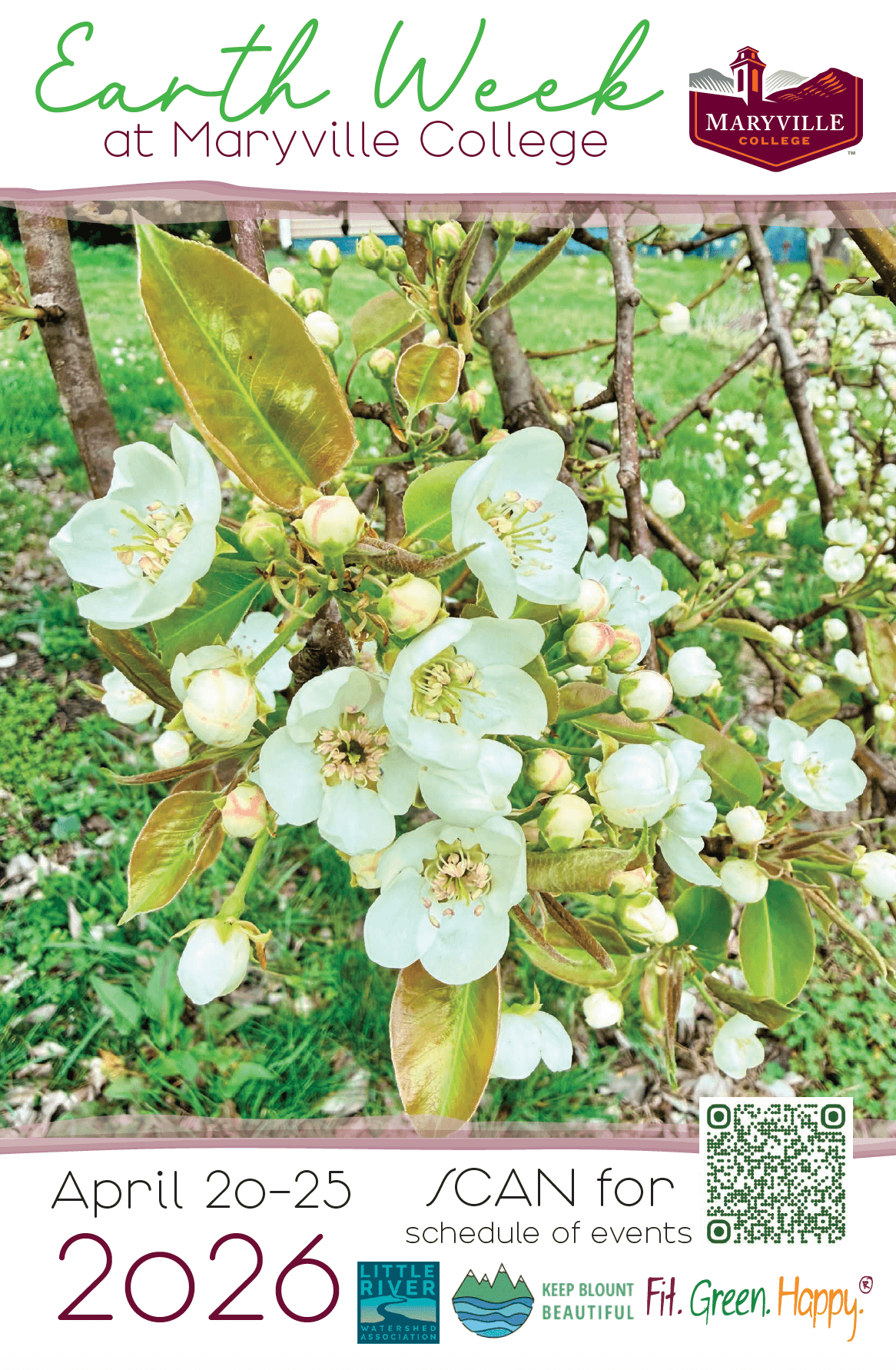
Check Out our Schedule of Events
Monday April 20
- 1 p.m. – Court Street Clean-up with ENV/SUS 101: Introduction to Environmental Issues and Foundations of Sustainability Course by Professors O’Gorman and Schwarte, in partnership with Keep Blount Beautiful, Meet Outside of Bartlett Hall. Materials will be provided.
- 3-4 p.m. – Keep Blount Beautiful sponsored Blount County Recycling Center Tour. This tour is an educational component of Glass Waste Diversion Program – Contact Britney Whipple, Jay Clark, Dr. O’Gorman
Tuesday April 21
- 11 a.m. Thaw 210 – ENVPLS345 Environmental Project Presentation – student recommendations to increase campus sustainability – Contact Dr. O’Gorman.
Wednesday April 22
- All Day – Lights Out – Faculty/Staff turn off lights in their campus spaces, let us know – Contact Dr. O’Gorman.
- Noon, Pearsons Quad – Environmental Education Event – ENVSUS101 class – Contact Dr. O’Gorman.
- 3-4 p.m. – “Rooted in Calm: Nature & Mental Wellness” Sponsored by Fit. Green. Happy. ® Join the MC Counseling Center for a workshop on how to use nature to reduce stress and cultivate wellness. Workshop will include information on the benefits of nature for mental health, tips for incorporating nature into your everyday life, and discussions on how we can protect green spaces to support well-being for all. – Contact Hannah Shinew, Claudia Werner, Jackie Eul
- 3-5 p.m. Crawford House – Camp 4 at Mountain Challenge! Fit. Green. Happy. ® times – Contact Jackie Eul
Friday, April 24
- 2-2:30 p.m. – Forest Bathing. Sponsored by Fit. Green. Happy. ® and Mountain Challenge. Meet at Crawford House – Contact Rachael Hurst
Saturday, April 25
- All Day – Little River Watershed Association (LWRA) – Little River Roundup
- 11:00 a.m. -3:00 p.m.: Land and water clean-ups happening at their respective locations
- 5:00p.m.: Hangout at the Greenbelt Amphitheater Park Begins
- 6:30p.m.: Volunteer Dinner/Cookout
- 8:00p.m.: Remarks and results from the Clean-up
- 8:10p.m.: Showing of the short film “The Voice of Little River” about us, Little River Watershed Association
- 8:30p.m.: Showing of the feature film “Hidden Rivers”
- 9:30p.m.: End

Maryville College’s location as the four-year liberal arts college closest to the Tennessee side of the Great Smoky Mountains has long infused its culture with an interest in conservation and environmental protection. Respect for the region’s indigenous Cherokee heritage, and for the 19th century Scots-Irish Presbyterian immigrants to East TN who founded the college, both fostered the school’s long-standing tradition of community service, faith and justice. Scientific research on the flora and fauna of this biodiverse region, and measurement of humanity’s impact on this space has been a touchstone of the work of the college for decade. Whether through traditional liberal arts majors, through courses in discipline specific majors or the interdisciplinary Environmental Studies major, applying lessons learned in class through internships off campus and around the world, or in our Sustainability Studies Minor, Environmental Science Major, or Outdoor Studies and Tourism major, students can find multiple paths by which to study and reflect upon nature and our impact on it. You can also consider coming to Maryville College as a high school student to participate in the Great Smokies Experience and get college credit.
Office of Environmental & Sustainability Initiatives (OESI)
Waste Diversion
- Recycling
- Thanks to a grant from the Arconic Foundation, MC overhauled our recycling program in 2022
- How to Recycle at MC!
- Composting
- MC currently composts pre-consumer produce via an MOU between MC’s food service provider and Rocky Park Farm.
Energy & Water Conservation
- Crawford House – carbon neutral, solar panels, etc.
Grounds and College Woods Management
OESI-supported Projects & Research
- Townsend H2O Quality Project
- Little River Watershed Connectivity Project – Dr. Jay Clark & Dr. Julie Konkel are active members of the Tennessee Aquatic Connectivity Team (TACT) and are securing funding to evaluate aquatic connectivity in the Little River Watershed.
- MC Fermentation Hops Farm
- Cooperation with the MC Woods Group
SCOTS-n-Smokies
Sustainability-oriented degree programs at MC
- Environmental Studies Major/Minor
- Environmental Science Major/Minor
- Sustainability Studies Minor
- Health and Wellness Promotion Major/Minor
- Outdoor Studies and Tourism Major/Minor
Partnerships
- Arconic Foundation
- MC partners with Genera Inc. to provide 100% biodegradable, compostable plates and bows for catered events.
- Rocky Park Farm
- Great Smoky Mountains Institute at Tremont